Support

Cathedral of Santa Maria Assunta

About

The majestic Brescia Cathedral is a unique architectural ensemble combining two churches from different eras on a single square. The dominant feature of the complex is the "New Cathedral" (Duomo Nuovo), dedicated to Santa Maria Assunta. This grand Baroque temple, built from white Botticino marble, is striking in its scale and is considered one of the most important religious buildings in Italy.
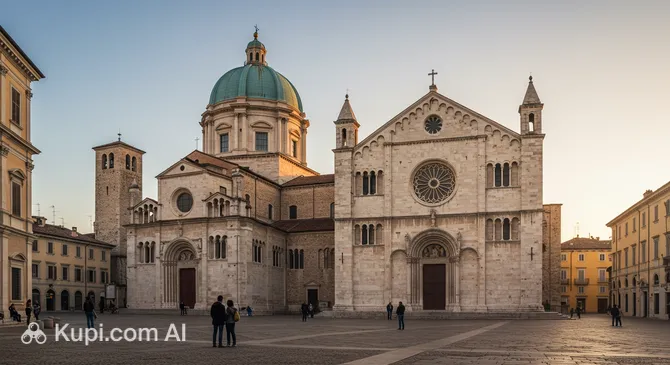
Brescia Cathedral
Brescia Cathedral. Иллюстрация. Источник: Kupi.com AI

The cathedral's 80-meter dome is particularly significant, ranking as the third-largest in the country, surpassed only by those in Rome and Florence. Inside, Brescia reveals true treasures to tourists: the interior is bathed in soft light that highlights the elegance of the Corinthian columns, paintings by the master Moretto, and the ancient sarcophagi of the city's patron saints.

Right next to the lavish facade of the New Cathedral stands its predecessor — the Old Cathedral (Duomo Vecchio), or the "Rotonda." This austere, circular 11th-century building is one of the finest surviving examples of Romanesque architecture in the region, creating a striking contrast between medieval simplicity and Baroque luxury on Piazza Paolo VI.

Contacts

To plan your visit to the Brescia Cathedral, it is helpful to have current contact information at hand. This will help you clarify details regarding ceremonies or special services. Below is the primary contact information and the exact address of the complex.

How to contactContact
AddressP.za Paolo VI, 25121 Brescia BS, Italy
Phone+39 030 375 7037
Websitewww.diocesi.brescia.it

What to Do

Inside the New Cathedral, the first thing to do is look up to appreciate the monumentality of its dome, then head toward the altar where the painting "The Sacrifice of Isaac" by Moretto is kept. Be sure to find the monument to Pope Paul VI, a native of these parts, and examine the frescoes by Romanino above the organ. The interior, clad in white marble and stucco, creates a sense of incredible space and solemnity.

Then move to the Old Cathedral ("The Rotonda"), where the atmosphere shifts dramatically to one that is intimate and mysterious. Here, you can descend into the ancient Crypt of San Filastrio, see the sarcophagus of Bishop Berardo Maggi made of rare red marble, and look through glass panels in the floor at fragments of an early Christian basilica and ancient Roman baths. If your visit coincides with March 28 or September 14, you will have a rare opportunity to see the relics of the True Cross in the Chapel of the Holy Cross.

A stroll across Piazza Paolo VI is also part of the experience: it is one of the few places where you can take a panoramic shot of both cathedrals representing different milestones in Christian history. After exploring the shrines, you can simply sit on the steps or in a nearby cafe, meditatively watching the play of light on the marble facades and listening to the peeling bells.

Getting There

The cathedral is located in the heart of the historic center, on Piazza Paolo VI. If you arrive in the city of Brescia by train, the walk from the central railway station takes about 15 minutes (a distance of just over 1 km). This is a pleasant route through old quarters, allowing you to immediately immerse yourself in the city's atmosphere.

For those who prefer public transport, bus and tram stops serving Piazza Duomo or Paolo VI are within walking distance. From Gabriele D'Annunzio Airport (BSO), the city center is also easily reached by shuttle or taxi. If you are using the city's bike-sharing or car-sharing systems, look for central stations near Piazza della Loggia.

Travelers by car should note that the cathedral is located in a limited traffic zone (ZTL). It is recommended to leave your car in one of the paid parking lots around the perimeter of the centro storico and walk the rest of the way, following the signs to the city's main attractions.

Ближайший город: Brescia

History & Facts

The history of the New Cathedral (Duomo Nuovo) began in 1604, when it was decided to erect a majestic Counter-Reformation church on the site of the dilapidated early Christian basilica of San Pietro de Dom. Led by architect Giovan Battista Lantana, construction stretched over two centuries due to financial difficulties and epidemics. The grand dome, which became a symbol of the city, was only completed by 1825, becoming the third-highest in Italy.

The Old Cathedral, known as the "Rotonda" (Duomo Vecchio), holds even greater historical value. Built around 1100, it is a rare example of a circular Romanesque church. In the 19th century, architects carried out a large-scale restoration, removing later Baroque additions to return the building to its original austere medieval appearance. Interestingly, the Rotonda once had a tall bell tower, but it collapsed in the 18th century and is now only visible in old paintings.

The cathedral complex in Brescia is unique because two main cathedrals from different eras sit peacefully side-by-side on the same square. This rare architectural arrangement allows you to travel from the austere 11th-century Middle Ages to the lush Baroque and 19th-century Classicism in just a few steps, witnessing the evolution of Italian architecture firsthand.

Time Needed

To take a leisurely tour of both churches, you will need 1.5 to 2 hours. This is plenty of time to appreciate the grand scale of the New Cathedral's interiors and immerse yourself in the mystical atmosphere of the Old "Rotonda."

Allow about 45–60 minutes for Duomo Nuovo to study Moretto's works and examine the details of the monumental dome. It is recommended to spend the remaining time (30–45 minutes) in Duomo Vecchio, descending into the crypt and viewing the unique medieval sarcophagi and fragments of ancient baths beneath the church floor.

Working Hours

You can visit the Brescia Cathedral daily; however, you should take the midday break into account. From Monday to Friday, the cathedral doors are open from 7:30 AM to 11:45 AM and from 2:30 PM to 6:45 PM. On Saturdays, evening hours are extended until 7:15 PM, and on Sundays, morning visits are possible from 8:00 AM to 12:45 PM.

Please note that tourist access may be limited during festive masses and on religious holidays. To tour the interiors and take photos, it is best to choose times between services so as not to disturb the worshippers.

DayWorking hours
Понедельник7:30 – 11:45, 2:30 – 18:45
Вторник7:30 – 11:45, 2:30 – 18:45
Среда7:30 – 11:45, 2:30 – 18:45
Четверг7:30 – 11:45, 2:30 – 18:45
Пятница7:30 – 11:45, 2:30 – 18:45
Суббота7:30 – 11:45, 2:30 – 19:15
Воскресенье8:00 – 12:45, 2:30 – 19:15

Nearby

The central location of the cathedral complex makes it an ideal starting point for further exploration of Lombardy's rich heritage. Just a few steps away, you will find the city's administrative and cultural symbols, each holding its own secrets.

A stroll through the surrounding area will allow you to see everything from ancient fortress walls to modern entertainment venues. Below is a list of interesting locations that can be reached on foot in just a few minutes.

NameDistance
Piazza Paolo VI0 km
Old Cathedral (Duomo Vecchio)0 km
Broletto Palace0.1 km
L'Oste Sobrio0.1 km
Amante0.1 km
Modì Café0.1 km
Victory Square0.2 km

Reached the end of the page?

That means the route is fully explored