Support

Parco archeologico di Brixia romana

About

Imagine a place where time stood still two millennia ago. Brixia Archaeological Park is a unique open-air museum complex located in the heart of Brescia. Spanning 14,000 square meters, it offers visitors a majestic panorama of the ancient past when the city was a vital center of the Roman province in Italy.
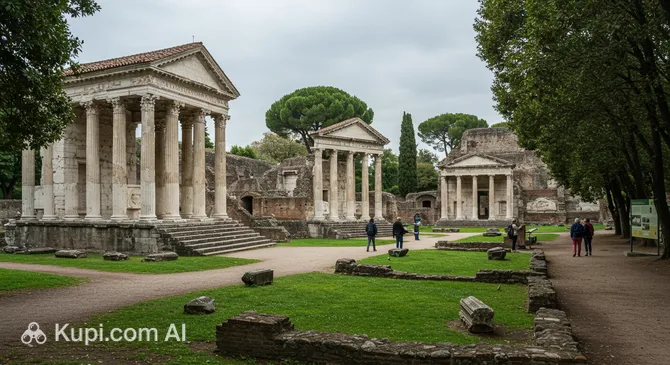
Brixia Roman Archaeological Park
Brixia Roman Archaeological Park. Иллюстрация. Источник: Kupi.com AI

This complex is rightfully considered one of the richest collections of Ancient Roman monuments in Northern Italy and is a UNESCO World Heritage site. Here, you can see not just isolated ruins, but a complete ensemble: from the remains of the monumental forum and Republican sanctuary to luxurious villas adorned with exquisite frescoes and fountains.

The main highlight of the park is its remarkable state of preservation. Guests can literally touch the stones of the Capitolium or look into the Domus dell'Ortaglia, where authentic Roman mosaics from the 2nd–3rd centuries AD have survived on the floors, capturing the spirit of the daily life of ancient patricians.

Contacts

To clarify visiting details or book group tours, you can use the official contact information of the complex. The city's museum service is always ready to assist tourists with up-to-date information.

How to contactContact
AddressVia dei Musei, 55, 25121 Brescia BS, Italy
Phone+39 030 817 4200
Websitewww.bresciamusei.com

What to Do

The main draw for visitors remains the Capitolium, built in 73 AD. Here, you can see the surviving Corinthian columns and touch the base of the sanctuary. Inside the temple lies a true gem of the collection — the bronze statue of the Winged Victory (Vittoria Alata). This rare 1st-century AD find is striking in its detail and elegance of form.

A walk through the residential quarters of ancient Brixia is equally fascinating. In the archaeological excavation areas of the Domus dell'Ortaglia and the Nymphaeum, you will discover the interiors of wealthy Roman houses with beautifully preserved floor mosaics, remains of ancient fountains, and heating systems. This is a rare chance to see the lifestyle of the Roman elite in great detail.

Be sure to walk along a section of the ancient road, the Decumanus Maximus, which today coincides with Via dei Musei, and take a look at the Roman theater. Even in its semi-ruined state, its stands allow you to appreciate the scale of ancient spectacles. In the museum halls, you can examine unique bronze heads of emperors and hundreds of other artifacts found during excavations.

Getting There

This cultural heritage site is located in the heart of the historic center at Via dei Musei, 55. If you prefer public transport, use buses going to stops near Piazza del Foro, from where the park entrance is just a couple of minutes of leisurely walking away.

For those who value maximum comfort, a taxi from the nearest metro station (such as Vittoria station) or directly from the Brescia Centrale railway station is an excellent option. The car ride takes only about 5–10 minutes depending on traffic.

If you arrive in the city by train from Milan or Verona, the walk from the station to the archaeological zone takes about 15–20 minutes. This is a great opportunity to see other city landmarks on your way to the ancient ruins.

Ближайший город: Brescia

History & Facts

The history of this site is rooted in deep antiquity: as early as the Bronze Age, there was a settlement on Cidneo Hill, which later became the capital of the Gallic tribe of the Cenomani. However, the true flourishing of Brixia began in 196 BC when it became part of the Roman Empire, evolving into one of the key outposts in northern modern-day Italy.

The park's most majestic structure — the Capitolium — was built in 73 AD by order of Emperor Vespasian. In antiquity, life here was vibrant: a huge forum measuring 40 by 120 meters served as the center of commerce and politics, while a grand theater hosted thousands of spectators.

Interestingly, after the fall of the empire and the barbarian invasions of the 4th–5th centuries, the ancient buildings were hidden for a long time under layers of earth and later structures. Systematic excavations only began here in 1823, and archaeologists continue to find amazing artifacts to this day, expanding our knowledge of the region's Roman past.

Time Needed

To explore all the key sites without rushing — from the Capitolium to the luxurious Roman villas with their mosaics — we recommend setting aside 1.5 to 2 hours for your visit. This is enough time for a thoughtful study of the museum exhibits and a stroll through the forum area.

If you plan to read every information plaque in detail or are a true connoisseur of ancient history, your visit could easily last half a day. The atmosphere of the ancient city encourages a leisurely contemplation of architectural details and the mastery of ancient builders.

Working Hours

When planning your trip, please note that the archaeological complex is open from Tuesday to Sunday. Monday is the traditional day off when the museum is closed for maintenance.

Standard working hours are from 10:00 to 18:00. In summer and winter periods, the schedule may vary slightly (sometimes closing half an hour earlier or later), so it is best to aim for the main operating window until 17:30–18:00.

DayWorking hours
ПонедельникЗакрыто
Вторник10:00 – 18:00
Среда10:00 – 18:00
Четверг10:00 – 18:00
Пятница10:00 – 18:00
Суббота10:00 – 18:00
Воскресенье10:00 – 18:00

Nearby

Visiting the ancient complex is just the beginning of your journey through the city's rich heritage. Nearby, you will find medieval squares, majestic castles, and modern recreational spaces that help complete the cultural picture of the region.

NameDistance
Capitoline Temple0.1 km
Broletto Palace0.3 km
Santa Giulia Museum0.3 km
Amante0.3 km
Old Cathedral (Duomo Vecchio)0.3 km
Brescia Cathedral0.3 km
Brescia Castle0.4 km

Reached the end of the page?

That means the route is fully explored