Support

Scrovegni Chapel

About

The Scrovegni Chapel, also known as the Arena Chapel, is a true gem of the city of Padua, located in the picturesque Veneto region of Italy. This small, rather modest-looking church from the outside is considered one of the greatest monuments of Proto-Renaissance art, attracting beauty lovers from all over the world. It was named after Enrico Scrovegni, a wealthy Paduan merchant who commissioned its construction in the early 14th century.
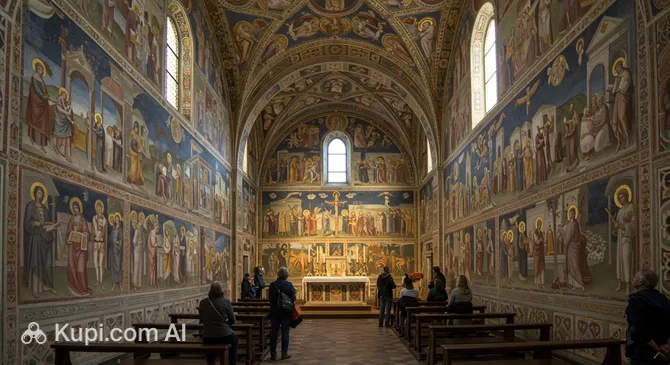
Scrovegni Chapel. Illustration.
Source: Kupi.com AI

Traveler photos:

The chapel's main treasure is the unique cycle of frescoes created by the genius artist Giotto di Bondone in 1304–1305. These paintings, which completely cover the walls and vault, tell the life stories of the Virgin Mary and Christ. Giotto made a real breakthrough in art, moving away from medieval canons and giving the figures and scenes an unprecedented level of volume, drama, and emotional depth for that time.

Officially, the chapel is dedicated to the Virgin Mary and bears the historical name of the Church of Saint Mary of Charity (Santa Maria della Carità). Today, it is part of the Eremitani Civic Museums complex. In 2021, the exceptional value of this site was once again recognized globally: Padua's 14th-century fresco cycles, including Giotto's works, were included in the UNESCO World Heritage list. A visit to the chapel is a unique opportunity to touch one of the most significant works in the history of Western art.

Contacts

Since the Scrovegni Chapel is part of the Eremitani Civic Museums complex, all current information regarding tickets, opening hours, and visiting rules is published centrally. To plan your visit and book tickets—which is a mandatory requirement—it is recommended to visit the official website of the Eremitani Museums or the tourism portal of Padua. Direct contact details for the chapel itself are generally not used for visitors.

How to contactContact
AddressPiazza Eremitani, 8, 35121 Padova PD, Italy
Phone number+39 049 201 0020
Websitewww.cappelladegliscrovegni.it

What to Do

The main reason to visit the Scrovegni Chapel is, without a doubt, the opportunity to see Giotto’s greatest masterpiece with your own eyes—a work that changed the course of European art. The entire interior of the chapel, from walls to ceiling, is completely covered in his famous frescoes. This grand cycle includes 38 scenes from the lives of the Virgin Mary and Christ, which unfold in chronological order to create a unified narrative. The lower tier of the walls features allegorical depictions of the seven virtues and seven vices, executed in the grisaille technique, which mimics sculpture.

As you immerse yourself in the atmosphere of the chapel, you can observe in detail how revolutionary Giotto's works were for their time. Pay attention to the depth of emotion on the characters' faces, the realism of their gestures, and the innovative approach to conveying space and light, which creates a sense of volume and three-dimensionality. Beyond enjoying the art, a visit to the chapel allows you to touch history. You will learn more about the Scrovegni family who commissioned the building and the modern methods used to preserve this fragile treasure for future generations.

A visit to the Scrovegni Chapel is a carefully organized process. To protect the priceless frescoes from the effects of humidity, visitors first spend about 15 minutes in a special acclimatization room, where they can watch a documentary about the chapel's history and art. The actual time spent inside is strictly limited, usually to 15 minutes, making every second spent alone with Giotto's genius particularly valuable. Since the chapel is part of the Eremitani Civic Museums, after your visit, you can continue exploring the rich collection of art and archaeology in the adjacent museum galleries.

Getting There

Getting to the Scrovegni Chapel is quite simple, as it is conveniently located in the center of Padua. For many travelers exploring Italy, the train is the most convenient way to reach the city. Padua has excellent rail connections with major tourist hubs like Venice and Verona, from where the journey takes very little time. The chapel is just a 10–15 minute walk from Padua's main railway station.

After arriving at the station, you can take a pleasant walk following the signs for the Eremitani Museums (Musei Eremitani), which the chapel is part of. If you prefer public transport, you can take city buses or the tram, which stop at “Piazza Eremitani”, located in the immediate vicinity of the attraction. For those traveling by car, there are paid parking lots near the museum complex where you can leave your vehicle during your visit.

Nearest city: Padua

History & Facts

The history of the Scrovegni Chapel in Padua is inseparable from the personality of its patron, the wealthy merchant Enrico Scrovegni. Its construction was an act of atonement for the sins of his father, Reginaldo, who was such a notorious usurer that Dante Alighieri mentioned him in his “Divine Comedy,” placing him in the seventh circle of Hell. To save his father's soul and his own, Enrico decided to build a magnificent chapel. The site chosen was symbolic—on the ruins of an ancient Roman arena owned by the Scrovegni family, which is why the chapel is also known as the Arena Chapel.

Work proceeded very quickly: permission to build was obtained in March 1302, and by March 25, 1303, on the Feast of the Annunciation, the chapel was consecrated. There is a well-founded suggestion that the great Giotto was not only the artist who painted the walls but also the building's architect. This theory is supported by the fact that the entire interior space is designed as a single entity, perfectly suited for housing a grand cycle of frescoes, where each tier and each wall is part of a collective narrative.

The original appearance of the complex surrounding the chapel was lost over time. In the 19th century, the Scrovegni family palace adjacent to the chapel and the portico at the entrance were demolished. These changes mean that today the chapel stands isolated, which differs slightly from the original design where it was part of a unified architectural ensemble. Despite these losses, the main treasure—Giotto's frescoes—has been preserved and carefully restored, continuing to amaze visitors with their innovation and emotional power.

Time Needed

For a full and leisurely experience at the Scrovegni Chapel, it is recommended to set aside about 1–1.5 hours. This time will allow you not only to see Giotto's famous frescoes but also to delve deeper into their atmosphere and history, which is especially important given the strict visiting rules for this unique art monument in Padua.

The visit itself is carefully structured to preserve the priceless paintings. The entire process begins in a special acclimatization room where visitors spend 15 minutes. During this time, you will watch a short documentary that prepares you for the masterpiece. You are allowed to stay inside the chapel itself for a strictly limited time—usually 15 minutes, although in some months this period may be extended to 20 minutes. This is done to maintain a stable microclimate inside.

Thus, the total recommended time of 1–1.5 hours includes all stages: arriving at the ticket office, potentially waiting for your group, the mandatory 15-minute film screening, 15 minutes of viewing the frescoes, and time to collect items from the locker room. By planning your visit with this much time to spare, you can enjoy one of the greatest treasures of Italy without rushing.

Working Hours

The Scrovegni Chapel is open to visitors year-round, making it accessible to tourists in any season. Standard opening hours are daily from 9:00 AM to 7:00 PM. However, it is worth noting that the schedule may change depending on the time of year and special events. For example, evening visits are organized during certain periods. The chapel is closed on major public holidays, such as January 1st, and December 25th and 26th.

The most important rule for everyone planning a visit: entry is possible by advance booking only. Due to its immense popularity and the need to maintain a specific microclimate to preserve the frescoes, it is impossible to buy tickets on-site the same day. Therefore, it is strongly recommended to book tickets in advance on the official website, where you can also find the most up-to-date schedule and clarify all the details of your visit.

DayOpening hours
Monday9:00 – 19:00
Tuesday9:00 – 22:00
Wednesday9:00 – 22:00
Thursday9:00 – 22:00
Friday9:00 – 19:00
Saturday9:00 – 19:00
Sunday9:00 – 22:00

Nearby

Visiting the Scrovegni Chapel is undoubtedly the highlight of any trip to Padua. However, to make your journey truly unforgettable, it is worth taking the time to explore the surroundings of this gem. The city is rich in history and culture, and many iconic sites are within walking distance of the chapel, allowing you to easily combine several visits in one day.

A walk through the nearby streets and squares will allow you to immerse yourself deeper in the atmosphere of this ancient city in Italy. Near the chapel, you will find not only other museums and historical monuments but also cozy cafes and restaurants where you can relax and share your impressions of what you've seen. Below is a list of interesting places located very close by.

NameDistance
Eremitani Museums0.1 km
Museum of Nature and Humankind0.1 km
Altinate San Gaetano Cultural Center0.4 km
Pedrocchi Café0.5 km
All'Ombra Della Piazza0.5 km
Palazzo Bo0.6 km
Piazza della Frutta0.6 km

Have you reached the end of the page?

So the route has been studied inside and out