Support

Puente de Piedra

About

The majestic Stone Bridge (Puente de Piedra) is one of the most recognizable and significant architectural symbols that Zamora is proud of. Spanning the calm waters of the Duero River, this historic landmark in Spain served for centuries as the main gateway to the city, connecting the residential neighborhoods on the left bank with the monumental historic center on the right.
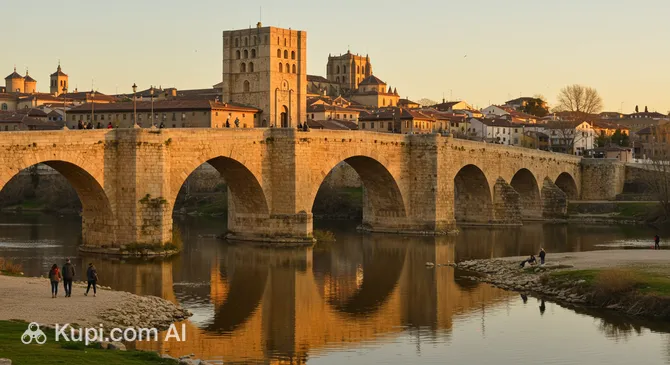
Stone Bridge
Stone Bridge. Иллюстрация. Источник: Kupi.com AI

The bridge's construction is impressive in its scale and reliability: it consists of 16 powerful stone arches. In the Middle Ages, it was known as the "New Bridge" and was the only reliable crossing over the river in this area. Thanks to its location on the legendary Vía de la Plata route, the bridge has witnessed many historical events and served as an important hub for trade and pilgrimage.

Today, the bridge is entirely pedestrian, allowing tourists and locals to freely enjoy its medieval aesthetic. From its parapets, stunning views open up of the old city with its ramparts and the domes of Romanesque churches reflecting in the water.

Contacts

For more information about visiting and other Romanesque landmarks in the city, you can use the following contact details:

How to contactContact
AddressC. Puente, 49028 Zamora, Spain
Phone+34 980 53 36 94
Websitewww.romanicozamora.es

What to Do

A walk across the Stone Bridge is, first and foremost, an opportunity to feel the rhythm of this ancient city. Since the bridge is pedestrian-only, you can take your time studying its construction, examining the massive pillars, and enjoying the fresh river breeze. It is an ideal spot for those seeking peace and inspiration surrounded by a historical landscape.

Photography enthusiasts should have their cameras ready: this spot offers the best angles of the Duero River and the panorama of the Old Town. The views of the cathedral and the city walls are particularly striking in the rays of the setting sun. Visitors often stop here to feed the birds or simply watch the river flow, which creates a peaceful atmosphere.

The bridge serves as an excellent starting point for further exploration of the city. Upon crossing to the right bank, you will immediately find yourself at the foot of the fortress walls, from where it is easy to reach Zamora Castle and other attractions. It is also worth descending to the embankment to walk along the river and appreciate the scale of the bridge by looking at it from below.

Getting There

The Stone Bridge is located at C. Puente, 49028 Zamora, connecting the historic core of the city with its southern outskirts. If you are already in the center, a walk from the Cathedral or the castle will take no more than 10–15 minutes. The route to the bridge leads through picturesque old streets that gently descend toward the river.

For those arriving in the city by public transport, the journey from the train station (Estación de Zamora) or the bus station takes about 20–30 minutes on foot. Alternatively, you can use a local taxi, which will quickly take you to Plaza de Belén or Avenida de Vigo.

Travelers by car can easily navigate via the A-52 highway. You can park on either side of the river: on the right bank near Avenida de Vigo or on the left bank close to the bridge. This is an ideal starting point for a walking tour of the entire historic part of the city.

Ближайший город: Zamora

History & Facts

The history of this structure dates back to the High Middle Ages. The Stone Bridge was completed in the early 13th century (although some elements date to the 14th century) and for many centuries remained the only crossing over the Duero in this area. In those times, it was often called the Puente Nuevo (New Bridge) to distinguish it from even older structures.

The bridge played a key strategic and economic role, as the famous Vía de la Plata (the Silver Way)—one of the most important trade and pilgrimage routes on the Iberian Peninsula—passed over it. This made the bridge a vital point for merchants, farmers, and travelers seeking to enter the fortified city center.

Over the centuries, the bridge has undergone numerous reconstructions, especially after severe floods that tested the strength of its pillars. Despite all the changes, it has retained its austere and majestic appearance, consisting of 16 arches, and is today considered one of the finest examples of civil architecture in the region, inextricably linked to the city's Romanesque ensemble.

Time Needed

To simply cross the Stone Bridge, take a few memorable photos, and enjoy the river panorama, you will need about 30–60 minutes. This is quite enough for a leisurely stroll from one bank to the other and back.

However, if you plan to include the bridge in a larger walking route through the Old Town, visiting the Castle and the Cathedral, we recommend setting aside at least 2–3 hours. It is especially beautiful here during the pre-sunset hours, when the soft light highlights the texture of the ancient stone.

Working Hours

One of the main advantages of this attraction is its absolute accessibility: the Stone Bridge is open to pedestrians 24 hours a day, seven days a week. You can come here early in the morning to watch the sunrise over the Duero, or late in the evening when the bridge is beautifully illuminated.

The schedule is the same throughout the week—from Monday to Sunday, the site is accessible around the clock, making it easy to fit a visit into any travel itinerary.

Круглосуточно

Nearby

Exploring the area around the bridge will allow you to immerse yourself deeper into the atmosphere of the medieval city. Just a few hundred meters away, the fortress walls and ancient quarters begin, where every stone breathes history.

Below are the most interesting sites located within walking distance of the Stone Bridge:

NameDistance
Historic Centre of Zamora0.3 km
Troncoso Viewpoint0.3 km
Church of San Pedro and San Ildefonso0.3 km
Statue of Viriato0.4 km
Mesón Bayadoliz0.4 km
Ethnographic Museum of Castile and León0.4 km
San Martín Park0.4 km

Reached the end of the page?

That means the route is fully explored