Support

Temple of Heaven

About

The Temple of Heaven (Tiantan) is a grand religious ensemble located in the heart of Beijing. Built in the early 15th century, it is recognized as the world's largest complex of ancient structures dedicated to imperial sacrifices. For centuries, this site was where the rulers of China communicated with heavenly forces, and its architecture embodies deep cosmological concepts of the universe.

The uniqueness of the complex lies in its layout: the northern part of the territory is rounded, symbolizing Heaven, while the southern part remains square, representing Earth. The entire ensemble is divided into inner and outer altars, with the main architectural masterpieces connected by a magnificent north-south axis passing through ancient cypress groves.
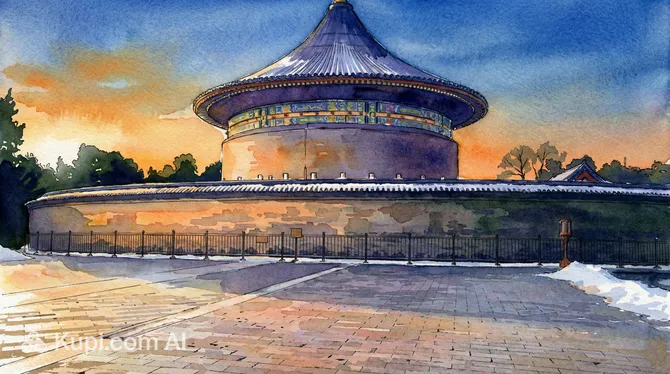
Temple of Heaven. Illustration.
Source: Kupi.com AI

Traveler photos:

The crown jewel of the Temple of Heaven is the Hall of Prayer for Good Harvests—an elegant wooden pagoda with bright blue tiles, built without the use of a single nail. Due to its perfect symmetry and rich marble carvings, the complex is included in the UNESCO World Heritage list and is considered an unsurpassed example of ancient Chinese engineering.

Contacts

To ensure your visit to the Temple of Heaven goes perfectly, we strongly recommend checking the official resource for up-to-date ticket prices and potential schedule changes in advance. This will help you avoid queues and plan your tour of the most important pavilions at your convenience.

How to contactContact
AddressКитай, Bei Jing Shi, Dong Cheng Qu, 东华门路 邮政编码: 100006

What to Do

It is best to start your journey through the complex with the Hall of Prayer for Good Harvests. This three-tiered building is striking not only for its blue roof but also for its intricate dougong bracket system, which supports the entire structure without nails. Walking along the 360-meter-long paved Danbi Bridge, you can feel the true majesty of imperial China and enjoy a symmetry where no detail is accidental.

Be sure to visit the Circular Mound Altar. Here, pay attention to the magic of numbers: the number of marble slabs in each circle is always a multiple of nine, which is considered a sacred heavenly number in Chinese numerology. It is also worth visiting the Imperial Vault of Heaven, famous for its "Whispering Wall." Thanks to its unique acoustics, a voice spoken softly at one end of the wall can be heard clearly at the other side of the circle.

Beyond the architecture, the Temple of Heaven offers a unique cultural experience. Arrive early in the morning to see hundreds of locals practicing tai chi, performing water calligraphy on the pavement, or singing ancient songs in the shade of old cypresses. This is a rare opportunity to feel the living soul of Beijing surrounded by silent witnesses to a great history.

Getting There

The Temple of Heaven is conveniently located in the southeastern part of central Beijing, making it easily accessible for travelers. The fastest way to get there is by metro. You can take Line 5 to Tiantandongmen station or Line 8 to Tiantan Dongmen. The station exits lead almost directly to the park's eastern or southern gates, which are just a few minutes' walk from the main ticket offices.

If you prefer surface transport, numerous bus routes serve the complex gates, including Nos. 6, 17, 20, and 120. For those who value comfort, a taxi or Didi ride from the Forbidden City will take about 15–20 minutes and cost approximately 20–30 RMB, depending on traffic conditions.

For those who enjoy walking, the route from the historical Qianmen Street takes about half an hour. However, do keep in mind the scale of the park and the weather: Beijing can be quite hot in the summer, so plan your trip for the early morning to ensure the walk is enjoyable.

Nearest city: Beijing

History & Facts

The history of this majestic site began in 1420, when the Yongle Emperor of the Ming Dynasty completed the construction of the complex alongside the legendary Forbidden City. It was originally named the Temple of Heaven and Earth, but in 1530, after the creation of a separate sanctuary for the Earth, the complex received its current name — Tiantan — and was dedicated entirely to heavenly forces. It was then that the pavilion roofs were changed to a deep blue color, symbolizing the endless sky.

For nearly five centuries, the rulers of China, considered the "Sons of Heaven," performed solemn rituals here. A total of 654 ceremonies were held, the most critical being the sacrifice on the day of the winter solstice. The Emperor prayed to the gods for rain, a bountiful harvest, and harmony in the state. Interestingly, in 1889, the main symbol of the complex — the Hall of Prayer for Good Harvests — was nearly destroyed by a lightning strike, but it was soon recreated in exact accordance with the original.

With the fall of the empire in the early 20th century, religious rites ceased, and in 1918, the grounds were transformed into a public park open to everyone. In 1998, the Temple of Heaven was inscribed on the UNESCO World Heritage list as a prominent architectural masterpiece and a unique embodiment of ancient Chinese cosmology, where every stone and roof curve carries deep philosophical meaning.

Time Needed

To explore the main architectural sites at a leisurely pace and enjoy the atmosphere of the ancient park, we recommend setting aside at least 3–4 hours for your visit. This is enough time to walk along the complex's main axis, study the symbolism of the altars, and take memorable photos at the Hall of Prayer for Good Harvests.

If you plan to visit the local museum of ritual artifacts in the Palace of Abstinence, explore the remote corners of the cypress groves, or simply want to observe the morning life of the city's residents, it is worth dedicating a good half-day to Tiantan. Remember that the park territory is vast (over 270 hectares), so comfortable shoes will be your best ally.

Working Hours

The grounds of the Temple of Heaven park are open to the public daily from early morning until late evening (typically from 06:00 to 22:00, closing slightly earlier in winter, around 20:00). This is a wonderful time to witness the daily life of the city's residents and enjoy the silence among the ancient trees.

However, keep in mind that the main architectural sites, such as the Hall of Prayer for Good Harvests and museum exhibitions, follow a stricter schedule: from 08:00 to 17:30. To ensure you can see all the inner pavilions without rushing, it is best to plan your visit for the first half of the day.

Nearby

A visit to the Temple of Heaven can easily be combined with other iconic landmarks in the capital located within a radius of just a few kilometers. Nearby are the majestic Forbidden City and the famous Tiananmen Square, which are essential stops for any traveler visiting Beijing.

Exploring the surrounding areas will allow you to delve deeper into the history of imperial China. After the tranquility of the temple groves, it is interesting to visit the National Museum of China or take a stroll along the lively Wangfujing pedestrian street, where the modern pace of the metropolis meets traditional culture.

NameDistance
Meridian Gate0.1 km
The Palace Museum0.3 km
Forbidden City0.4 km
Tiananmen Square0.6 km
Tiananmen Square0.9 km
National Museum of China1 km
Wangfujing Pedestrian Street1.2 km

Reached the end of the page?

That means the route is fully explored