Support

Bell and Drum Towers of Beijing

About

In the heart of old Beijing, at the northern end of its historical central axis, stands a majestic ensemble—the Bell and Drum Towers. These massive structures served for centuries as China's main chronometer, marking the time for the residents of the imperial capital. Today, they remain some of the city's most recognizable symbols, embodying the harmony of ancient architecture and strict urban planning.

The Drum Tower (Gulou) is an impressive two-story wooden building reaching a height of 47 meters. It retains the solemn appearance of the Ming era and stands on a high stone base. A few dozen meters to the north sits its companion—the Bell Tower (Zhonglou). It is slightly taller and built of gray stone with a graceful green glazed roof, giving it a special elegance against the backdrop of traditional neighborhoods.
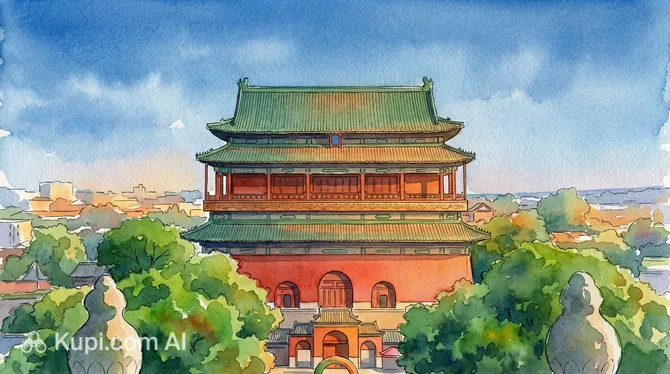
Bell and Drum Towers of Beijing. Illustration.
Source: Kupi.com AI

Traveler photos:

In addition to their historical value, the towers serve as an excellent observation point. From their upper levels, breathtaking panoramic views open up over the endless labyrinths of hutongs, modern skyscrapers, and distant mountains. This is a place where time seems to stand still, allowing you to feel the rhythm of the ancient city surrounded by recognized monuments of national cultural heritage.

Contacts

When planning a visit to the Bell and Drum Towers in Beijing, it is worth remembering that this is an important national historic site. Before your trip, we recommend checking for the latest information on possible changes to operating hours, as access to the upper levels may be restricted during restoration work or festive events.

How to contactContact
AddressКитай, Bei Jing Shi, Dong Cheng Qu, Andingmen, Zhong Lou Wan Hu Tong, 临9号 邮政编码: 100009

What to Do

The main highlight of visiting the Drum Tower is undoubtedly the drummers' show. The performance takes place every hour and allows you to hear the powerful rhythm of authentic instruments. Inside the tower, you can also see a replica of a massive historical ox-hide drum and surviving fragments of ancient instruments that signaled the start and end of the day to the city for centuries.

In the Bell Tower, your attention will be drawn to the legendary bronze bell from the Yongle period. Weighing 63 tons, it is considered the largest and heaviest bell in the world that is still functional. The deep sound of this giant once carried for many kilometers, coordinating the life of the entire vast capital.

Don't miss the chance to explore the exhibits dedicated to ancient timekeeping methods. Here you can find unique water and sun clocks, as well as "incense clocks." After exploring the interiors, be sure to take a walk through the surrounding hutongs—ancient alleys where the atmosphere of authentic old Beijing is preserved with its traditional courtyards and cozy shops.

Getting There

The attraction is located in the historic Dongcheng District and is well-integrated into the city's transport network. The easiest way to get there is by metro: the Guloudajie station (Lines 2 and 8, Exit B) is just a few minutes' walk away. You can also use the Shichahai station on Line 8, which will lead you directly to the picturesque alleys leading to the towers.

If you are in the Forbidden City area, the walk to the towers will take about 20–30 minutes along Dianmen Street. The route passes through old neighborhoods, making it a very informative stroll. For a taxi or Didi ride, simply specify the address Zhonglouwan Hutong—this location is well-known to all city drivers.

Nearest city: Beijing

History & Facts

The history of this architectural duo began back in 1272, during the reign of Kublai Khan of the Yuan Dynasty. In those days, the Drum Tower was called Qi Zheng Lou, meaning "Tower of Orderly Administration," symbolizing seven celestial bodies. In 1420, under the Yongle Emperor of the Ming Dynasty, the structures were rebuilt and moved slightly to the east, taking their current place of honor on the capital's central axis.

The fate of the towers was full of trials. While the Drum Tower largely retained its wooden appearance, the Bell Tower suffered from devastating fires several times. In 1745, during the Qing Dynasty, it was finally restored in stone, which ensured its longevity. Interestingly, after 1924, the towers officially ceased to function as city clocks, and at various times, they housed a museum of public education and even a cinema.

Since 1996, the ensemble has been recognized as a key cultural site of national importance. It is believed that similar towers in many other cities across the Middle Kingdom were modeled after these Beijing structures. Today, they stand as living witnesses to how the face of one of the world's greatest capitals has changed over eight centuries while maintaining their unwavering status as keepers of time.

Time Needed

To explore both towers at a leisurely pace, climb their steep stairs, and enjoy the views, it is best to set aside 1.5 to 2 hours. This is enough time to study the museum exhibits and attend one of the famous drummer shows.

If you also plan to walk through the surrounding hutongs or visit the cozy cafes in the Shichahai area, you should plan for about half a day. The rhythm of this neighborhood encourages leisurely contemplation, so it’s best not to rush your visit to fully experience the charm of the old capital.

Working Hours

The Bell and Drum Towers are open to visitors daily from 9:00 AM to 5:00 PM. The site operates without lunch breaks, making it easy to fit a visit into any tourist itinerary through the capital's center.

Please note that the drummers' show at the Drum Tower is held every hour. It is recommended to arrive 10–15 minutes before the performance starts to secure a good viewing spot. It is advisable to check the current show schedule and any potential changes to operating hours during holidays on-site or via official Beijing tourism resources.

Nearby

A visit to the towers pairs perfectly with exploring the northern part of the historic center. Right nearby lie the famous Beijing hutongs, where life flows at its own leisurely pace. A walk through these alleys can lead you to the magnificent Prince Gong's Mansion or the shaded paths of Jingshan Park, which offers one of the best views of the imperial palaces.

If you are interested in spiritual culture, the majestic Yonghe Temple and the ancient Guozijian Imperial Academy are nearby. The location of the towers makes them an excellent starting point for a deep dive into the atmosphere of old Beijing.

NameDistance
Prince Gong Mansion1 km
Imperial College (Guozijian)1.6 km
Jingshan Park1.8 km
Beihai Park1.8 km
Yonghe Temple (Lama Temple)2 km
Forbidden City2.7 km
The Palace Museum2.8 km

Reached the end of the page?

That means the route is fully explored