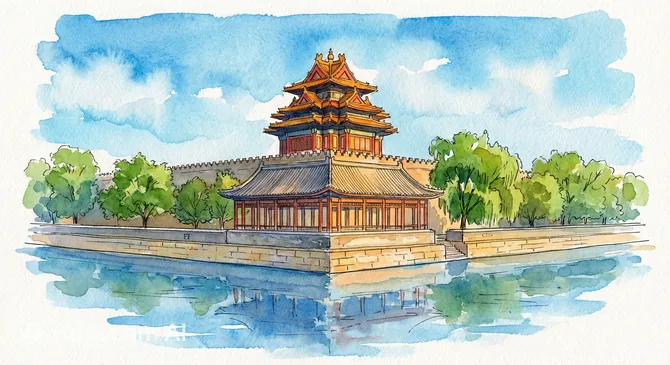
The Imperial Ancestral Temple, also known as Taimiao, is a majestic architectural ensemble located in the heart of Beijing. This unique cultural heritage site of China served as a sacred place where the rulers of the Ming and Qing dynasties offered prayers and paid homage to their predecessors. The temple is a quiet oasis, hidden from the city's hustle and bustle behind high walls and surrounded by centuries-old pines and cypresses.
Imperial Ancestral Temple. Illustration.
Source: Kupi.com AI
Traveler photos:
The complex is impressive in its monumentality: 92 ancient buildings have been preserved here, including more than 600 rooms. The temple's architectural style strictly follows the canons of Chinese cosmology, combining circular and square shapes that symbolize Heaven and Earth. A special charm is added to the place by its characteristic blue roofs and exquisite wooden structures, making it one of the most complete imperial cult structures in the country.
Visiting this site allows you to touch the deep traditions of the Middle Kingdom. With a rating of 4.4, the Imperial Ancestral Temple is recognized as one of the city's most atmospheric historical sites, where history comes alive in every detail of the carved facades and shaded alleys. It is a true masterpiece of ancient architecture, a must-visit for lovers of Eastern culture.
Contacts
When planning a visit to the Imperial Ancestral Temple in Beijing, we recommend checking for the latest information in advance. Since the site is of national importance, visiting rules may change depending on the season or the holding of official events.
For your convenience, below are the main contact details and links to resources that will help make your walk as comfortable and organized as possible.
At the Imperial Ancestral Temple, time seems to slow down, offering visitors the opportunity for leisurely strolls through manicured gardens. Here, you can spend hours contemplating the ancient architecture and studying the complex symbols encoded in the forms of the altars and halls. This is an ideal place for those seeking solitude and wanting to immerse themselves in the atmosphere of ancient imperial rituals away from noisy tour groups.
Photography enthusiasts will appreciate the majestic pavilions and the play of light on the wooden columns. The inner halls, where the "Sons of Heaven" once conducted solemn ceremonies, offer a glimpse into the closed world of the Chinese monarchy. An interesting feature: the proximity to other iconic landmarks in Beijing makes it easy to combine your visit for a complete impression of the city's imperial past.
To feel the true spirit of the place, stop by in the early morning. You will be able to see locals practicing Tai Chi in the open spaces among centuries-old trees, which adds a special authenticity to your walk. In summer, the park often comes alive with the sounds of traditional music, and sometimes demonstrations of ancient rituals are held here, recreating the grandeur of the Ming and Qing dynasties.
Getting There
The Imperial Ancestral Temple is located in the historic Dongcheng district, south of the Forbidden City. The most convenient and fastest way to get here is by using the Beijing Subway. You should take Line 5 to Tiantandongmen station (Exit C). From the metro, you can reach the entrance to the complex on foot in just 10 minutes, walking in a southerly direction.
If you prefer a taxi or services like Didi, simply specify the name "Imperial Ancestral Temple" or "Taimiao." A trip from the central districts of Beijing usually takes about 15–20 minutes. Buses No. 6, 34, and 106 also stop nearby (get off at Yongnei Dajie). Please note that parking spaces near the temple are very limited, so public transport remains the priority option.
For those who enjoy active travel, a bicycle is an excellent choice. There are convenient bike paths near the complex, and numerous bike-sharing points allow you to easily rent a bike and ride comfortably to the temple while taking in the sights of the Dongcheng district.
Nearest city: Beijing
History & Facts
The history of the Imperial Ancestral Temple began in the early 15th century when the Yongle Emperor of the Ming dynasty initiated large-scale construction alongside the legendary Forbidden City complex. Between 1406 and 1420, the temple was intended to be part of the grand Altar of Heaven and Earth, where rulers offered sacrifices for the prosperity of the empire and a bountiful harvest.
Significant changes occurred in the 1530s under the Jiajing Emperor: the complex was divided, and the temple took on a new specialization, focusing on the veneration of celestial forces and ancestral spirits. Later, in the 18th century during the Qing dynasty, the ensemble underwent a massive reconstruction under the leadership of the Qianlong and Guangxu emperors. It was then that it acquired its current features, spreading over a vast territory and becoming the primary place for worshipping ancient sages.
For centuries, Taimiao emphasized the vital cosmological role of Chinese rulers as intermediaries between Heaven and Earth. Today, this complex is recognized as a World Heritage site and is considered the largest and most significant sacrificial structure in all of China, having preserved its unique architectural integrity.
Time Needed
To explore the Imperial Ancestral Temple at a leisurely pace, most travelers need about 1.5–2 hours. This is quite enough time to spend about 45 minutes exploring the main ritual halls and altars, and dedicate the rest of the visit to strolling through the picturesque gardens and taking memorable photos among the ancient cypresses.
If you plan to combine a visit to Taimiao with a visit to the neighboring Temple of Heaven, we recommend allowing at least 3–4 hours for the entire walk. The duration of your stay may increase if you decide to watch the morning activities of the locals or want to examine all the exhibits in the pavilions in detail.
Working Hours
The Imperial Ancestral Temple is open to visitors daily from 06:30 to 19:30. This long operating schedule without lunch breaks provides an excellent opportunity to choose the most comfortable time for a visit: you can come right at the opening to enjoy the morning silence, or stop by during the pre-sunset hours.
The early hours are especially recommended for those who want to avoid the tourist crowds and see the park in its most peaceful state. Nevertheless, it is worth checking the information on official resources before your trip, as the schedule may change slightly on public holidays or during special events.
06:30–19:30
Nearby
The location of the Imperial Ancestral Temple in the very heart of Beijing offers tourists magnificent opportunities for further exploration of the city. Key symbols of the country are within walking distance, and a visit to them will help form a complete picture of the grandeur of the imperial heritage. A walk through these historical sites will allow you to transition smoothly from the contemplative tranquility of the temple gardens to the vast scale of the capital's main squares.
Just a few hundred meters away stands the majestic Meridian Gate, opening the way to the Forbidden City. Also very close by is the famous Tiananmen Square, where the National Museum of China and other iconic monuments are located. Combining these locations into one itinerary will make your day rich and truly unforgettable.