Support

Mausoleum of Mao Zedong

About

The Chairman Mao Memorial Hall is a grand memorial complex located in the heart of Beijing, on the famous Tiananmen Square. This monumental structure was erected as a tribute to the founder of the People's Republic of China and is one of the most visited and revered sites in China.
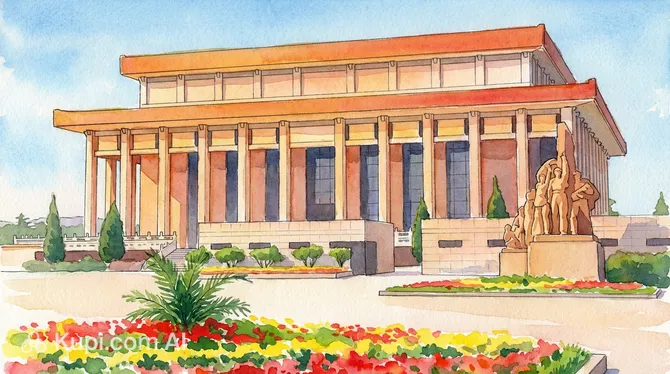
Mausoleum of Mao Zedong. Illustration.
Source: Kupi.com AI

Traveler photos:

The architectural style of the mausoleum is a unique blend of Soviet monumentalism and traditional Chinese elements. The building is surrounded by 44 massive granite columns, and the facades are decorated with dozens of sculptures depicting scenes from the lives of workers, peasants, and soldiers of the revolutionary era. The vast area of the complex, exceeding 57,000 square meters, underscores its national significance.

As of 2024, the memorial has been included in the UNESCO World Heritage list as part of the city's historic axis. It is not just a tomb, but an important cultural and historical landmark that allows travelers to connect with key chapters of 20th-century Chinese history and experience the solemn atmosphere of the country's main square.

Contacts

When planning a visit to the Chairman Mao Memorial Hall in Beijing, we strongly recommend checking for current information before your visit. As the memorial is an important state site, access hours and visitor rules may change depending on official events taking place in China.

How to contactContact
AddressКитай, 北京市东城区天安门W93X+246 邮政编码: 100051
Phone+86 10 6513 2277
Websitecpc.people.com.cn

What to Do

During a visit to the Chairman Mao Memorial Hall, visitors pass through several solemn halls. In the North Hall, guests are greeted by an impressive 3.5-meter statue of the leader, carved from white gypsum, set against a massive embroidered tapestry titled "The Land of the Motherland." This hall serves as the ceremonial entrance, where silence and respect are strictly observed.

The highlight of the visit is passing through the Central Hall, where the body of the "Great Helmsman" rests in a crystal sarcophagus. The viewing is conducted while moving, allowing every visitor to see this historical relic. Beyond the main hall, the complex includes memorial rooms on the second floor that chronicle the lives and work of other prominent leaders of China.

In total, the memorial features 10 halls, each with its own unique atmosphere and architectural design. A walk around the exterior is also of interest: you can examine the 62 sculptures decorating the perimeter in detail and enjoy the view of the Tiananmen Square ensemble from the foot of the mausoleum.

Getting There

Finding the Chairman Mao Memorial Hall is easy, as it is located in the very heart of Beijing, at the southern end of Tiananmen Square. This area is the city's primary tourist hub, making it quick and convenient to reach from any district.

The simplest and most reliable way is to use the Beijing Subway. The nearest stations are "Tiananmen East" (天安门东站) and "Tiananmen West" (天安门西站) on Line 1. From the subway exits, you can reach the memorial entrance on foot in just 5–10 minutes. Numerous bus routes also serve the square, connecting the center with all parts of the metropolis.

If you prefer a taxi, keep in mind that traffic directly around the square is often restricted for security reasons. A driver may drop you off a couple of blocks from the memorial, giving you a great opportunity for a short walk through the capital's historic center.

Nearest city: Beijing

History & Facts

The history of the Chairman Mao Memorial Hall began immediately after his death in September 1976. Although the leader himself expressed a wish to be cremated, the country's leadership decided to immortalize his memory in a grand memorial. The first stone was laid in November 1976, and construction proceeded at an incredible pace—the complex was completed in just seven months.

More than 700,000 volunteers from across the country participated in the construction. Materials for the memorial were brought from all corners of China as a symbol of national unity: granite was brought from Sichuan Province, water from the Taiwan Strait, and sand from the Gobi Desert. The lead architect was Xu Yinpei, who drew inspiration from classic memorial structures, including the Lincoln Memorial.

The official opening took place on September 9, 1977, exactly one year after the leader's passing. Since then, the Mausoleum has become a site of pilgrimage and a significant ideological symbol. Notably, in 2024, the complex was officially recognized as part of the UNESCO World Heritage site "Beijing Central Axis," confirming its architectural and historical importance.

Time Needed

To fully explore the halls of the Chairman Mao Memorial Hall, it is recommended to set aside 1.5 to 2 hours. This is usually enough time to walk through the main rooms, observe the architectural details, and view the memorial exhibitions dedicated to the leaders of China.

However, tourists should take potential queues into account. On weekends, national holidays, and during the summer season, waiting times at the entrance can increase significantly, which may extend the total visit to 3 hours or more. To save time, it is best to plan your visit for early morning on weekdays.

Working Hours

The Chairman Mao Memorial Hall operates on a specific schedule that should be considered when planning a trip to Beijing. It is open to visitors from Tuesday to Sunday, but only during morning hours—from 07:00 to 11:00. The memorial complex is closed on Mondays.

It is recommended to arrive at the square early, as the number of daily visitors is limited and entry requires passing through security checks. On holidays and dates of significant historical importance to China, the schedule may change, so it's worth checking the latest news on the official website before heading out.

DayWorking hours
MondayЗакрыто
Tuesday07:00–11:00
Wednesday07:00–11:00
Thursday07:00–11:00
Friday07:00–11:00
Saturday07:00–11:00
Sunday07:00–11:00

Nearby

A visit to the memorial in the heart of the capital opens the door to many other iconic sites. Exploring the surroundings will allow you to dive deeper into the atmosphere of Beijing and see how ancient history sits alongside modern state power. Just a few hundred meters away lies the legendary Tiananmen Square, whose scale is truly breathtaking.

For those interested in art and antiquities, the National Museum of China is located right nearby, housing extensive collections of artifacts. Combining a visit to the memorial with a stroll to the Imperial Palace or along the Wangfujing shopping street will make your day as rich and informative as possible.

NameDistance
Tiananmen Square0.3 km
National Museum of China0.4 km
Tiananmen Square0.7 km
Li Qun Roast Duck Restaurant0.9 km
Meridian Gate1.3 km
The Palace Museum1.5 km
Wangfujing Pedestrian Street1.5 km

Reached the end of the page?

That means the route is fully explored