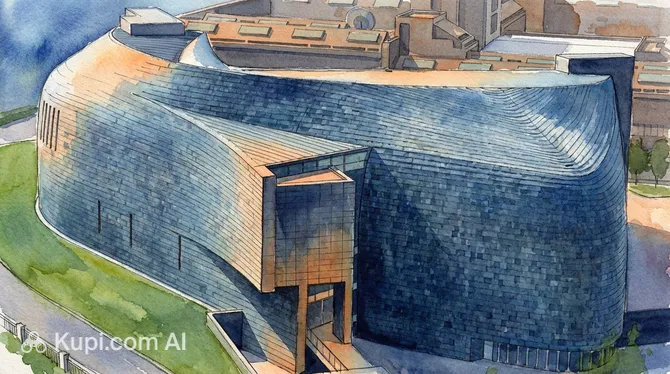
The CAFA Art Museum (Central Academy of Fine Arts) is one of Beijing's most significant cultural and educational venues. Located in China, this facility is an integral part of the country's leading creative university, which is rightfully considered the most prestigious school of fine arts in the Middle Kingdom.
Central Academy of Fine Arts Art Museum. Illustration.
Source: Kupi.com AI
Traveler photos:
The Academy is part of the prestigious national "Double First-Class" university plan. Admission is incredibly competitive: every year, more than 90% of applicants do not pass the rigorous selection process. CAFA comprises eight specialized schools covering a wide range of disciplines—from traditional Chinese guohua painting and architecture to experimental art and design.
The academy's museum serves not only as a training ground for future masters but also as an open space for all lovers of beauty. It is a place where one can trace how classical traditions are transformed under the influence of modern global trends, creating the unique artistic landscape of contemporary China.
Contacts
When planning a visit to the CAFA Art Museum, we recommend checking for the latest information on official resources beforehand. Since the museum is part of an active educational institution, its schedule may change due to internal academy events or exhibition rotations.
Below are the main contact details and the institution's address to help you find your way and, if necessary, contact the administration before your trip.
Visiting the CAFA Art Museum is an opportunity to see an impressive collection of approximately 13,000 works. Special attention should be paid to the section featuring rare Chinese scrolls from the Ming Dynasty and works by recognized masters of oil painting, graphics, and sculpture.
In the museum's six-story building, which opened for the Academy's 90th anniversary in 2008, visitors can also discover folk art: unique embroideries, ethnic costumes, and traditional New Year paintings are on display here. The collections also include valuable archaeological finds—bronze and jade artifacts, and ancient ceramics.
In addition to touring the main halls, guests are invited to peek into artists' studios or attend lectures and conferences often held within the museum's walls. You can round off your cultural program in the cozy cafeteria or the bookstore, which offers a wide selection of literature on art history and theory.
Getting There
The easiest way to reach the academy, located in the Chaoyang District at 8 Hua Jia Di Nan Jie, is by the capital's metro. The nearest stations are Wangjing West (Line 15) or Tiantongyuan North (Line 5). From the metro, you can walk to the museum entrance in about 15–20 minutes.
If you prefer surface transport, buses frequently run through the Chaoyang District, such as routes No. 909 and No. 418. For the most comfortable journey from central Beijing, you can use a taxi, which will take about 30–40 minutes depending on traffic.
Nearest city: Beijing
History & Facts
The history of this renowned educational institution began in 1918. On the initiative of the prominent educator and enlightener Cai Yuanpei, the National Beijing Art School was founded—the first state art institute in China's history, laying the foundations for modern art education in the country.
An important milestone was April 1950, when the National Art School in Beiping merged with the Department of Fine Arts of North China University. This period saw the birth of the Central Academy of Fine Arts. Notably, the calligraphic inscription of the academy's name, which still graces its symbols today, was personally written by Mao Zedong.
Over the years, the institution has been led by legendary artists such as Xu Beihong, Jiang Feng, and Wu Zuoren. These masters not only guided the education but also shaped the face of modern Chinese art, harmoniously blending Western techniques with deep national traditions.
Time Needed
To fully appreciate the extensive holdings of the CAFA Art Museum, guests are recommended to set aside 2 to 3 hours for their visit. This time is quite sufficient for viewing both the permanent collections and the most prominent temporary exhibitions.
The duration of your stay may increase if you decide to attend an open lecture or explore the selection of books in the academy's specialized bookstore. Keep in mind that during student thesis defense periods, exhibitions become particularly large-scale, which may require more time for a thoughtful viewing.
Working Hours
The exact museum schedule may vary depending on the season, as well as the temporary exhibition schedule in Beijing. Since the museum is part of an educational institution, visiting hours for the general public sometimes change due to internal academy events.
We strongly recommend checking the current schedule on the official museum website or confirming information by phone before your trip. This will help you plan your visit so that all the exhibitions you are interested in are open.
Nearby
A visit to the academy can easily be complemented by a stroll through other iconic cultural spots in the city. Very close by is the famous 798 Art Zone—a vast creative cluster in former factory buildings that has become the epicenter of avant-garde art. The proximity of these two venues allows you to see the entire journey of Chinese creativity in a single day: from the classical school to bold experiments.
Additionally, within easy reach by transport are the majestic Yonghe Temple and the futuristic Beijing National Stadium. Exploring the surroundings of the Chaoyang District will give you an unforgettable impression of Beijing's contrasts, where ancient shrines stand alongside masterpieces of modern architecture.