Support

Hagia Sophia of Thessaloniki

About

The Hagia Sophia Cathedral in Thessaloniki is an outstanding monument of Christian architecture, dedicated to the Holy Wisdom of God. Located on the square of the same name in the heart of the city, this cross-in-square, three-aisled church is one of the key spiritual and historical centers of Greece. Its history goes back centuries, and today it is under the jurisdiction of the Metropolis of Thessaloniki.
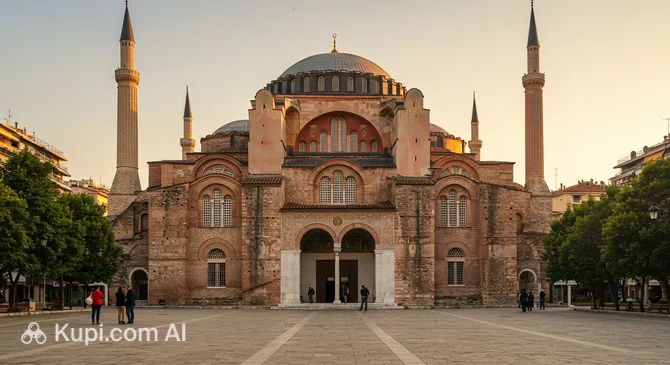
Hagia Sophia of Thessaloniki. Illustration.
Source: Kupi.com AI

Traveler photos:

The uniqueness of the Hagia Sophia Cathedral lies in its architectural design. It is a rare example of ecclesiastical architecture from the Iconoclastic period, harmoniously combining features of a cross-in-square church and a traditional three-aisled basilica. This architectural innovation reflects a transitional stage in Byzantine church building and makes the cathedral particularly valuable for researchers and history enthusiasts.

Inside, the church is adorned with magnificent mosaics, which are another distinguishing feature and attract visitors from all over the world. Due to its exceptional historical and cultural significance, the Hagia Sophia Cathedral was included in the prestigious UNESCO World Heritage list in 1988 as part of the early Christian and Byzantine monuments of Thessaloniki. Visiting this cathedral is an opportunity to touch centuries-old history and enjoy a masterpiece of Byzantine art.

Contacts

To get the most up-to-date information on the opening hours of the Hagia Sophia Cathedral in Thessaloniki, possible tours, or contact details, we recommend consulting the official tourism resources of Thessaloniki or checking the information directly on-site. The cathedral is located in the very heart of the city, on the square of the same name, making it easily accessible on foot or by public transport.

How to contactContact
AddressAgias Sofias, Thessaloniki 546 22, Greece
Phone number+30 231 027 0253
Websitewww.agiasofia.info

What to Do

Upon entering the Hagia Sophia Cathedral in Thessaloniki, travelers immediately find themselves in a spacious narthex (vestibule), where partially preserved ancient frescoes will catch their attention. Looking closely at the arches of the window openings on the western wall of the church, one can distinguish the surviving faces of pious church fathers. Among the depicted saints are local righteous figures, such as Saint Theodora of Thessaloniki, whose life was connected to the monastery in the 9th century.

Of particular interest to visitors is the church's interior decoration, especially its famous Byzantine mosaics. Many of these masterpieces have survived to this day thanks to a surprising coincidence: during the Ottoman rule, they were covered with a layer of plaster. Later, the plaster was carefully removed, revealing unique examples of mosaic art to the world, which today inspire admiration for their beauty and craftsmanship. Viewing these ancient images allows you to feel the spirit of the era and appreciate the high level of art of that time.

In addition to the magnificent interior, the cathedral's architecture itself will not leave you indifferent. Hagia Sophia is a rare example of a transitional type from a basilica to a cross-in-square church, making it especially valuable from a historical and architectural perspective. Strolling through the church, visitors can appreciate its majestic vaults, powerful columns, and unique layout, reflecting an important stage in the development of Byzantine church architecture. This is not just a sightseeing trip, but a true immersion into the history of Christianity and architecture.

Getting There

The Hagia Sophia Cathedral is located in the very heart of Thessaloniki, on the square of the same name, making it highly accessible for tourists. If you are staying in the city center, you will likely be able to reach the cathedral on foot, enjoying the atmosphere of Thessaloniki along the way.

For those who prefer public transport, Thessaloniki has a well-developed bus network. Many routes pass through the city center, and you will surely find a bus that takes you right near Hagia Sophia Square. It is recommended to check the route numbers in advance on the official city transport website or at the bus stops.

Another convenient way to reach the Hagia Sophia Cathedral is by taxi. Taxis in Thessaloniki are relatively affordable, and a trip from most parts of the city to the center won't take long or be too expensive. This is an especially good option if you are traveling with children, have many belongings, or simply value comfort.

Nearest city: Thessaloniki

History & Facts

The history of the Hagia Sophia Cathedral in Thessaloniki is rooted in deep antiquity. On the site where the majestic church stands today, an early Christian five-aisled basilica dedicated to St. Mark stood in the first half of the 5th century. This structure was part of a vast religious complex covering more than 8,000 square meters. Unfortunately, a powerful earthquake between 618 and 620 destroyed this original church. The current church was built on its site, though it occupies only part of the previous complex's territory.

The construction of the modern Hagia Sophia Cathedral took place during a complex but important period of Byzantine history—the late 7th to early 8th century, the era of the so-called Iconoclastic controversy. It is believed that the church's construction was completed during the reign of Emperor Leo III the Isaurian. The first written mentions of the cathedral date back to 797, by the hand of Saint Theodore the Studite, indicating the church's importance even in those distant times. The architectural style of the cathedral reflects the transitional stage from a basilica to a cross-in-square church, making it a unique monument of that era.

The cathedral's fate was complex. After the Ottoman conquest of Thessaloniki in 1430, the church continued to be used for Christian worship for nearly a century until 1523, when it was converted into a mosque known as the Aya Sofia Camii. During this period, its exterior underwent changes: an Ottoman-style portico adorned the facade, and the bell tower was converted into a minaret, with a second one added later. When Thessaloniki became part of Greece in 1912, the cathedral was returned to the Christians. The Ottoman minaret was dismantled, and the bell tower was restored to its original function. Much of the interior decoration was plastered over after the devastating Great Thessaloniki Fire of 1917, and the church's famous dome was only restored in 1980, returning the building to its historical appearance.

Time Needed

To explore the Hagia Sophia Cathedral in Thessaloniki, most visitors will need approximately 1-2 hours. This time is usually enough to leisurely walk through the church, appreciate its unique architecture that combines features of a basilica and a cross-in-square structure, and feel the special atmosphere of this ancient place. During this time, you can form a general impression of the cathedral's scale, its interior decor, and historical significance.

If you plan to study the famous Byzantine mosaics and surviving frescoes in more detail, or delve into the historical aspects of the church's different periods, it's worth setting aside a bit more time. Carefully examining the mosaic compositions—especially the impressive dome mosaic depicting the "Ascension of Christ" or the unique Iconoclastic-era mosaics in the altar apse—can take an additional 30-60 minutes. Visitors with a deep interest in Byzantine art or Orthodox history might spend even more time here, immersing themselves in the details and enjoying the spiritual atmosphere.

Thus, the optimal time for visiting the Hagia Sophia Cathedral depends on your personal interests and depth of focus. For a general overview of this prominent Thessaloniki landmark, one hour is enough, but for a more comprehensive and thoughtful visit, it's better to plan for about two hours. In any case, visiting this significant monument, listed as a UNESCO World Heritage site, will leave deep and memorable impressions.

Working Hours

The Hagia Sophia Cathedral in Thessaloniki is usually open to visitors daily, as it is an active church. Entrance for individual viewing is generally free, and no advance ticket booking is required. However, exact opening hours may vary depending on the season, religious holidays, or special services. We highly recommend checking the current schedule on the day of your visit on official Thessaloniki tourism portals or directly on-site.

You can visit the Hagia Sophia Cathedral throughout the year. If you plan to visit as part of an organized tour group, we recommend contacting the organizers in advance to clarify the conditions and potential need for pre-registration. For independent visits, it is sufficient to arrive during the church's opening hours, keeping in mind the need for respectful behavior in this holy place.

7:00 – 21:00

Nearby

Visiting the majestic Hagia Sophia Cathedral in Thessaloniki is undoubtedly a highlight of any trip. However, to make your journey even more enriching and complete, it is worth exploring its surroundings. Thessaloniki is a city with a rich history, and many other interesting sites are located near the cathedral to help you better understand its culture and atmosphere.

Strolling through the nearby streets will allow you to discover hidden gems, cozy cafes, and other attractions that will complement your visit to one of the city's main symbols. Below is a list of some of these sites, including approximate distances from the Hagia Sophia Cathedral.

NameDistance
Agia Sofia Square0.1 km
Selfie Museum0.3 km
Arch of Galerius0.4 km
Aristotelous Square0.5 km
Rotunda of Galerius0.5 km
Electra Palace Bar0.5 km
Roman Forum of Thessaloniki0.6 km

Have you reached the end of the page?

So the route has been studied inside and out