Support

Bulguksa Temple

About

Bulguksa Temple is an outstanding Buddhist temple complex located in the ancient city of Gyeongju, South Korea. This temple is one of the most significant and well-preserved in the country, which is why it was added to the UNESCO World Heritage List in 1995 along with Seokguram Grotto. For travelers, it is more than just an ancient structure; it is an opportunity to touch upon centuries of Korean history and spiritual culture.
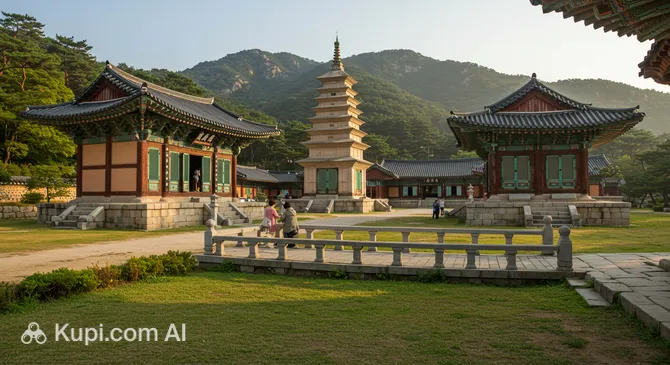
Bulguksa Temple. Illustration.
Source: Kupi.com AI

Traveler photos:

The architectural ensemble of Bulguksa is striking in its harmony and includes elegant wooden prayer halls and unique stone structures. One of the main features that distinguishes it from other Korean temples is the presence of two famous pagodas in the inner courtyard. The three-story Seokgatap (Sakyamuni Pagoda) and the elaborately carved Dabotap (Pagoda of Treasures) are recognized as National Treasures of Korea and symbolize the pinnacle of ancient craftsmanship.

Bulguksa Temple is considered the main relic of Gyeongju, and its artistic value and the beauty of its stone sculptures are known far beyond the country's borders. In total, there are seven objects on the monastery grounds that are on the list of National Treasures of Korea, including the stone pagodas, the Cheongungyo bridge, and gilded bronze Buddha statues. A visit to this place leaves an unforgettable impression and allows for a deeper understanding of the region's rich cultural heritage.

Contacts

For the most up-to-date information on opening hours, special events, or visiting rules, it is recommended to consult official sources. The main contact details for the temple complex are provided below.

Getting to the temple from downtown Gyeongju is quite easy using public transport—buses No. 10 and No. 11 run regularly to the complex entrance.

How to contactContact
Address385 Bulguk-ro, Gyeongju, Gyeongsangbuk-do, South Korea
Phone number+82 54-746-9913
Websitewww.bulguksa.or.kr

What to Do

A visit to Bulguksa Temple offers travelers the chance to experience unique architectural and spiritual treasures. You should begin your exploration of the complex in the inner courtyard, home to two famous stone pagodas—Seokgatap and Dabotap. They create a striking contrast: Seokgatap is characterized by simplicity and concise forms, while Dabotap delights with its complex and exquisite design. Interestingly, an image of the detailed Dabotap pagoda can be seen on the South Korean 10-won coin.

Next, the path leads to the main prayer halls. The centerpiece is Daeungjeon (Hall of Great Enlightenment), which is the sanctuary of Sakyamuni Buddha. It was built in 681 and contains a large gilded Buddha statue surrounded by smaller statues of his followers. Tucked away behind the main hall is Musoljeon (Hall of No Words)—one of the temple's oldest structures, dating back to 670, where an atmosphere of serenity prevails.

History and architecture buffs will find it interesting to study the unique features of Unified Silla period architecture. The master builders of that time harmoniously combined geometric shapes such as octagons, squares, and circles into the pagoda designs. In addition to the main pavilions and pagodas, other noteworthy details can be found throughout the complex, such as a preserved stone lion that was once one of four guardians watching over the staircase.

Getting There

Reaching Bulguksa Temple from the city of Gyeongju is quite simple, as it is one of the region's most popular attractions. The most convenient and budget-friendly way is to use public transport. Buses run regularly from the city center, as well as from the intercity bus terminal and Gyeongju Railway Station. Routes No. 10 and No. 11 are your best bet, as they stop right at the entrance to the temple complex. The journey usually takes about 40-50 minutes, depending on traffic.

If you arrive in Gyeongju by KTX high-speed train at Singyeongju Station, which is located a bit outside the city center, there is also a direct bus to the temple from there. In this case, look for route No. 700. This allows tourists traveling from other cities in South Korea, such as Seoul or Busan, to reach Bulguksa easily without needing extra transfers in the center.

For those who prefer a faster and more comfortable way to travel, taxis are always available. A taxi ride from central Gyeongju to the temple will take approximately 20-30 minutes. This option can be particularly convenient for small groups or families with children. Additionally, if you are traveling by rental car, there is a spacious parking lot at the entrance to the temple complex.

Nearest city: Gyeongju

History & Facts

The history of Bulguksa Temple dates back to the 6th century, during the Silla Kingdom era. According to chronicles, the first sanctuary on this site was built in 528 during the reign of King Beopheung. It was originally named "Hwaom Bulguksa." However, the magnificent complex we see today began to take shape in 751, thanks to a large-scale reconstruction led by Prime Minister Kim Dae-seong, who dedicated the work to the spirits of his ancestors.

The true gems of the complex are the two famous stone pagodas—Dabotap and Seokgatap—which serve as outstanding examples of Unified Silla period architecture. The three-story Seokgatap pagoda is over 13 centuries old and is built in a style that is traditionally Korean: simple and austere. In contrast, the Dabotap pagoda impresses with its complex design and exquisite ornamentation. This architectural duo symbolizes harmony and the pinnacle of ancient craftsmanship.

Among the temple's oldest structures is Musoljeon, or the "Hall of No Words," dating back to 670. Its name reflects deep Buddhist philosophy, which suggests that the Buddha's true teachings cannot be conveyed through words alone. The temple's main hall, Daeungjeon (Hall of Great Enlightenment), was built in 681 and serves as the central sanctuary dedicated to Sakyamuni Buddha. These structures allow visitors to touch upon centuries of spiritual tradition.

The outstanding historical and cultural value of Bulguksa Temple received global recognition in 1995 when it was added to the UNESCO World Heritage List. This status confirms its exceptional importance not only to South Korea but to all of humanity, preserving its unique legacy for future generations.

Time Needed

It is recommended to set aside at least 2-3 hours to explore Bulguksa Temple. This will be enough time to take a leisurely stroll through the main grounds, see the famous Seokgatap and Dabotap pagodas, look into the main prayer halls like Daeungjeon and Musoljeon, and take beautiful photos against the backdrop of the picturesque architecture and nature.

If you want to immerse yourself more deeply in the atmosphere of the place, study every architectural detail, and visit the less-known corners of the complex, you should plan for about half a day. Many travelers combine a visit to Bulguksa with a trip to the nearby Seokguram Grotto, which is also a UNESCO World Heritage site. A bus runs between these two attractions, but the travel and sightseeing of the grotto will require an additional 1.5–2 hours.

For those seeking a truly unique experience, Bulguksa Temple offers "templestay" programs, allowing you to immerse yourself in the life of monks for a day. Such a program, which includes meditation and participation in ceremonies, takes an entire day and provides a much deeper impression of visiting this iconic site in South Korea.

Working Hours

Bulguksa Temple is open to visitors year-round, but opening hours may change depending on the season. From March to September, the complex welcomes guests from 7:00 AM to 6:00 PM. In October, it is open from 7:00 AM to 5:30 PM, and from November to January, from 7:30 AM to 5:00 PM. In February, the hours are 7:30 AM to 5:30 PM. It is worth noting that some sources list general operating hours from 9:00 AM to 6:00 PM, so it is recommended to check the official website for the latest information before your visit.

As a rule, you do not need to book tickets specifically for Bulguksa Temple; they can be purchased on-site. However, if you plan to join an excursion group or use the services of a guide, it is better to check the conditions in advance. Since this is one of the most popular attractions in Gyeongju, it can get quite crowded during peak seasons, especially in spring and autumn.

9:00 – 18:00

Nearby

Visiting Bulguksa Temple is just one part of an exciting journey through the historic region of Gyeongju. The area surrounding the temple is filled with other significant sites that will help you form a more complete picture of the culture and history of Korea's ancient capital. By taking the time to explore them, you can dive deeper into the atmosphere of the Silla era and discover new facets of this amazing corner of South Korea.

It is particularly noteworthy that many of the key attractions are located in close proximity to the temple, making them easy to explore. For example, the famous Seokguram Grotto, also a UNESCO World Heritage site, is located just a few kilometers away and is a logical continuation of the itinerary for most travelers. Below is a list of interesting places located nearby.

NameDistance
Brahma Gate, Bulguksa Temple0.3 km
Seokguram Grotto1.6 km
Blue One Private Condo5.4 km
Kangdong Resort5.6 km
Gyeongju Tower6 km
Jurung Jurung Gyeongju6.2 km
California Beach6.7 km

Have you reached the end of the page?

So the route has been studied inside and out