Support

Nizhny Novgorod Kremlin

About

The Nizhny Novgorod Kremlin is not just the main attraction and the heart of Nizhny Novgorod, but a majestic medieval fortress where the city's history began. Located on a high bank at the confluence of the Oka and Volga rivers, it is one of Russia's most valuable architectural monuments and one of the best-preserved fortresses in the country. It is a true city within a city, holding centuries-old secrets and legends.

Built in the early 16th century as a powerful defensive line on the eastern borders, the Kremlin was equipped with the latest fortification science of the time. Its two-kilometer red brick walls, reaching up to 22 meters in height, connect 13 towers, each with its own unique history. Throughout its centuries-long history, the fortress was never captured by the enemy, a testament to its incredible power and well-thought-out design.

Today, the Nizhny Novgorod Kremlin is a large-scale cultural and historical complex where the past meets the present. Its vast territory contains administrative buildings, museums, exhibition halls, the ancient Cathedral of the Archangel Michael with the tomb of Kuzma Minin, as well as cozy parks and observation decks. Visitors can take a unique walk along the entire perimeter of the Kremlin wall—this is the longest such route in Russia, offering breathtaking panoramas of the city and the vast Volga vistas.
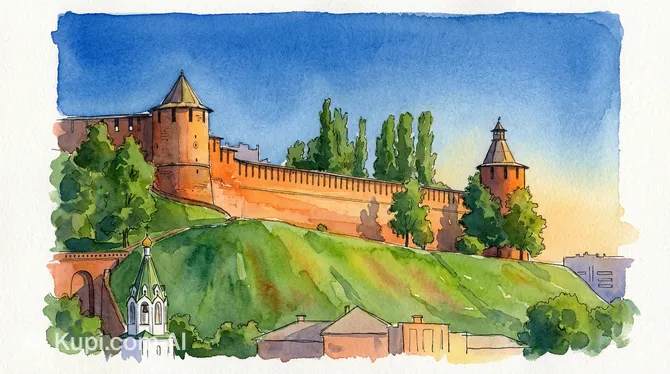
Nizhny Novgorod Kremlin. Illustration.
Source: Kupi.com AI

Traveler photos:

Contacts

To plan your visit, book guided tours, or get the latest information on exhibitions and events at the Nizhny Novgorod Kremlin, you can use the official contact details. The most up-to-date information is always available on the official website of the museum complex.

How to contactContact
AddressMinin and Pozharsky Sq, Nizhnij Novgorod, Nizhegorodskaya oblast', Russia, 603005
Phone number+7 831 282-25-40
Websitengiamz.ru

What to Do

A visit to the Nizhny Novgorod Kremlin is a true immersion into history. For many, the main adventure is walking along the fortress walls, with a full circular route stretching over two kilometers. During the walk, you can explore ancient towers, each featuring unique architecture and its own secrets. For example, the construction of the stone fortress began with the Storage Tower (Kladovaya Tower), formerly known as the Tverskaya Tower. Additionally, various museum exhibitions are open on the grounds, where you can learn more about the history of the Kremlin and the city itself.

Beyond the defensive structures, you can see ancient churches and other historical buildings that give this place a special atmosphere. Be sure to find time to admire the magnificent panorama of the confluence of the Oka and Volga—this spot is rightfully considered one of the most picturesque in Nizhny Novgorod and attracts photography enthusiasts. Some towers, such as the Tainitskaya and Georgievskaya towers, have special observation decks with breathtaking views.

The Nizhny Novgorod Kremlin is not just a monument frozen in stone, but a vibrant center of cultural life for the city. The Arsenal building houses a contemporary art center, and the former Military Governor's house is now a branch of the art museum. Exhibitions, festivals, and other city events are regularly held here, making a visit interesting at any time of year. Before your trip, it's worth checking the event calendar—you might catch one of the exciting events taking place on its historical grounds.

Getting There

Getting to the Nizhny Novgorod Kremlin is easy, as it is located in the heart of the historic center of Nizhny Novgorod, on Minin and Pozharsky Square. Thanks to this location, the city's main fortress is easily accessible from any part of town by public transport, taxi, or private car.

The most convenient way to reach the Kremlin is by using the extensive public transport network. Numerous buses and minibuses stop at the "Minin and Pozharsky Square" (Ploshchad Minina i Pozharskogo) stop, which is located in the immediate vicinity of the main entrance to the Kremlin through the Dmitrievskaya Tower. Transport from all city districts, including routes from the railway station, arrives here. For example, you can take buses No. 3, 38, 58, and others from the station.

You can also use the metro. The nearest station is "Gorkovskaya," located about one and a half kilometers from the Kremlin. From there, you can take a pleasant walk along the city's main pedestrian street—Bolshaya Pokrovskaya, which is an attraction in its own right and will lead you straight to the walls of the ancient fortress. A taxi ride from the central districts will be fast and inexpensive. If you are traveling by private car, keep in mind that finding parking near the Kremlin can be difficult on weekends and holidays.

Nearest city: Nizhny Novgorod

History & Facts

The history of the Nizhny Novgorod Kremlin dates back to the 13th century. The first wooden fortress was built on this site almost simultaneously with the founding of Nizhny Novgorod itself in 1221 by Prince Yuri of Vladimir. In the 14th and 15th centuries, it served as the residence of local princes and was a key eastern outpost of the Russian lands, making it a strategically important site.

The decision to build a stone fortress was made under Ivan III, when Nizhny Novgorod became the primary staging ground for military campaigns against the Kazan Khanate. Work began in 1500 but was interrupted by an enemy raid in 1505. Construction resumed in 1508 under the guidance of the talented Italian architect Pietro Francesco (Pyotr Fryazin), who was specially invited from Moscow. After a severe fire in 1513 destroyed the old oak fortifications, the construction of the stone citadel was accelerated and completed around 1516.

Since its completion, the Nizhny Novgorod Kremlin has been a true symbol of invincibility. In the 16th century, it withstood several sieges and assaults by the Kazan Tatars, but it was never captured by the enemy, confirming its reputation as an impregnable stronghold. By the end of the 17th century, the fortress had lost its military significance, transforming into the city's administrative center. Remarkably, this grand fortification, unlike many others, has survived to this day almost in its original form, making it a unique monument of military architecture.

Time Needed

When planning a visit to the Nizhny Novgorod Kremlin, it is worth considering how much time you are willing to spend exploring it. For a quick overview, which includes walking the main grounds, seeing the monuments, and enjoying the views from observation decks without entering museums, 1.5–2 hours will be sufficient. This will allow you to leisurely visit key spots, feel the atmosphere, and take beautiful photos of the confluence of the Oka and Volga rivers.

The central highlight is the full circular walk along the two-kilometer fortress wall, which itself can take about 1–1.5 hours. This route not only allows you to enjoy magnificent panoramas of the city but also to peek into some of the towers, which house small exhibitions or observation decks. Please note that the wall route has elevation changes, so the walk will require some physical effort.

If you want a more thorough immersion into history and culture, it is best to set aside at least 3–4 hours, or even half a day, for your visit. Its vast territory houses several major museums, including a branch of the Art Museum and the "Arsenal" Center for Contemporary Art, as well as the ancient Cathedral of the Archangel Michael. Visiting even one of these will significantly increase your visit time, offering a more complete picture of this unique historical complex.

Working Hours

The grounds of the Nizhny Novgorod Kremlin are open to visitors year-round, allowing guests to enjoy its views in any season. Entry to the grounds is free, and they are available for walks daily; however, opening hours depend on the time of year. In the summer period (roughly from May 1 to October 31), the Kremlin is open from 6:00 to midnight, and in the winter (from November 1 to April 30)—from 6:00 to 22:00. Please note that access to museums and the famous circular route along the fortress wall follows a different schedule and requires a ticket.

The main highlight—the walk along the Kremlin wall—is seasonal. It is typically available to visitors from spring to autumn, approximately from April to November. During this period, the ticket offices and the entrance to the wall are usually open from 10:00, and closing times may vary from 17:00 to 20:00 depending on the month and daylight hours. During the high season and on weekends, it is recommended to purchase tickets in advance to avoid queues; this can be done at the onsite ticket offices or online. Since working hours may change, we strongly recommend checking for the latest information on the official Nizhny Novgorod Kremlin portal before your visit.

DayOpening hours
MondayClosed
Tuesday10:00 – 17:00
Wednesday10:00 – 17:00
Thursday10:00 – 19:00
Friday10:00 – 17:00
Saturday10:00 – 17:00
SundayClosed

Nearby

A visit to the Nizhny Novgorod Kremlin is just the beginning of your acquaintance with the rich history and culture of Nizhny Novgorod. Thanks to its central location, the fortress serves as an ideal starting point for exploring other iconic city sites. Many of them are within walking distance, allowing you to easily plan a feature-rich walking route.

Exploring the area around the Kremlin will significantly enrich your experience. Just a few steps from its ancient walls, you will find famous monuments, art museums, and cozy spots that together create the unique character of the historic center. Such a walk will allow you to see how the city's past and present are harmoniously intertwined.

NameDistance
Dmitrievskaya Tower0.2 km
Monument to Yevgeny Evstigneev0.3 km
Kremlin Arsenal0.3 km
Nizhny Novgorod State Art Museum0.4 km
Valery Chkalov Monument0.5 km
Dzhani Restaurant0.5 km
Nizhny Novgorod Exotarium0.5 km

Have you reached the end of the page?

So the route has been studied inside and out