Support

Nizhny Novgorod Fair

About

The Nizhny Novgorod Fair is more than just a landmark; it is an entire historical district and the largest exhibition complex in Nizhny Novgorod, located in its Zarechnaya part. In the past, it was famous throughout Russia as the largest fair in the Empire. It was thanks to the fair that Nizhny Novgorod earned the apt nickname "Russia's pocket", highlighting its commercial power and economic significance.
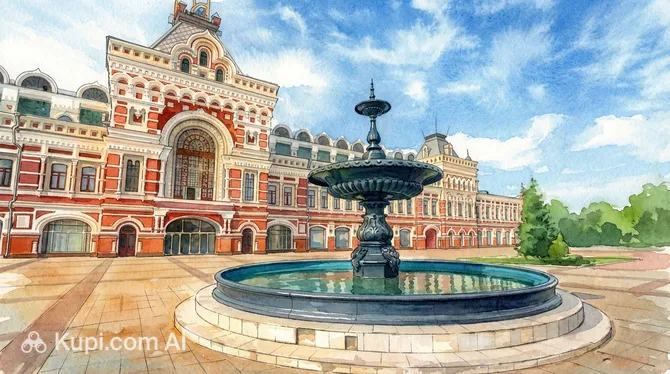
Nizhny Novgorod Fair. Illustration.
Source: Kupi.com AI

Traveler photos:

Today, the Nizhny Novgorod Fair has transformed into a modern congress and exhibition center, playing a key role in the business life of the Volga region while carefully preserving its rich historical traditions. In the grand Main Fair Building, visitors can explore the fascinating "Russia — My History" multimedia exhibition, which offers an immersive journey into the country's past.

With over four centuries of history, the fair is not just a trading platform but a true cultural brand of Nizhny Novgorod. It is a place where the past meets the present, offering guests a unique blend of business activity, cultural events, and historical heritage, making it a must-see destination in the city.

Contacts

To get the latest information on events, opening hours, and contact details for the Nizhny Novgorod Fair, we recommend visiting the official website of the exhibition complex. You can also find detailed information at tourist centers in Nizhny Novgorod or on information stands throughout the fairgrounds.

How to contactContact
AddressUlitsa Sovnarkomovskaya, 13, Nizhnij Novgorod, Nizhegorodskaya oblast', Russia, 603086
Phone number+7 831 224-88-87
Websitewww.yarmarka.ru

What to Do

At the Nizhny Novgorod Fair, visitors can not only learn more about the country's history at the "Russia — My History" exhibition in the Main Fair Building but also witness or participate in various modern events. The modern exhibition center regularly hosts major exhibitions, congresses, and cultural events that reflect the business and creative life of the region. These can range from specialized industry expos to vibrant festivals, concerts, or significant forums, so it is recommended to check the current program before your visit.

Beyond the modern pavilions, a walk through the Nizhny Novgorod Fair is a unique opportunity to touch its rich past. Look out for the surviving historical buildings and architectural monuments that speak volumes of the former scale and central trading importance of this site for all of Russia. Every corner here holds its own legends, and the atmosphere is steeped in the spirit of old merchant traditions and unique fairground excitement.

Unique structures added special character and identity to the fair in the past. For instance, the famous four buildings of the Chinese rows, skillfully designed as Eastern pagodas, were not only architectural gems but also a bustling hub for the tea trade. Significant religious sites also coexisted harmoniously on the fairgrounds, such as the majestic Kazan Church with its impressive four-tier bell tower and high spire, an Armenian church, and a mosque, emphasizing the diversity of cultures that converged at this trading hub. Exploring the history of these sites adds depth to your visit.

Getting There

The Nizhny Novgorod Fair is conveniently located in the Zarechnaya (lower) part of Nizhny Novgorod, making it easily accessible for visitors. There are several ways to reach this historic and business hub, depending on your preferences and starting point in the city. Whether you choose public transport or a taxi, getting to the fair is straightforward.

One of the most convenient public transport options is the metro. The nearest station is "Strelka" (Sormovsko-Meshcherskaya line, blue branch). It is just a few minutes' walk from the metro exit to the Main Fair Building and the main pavilions. Additionally, numerous bus and trolleybus routes, as well as route taxis, serve the Nizhny Novgorod Fair. Look for stops named "Yarmarka" (Fair) or "Ploshchad Lenina" (Lenin Square), which are in the immediate vicinity of the complex.

If you prefer individual comfort and speed, taxis are always available. A ride from the central part of Nizhny Novgorod—for example, from the Kremlin or Bolshaya Pokrovskaya Street—to the Nizhny Novgorod Fair usually doesn't take long, though traffic conditions should be considered, especially during peak hours or major events. For those traveling by private car, there are parking areas near the fairgrounds, but availability may vary depending on current events.

Nearest city: Nizhny Novgorod

History & Facts

The history of the Nizhny Novgorod Fair dates back over four centuries. Interestingly, the famous fair did not originate in Nizhny Novgorod itself, but about 100 kilometers downstream on the Volga River, by the walls of the Makaryev Monastery. It was granted official status by a decree from Tsar Alexei Mikhailovich in 1641. In those days, trade at the Makaryev Monastery was duty-free for the first five days, attracting many merchants.

Volga trade has long traditions, beginning in the first half of the 13th century at Arsk Field near Kazan. A significant milestone was Vasily III's decision in 1524 to prohibit Russian merchants from traveling to Kazan and establish a Russian fair in Vasilsursk. Once the entire Volga trade route came under the control of the Moscow state in the mid-16th century, it created favorable conditions for the rapid development of both domestic and foreign trade, laying the foundation for the future prosperity of the Nizhny Novgorod Fair.

The true golden age of the Nizhny Novgorod Fair occurred in the second half of the 19th century. This was significantly bolstered by the opening of strategic transport arteries: the Nikolayevskaya Railway in 1851 and later the Nizhny Novgorod Railway. Consequently, the fair gained international recognition and scale, attracting up to 200,000 people to Nizhny Novgorod annually—a staggering figure for that time. It became more than just a marketplace; it was a true economic powerhouse.

Among the notable events in the fair's history was the consecration of the majestic Alexander Nevsky Cathedral (officially the Cathedral of the Holy Right-Believing Prince Alexander Nevsky). In 1881, a solemn consecration ceremony was held, attended by Emperor Alexander III, Empress Maria Feodorovna, and Tsesarevich Nicholas. The fair was also famous for its infrastructure: in the 1860s, merchant E. Schmidt installed 650 lanterns on its territory, and about a quarter-century later, cutting-edge electric lighting was introduced, making it one of the most modern trading platforms in Russia.

Time Needed

When planning a visit to the Nizhny Novgorod Fair, keep in mind that the time required to see it can vary greatly. For a general overview of the grounds, a walk through the historical section, and viewing the Main Fair Building from the outside, 1-2 hours may be enough. This allows you to get a general impression of this iconic Nizhny Novgorod landmark and soak in its atmosphere.

If you have a deeper interest and plan to visit the "Russia — My History" multimedia exhibition housed in the Main Fair Building, allow an additional 2-3 hours. The exhibition is quite extensive and interactive, requiring time for a thoughtful visit. Furthermore, the Nizhny Novgorod Fair is an active exhibition center; if your visit coincides with a major exhibition, congress, or festival of interest, your stay could easily extend to half a day or even a full day.

In summary, a couple of hours is enough for a quick look, but to fully immerse yourself in the history and current events of the fair, it's worth setting aside at least half a day. We recommend checking the events calendar in advance to plan your visit optimally and get the most out of this unique location in Russia.

Working Hours

The opening hours of the Nizhny Novgorod Fair depend directly on the events and exhibitions being held, as well as the season. The Main Fair Building, which houses the "Russia — My History" multimedia exhibition, and other exhibition pavilions have their own schedules. Generally, the exhibition complex operates year-round, but specific access hours for exhibits and pavilions are determined by the current event program.

Since precise information on opening hours for any given day or event can change, it is strongly recommended to check the current schedule on the official website of the Nizhny Novgorod Fair or at Nizhny Novgorod tourist information centers before your visit. For certain major exhibitions, forums, or cultural events, advance ticket purchase or registration may be required, so it's worth checking the attendance conditions for your event of interest in advance to plan your visit effectively.

DayOpening hours
MondayClosed
Tuesday8:00 – 17:00
Wednesday8:00 – 17:00
Thursday8:00 – 17:00
Friday8:00 – 16:00
SaturdayClosed
SundayClosed

Nearby

Visiting the Nizhny Novgorod Fair is undoubtedly a highlight, but exploring its surroundings can significantly enrich your experience of Nizhny Novgorod. The area around the fairgrounds is home to many interesting sites that allow for a deeper dive into the city's history and culture, or simply a pleasant time.

Exploring nearby attractions will give you a more complete picture of this unique corner of Russia. From majestic cathedrals to scenic embankments and modern shopping centers, there is something for everyone. Below is a list of some interesting sites located near the Nizhny Novgorod Fair.

NameDistance
Alexander Nevsky Cathedral0.9 km
Strelka (Confluence of the Volga and Oka Rivers)1.1 km
Monument to Jules Verne1.3 km
Copper Pipes1.3 km
Seventh Heaven1.3 km
Yale Restaurant1.5 km
Church of the Nativity1.5 km

Have you reached the end of the page?

So the route has been studied inside and out