Support

Barcelona Cathedral

About

Barcelona Cathedral, officially known as the Cathedral of the Holy Cross and Saint Eulalia, is the heart and soul of the famous Gothic Quarter. It is the city's main Catholic church and a majestic architectural monument, considered one of the most significant examples of Gothic style in all of Spain. Its impressive facade and spires, rising above the narrow streets, create an unforgettable sight and invite you to step inside.
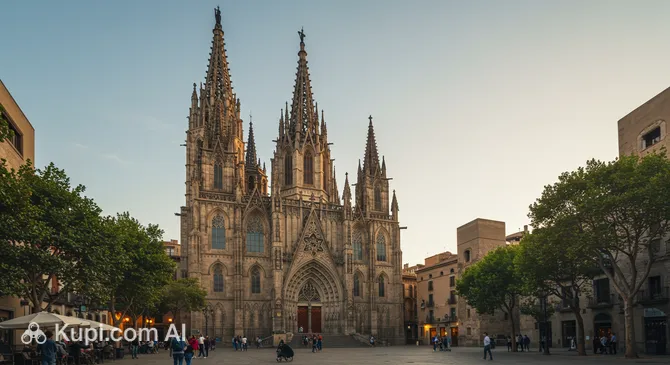
Barcelona Cathedral. Illustration.
Source: Kupi.com AI

Traveler photos:

The cathedral is an outstanding example of Catalan Gothic architecture. Its design, based on a three-aisle structure with a dominant central nave, became a model for many other churches in the region. Construction lasted over 150 years, from 1298 to 1448, resulting in a harmonious and monumental structure. Despite its venerable age, the cathedral is beautifully preserved, and today visitors can admire its authentic medieval beauty.

Of special significance to believers and history buffs is the cathedral crypt, which houses the relics of Saint Eulalia—the young patron saint of Barcelona who suffered martyrdom in the 4th century. Her story and purity are symbolically reflected in one of the cathedral's most charming details: the internal courtyard, home to thirteen white geese. The number of geese corresponds to the saint's age at the time of her death. A visit to this quiet corner offers a sense of peace and a connection to centuries-old tradition.

Contacts

To plan your visit to the Cathedral, check the latest schedule, or clarify any visiting details, it is recommended to use the official contact information. All necessary information is available on the cathedral's website, and you can also reach out to representatives by phone.

How to contactContact
AddressPcta. de la Seu, s/n, Ciutat Vella, 08002 Barcelona, Spain
Phone number+34 933 42 82 60
Websitecatedralbcn.org

What to Do

A visit to Barcelona Cathedral is an opportunity to see and feel the city's centuries-old history firsthand. Your introduction to the cathedral begins with its external Gothic architecture. The main facade, with its delicate spires, is particularly striking; despite the medieval appearance of the entire building, this section was only completed in the late 19th and early 20th centuries. Once inside, you can fully appreciate the grandeur of the interior, reflecting the rich history of this iconic religious site.

Be sure to descend into the cathedral crypt, where the relics of Saint Eulalia, the city's patron saint, have been kept since the 14th century. This place possesses a special atmosphere of tranquility and historical depth. Afterward, make sure to visit the famous cloister—a quiet inner courtyard designed with the help of architect Bertran Riquer. Here, in the shade of palms and magnolias, you can relax by the fountain and enjoy the serenity while watching the famous white geese, which symbolize the saint's purity.

Beyond its architectural and historical treasures, the cathedral offers other experiences. As it is an active church, visitors can attend services, allowing for a deeper sense of the city's spiritual life. If you don't plan to participate in the services, you can simply sit on the benches, soaking in the peaceful atmosphere and examining the numerous interior details: from the stained glass and 25 chapels to the carved wooden choir stalls. It is a wonderful opportunity to take a break from the city bustle and touch eternity.

Getting There

The Cathedral is located in the heart of Barcelona, in the Gothic Quarter, making it easily accessible from anywhere in the city. Thanks to its central location, the cathedral can be reached in many ways, including public transport and pleasant walks through historical streets. It is the perfect starting point for exploring the Old City.

The most convenient and fastest way to reach the cathedral is by metro. The nearest station, Jaume I, is on the yellow line L4 and is located just a few minutes' walk from the landmark. You can also take the Liceu station (green line L3) or Catalunya (lines L1 and L3); a walk from these will take about 10–15 minutes and allow you to enjoy the atmosphere of La Rambla. Additionally, many city buses stop in this area, and the Hop-on Hop-off tourist bus has a "Catedral - Gòtic" stop in the immediate vicinity.

If you prefer comfort, you can use a taxi or ride-sharing services. However, keep in mind that many streets in the Gothic Quarter are pedestrian-only. Because of this, a car likely won't be able to drop you off right at the cathedral entrance, and the driver will leave you on the nearest accessible street. Therefore, walking from central squares, such as Plaça de Catalunya, is often not only possible but the most enjoyable way to arrive, allowing you to fully immerse yourself in the charm of the old city.

Nearest city: Barcelona

History & Facts

The history of Barcelona Cathedral dates back to antiquity, making it not just a temple but a true historical chronicle. The site on which it stands was sacred long before the Gothic spires appeared. The first Christian temple was built here as early as the 6th century, but it was destroyed in the 10th century. Later, in the 11th century, a second, Romanesque cathedral was erected on the same spot. Fragments of that very building were used in the construction of the current, third cathedral, which was founded on the site of an ancient Visigothic chapel and a basilica dedicated to Saint Eulalia. Thus, every stone here holds the memory of different eras.

The main construction of the modern Gothic cathedral began in 1298 and continued for more than a hundred years, until 1420. Several generations of architects worked on its creation, including masters such as Jaume Fabre, Bertran Riquer, and Arnau Bargués. By the 15th century, the main part of the grand building was completed, yet its appearance was still different from what we see today. One of the most surprising facts is that the cathedral stood for several centuries without its main facade.

The Cathedral acquired its famous and impressive look only in the late 19th and early 20th centuries. It was then that the magnificent main facade with its ornate towers and central spire, which now overlooks Cathedral Square (Pla de la Seu), was finally completed. These elements were designed in the Neo-Gothic style but harmoniously complemented the building's medieval foundation. Thanks to this final touch, the cathedral became not only a spiritual center but also one of Barcelona's most recognizable architectural symbols, combining authentic Gothic with a later, yet equally elegant, interpretation.

Time Needed

When planning a visit to Barcelona Cathedral, you should allow for approximately 1–2 hours. This is generally enough time for a leisurely tour of the main areas: the majestic central nave, the famous cloister courtyard with its white geese, and the crypt of Saint Eulalia. Such a visit will provide a complete impression of the scale and beauty of this Gothic masterpiece.

If you wish to explore the cathedral in more detail, your visiting time may increase. Climbing to the roof deserves special attention and you should set aside an additional 30–40 minutes for it. From there, you can enjoy a magnificent panoramic view of the Gothic Quarter. Extra time will also be needed to view the carved choir stalls, the numerous chapels, and to visit the cathedral museum. Therefore, for a full and thoughtful immersion into the history and art of the cathedral, it is best to budget up to 2.5 hours in your plans.

Working Hours

Barcelona Cathedral is open for tourist visits almost year-round; however, opening hours may vary depending on the day of the week and religious holidays. Generally, the cathedral is accessible to tourists Monday through Friday from 9:30 am to 6:30 pm, and on Saturdays from 9:30 am to 5:15 pm. On Sundays and public holidays, the time for cultural visits is usually shorter and takes place in the afternoon, roughly from 2:00 pm to 5:00 pm. Please note that entry for tourists closes 30–45 minutes before closing time.

While entry to the main part of the cathedral may be free during certain hours designated for prayer, a full tourist visit—including the choir stalls, roof access, and the chapter hall—requires a ticket. Booking tickets online in advance is not strictly mandatory but is recommended, especially during high season, to avoid queues. As the cathedral is an active church, the schedule is subject to change. Before your visit, we strongly advise checking the latest opening hours and ticket prices on the cathedral's official website.

DayOpening hours
Monday9:30 – 17:45
Tuesday9:30 – 17:45
Wednesday9:30 – 17:45
Thursday9:30 – 17:45
Friday9:30 – 17:45
Saturday9:30 – 17:15
Sunday2:00 – 16:30

Nearby

A visit to the Cathedral is just the beginning of your journey through the historical heart of Barcelona. The cathedral is the jewel of the Gothic Quarter, and a walk through its surroundings can significantly enrich your experience. This area is a labyrinth of narrow cobbled streets, hidden squares, and ancient buildings, each with its own story to tell.

To better plan your walk after visiting the cathedral, take a look at the list of nearby points of interest. Many iconic landmarks, as well as cozy cafes and restaurants, are just a few minutes' walk away, making it easy to combine your cultural program with some relaxation.

NameDistance
Bishop's Bridge0.1 km
Palace of Catalan Music0.4 km
Picasso Museum0.4 km
El Xampanyet0.5 km
Colom Restaurant0.5 km
Cañete0.6 km
Palau Güell0.6 km

Have you reached the end of the page?

So the route has been studied inside and out