Support

Montjuïc Castle

About

At the top of the hill of the same name, at an altitude of 173 meters above sea level, proudly stands Montjuïc Castle (Castell de Montjuïc)—one of the most significant and recognizable landmarks in Barcelona. This monumental fortress is an integral part of the history and landscape of both the Catalan capital and all of Spain.

The castle is an ideal vantage point. From its powerful walls, some of the best panoramic views of the urban skyline, the busy port, and the endless Mediterranean Sea unfold. The fortress is surrounded by a large park area, which has become a favorite spot for leisurely walks and relaxation for both tourists and locals.
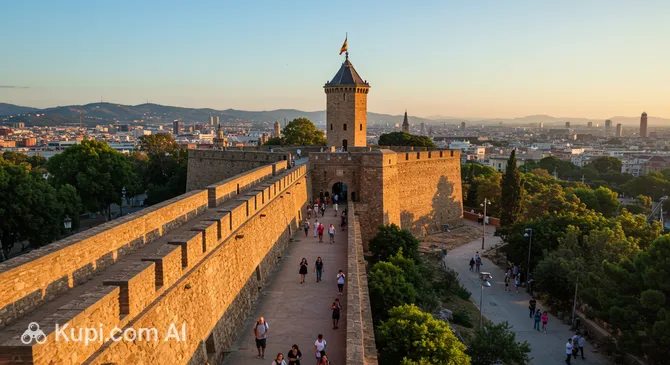
Montjuïc Castle. Illustration.
Source: Kupi.com AI

Traveler photos:

Montjuïc is not just an old fortification but a true symbol of the city and a vital element of cultural heritage. Its powerful walls and bastions, construction of which began as early as 1640, hold the memory of the region's rich and multifaceted past. The fortress has witnessed many key events in Barcelona's history.

Today, Montjuïc Castle lives a new life as a popular public and cultural space. It houses a museum and regularly hosts temporary exhibitions, concerts, and other events. This makes a visit to the fortress interesting for travelers of all ages who want to touch history and enjoy magnificent landscapes.

Contacts

To plan your visit to Montjuïc Castle, check the current opening hours, ticket prices, and the schedule of upcoming events, it is recommended to use the official fortress website. This is the most reliable source of information for travelers.

How to contactContact
AddressCtra. de Montjuïc, 66, Sants-Montjuïc, 08038 Barcelona, Spain
Phone number+34 932 56 44 40
Websiteajuntament.barcelona.cat

What to Do

The main reason visitors ascend to Montjuïc Castle is undoubtedly the breathtaking panoramic views. From its observation decks and massive walls, you get one of the best panoramas of Barcelona. You can see the bustling seaport, the city blocks, and the endless Mediterranean Sea in detail. It is the perfect place to take stunning photos to remember your trip and simply relax while enjoying the moment.

Beyond the impressive views, there is much to see inside the fortress. While the large military museum that operated here since 1963 was closed after the castle was transferred to the city, a visitor center with a permanent exhibition dedicated to the site's history remains open. Additionally, Montjuïc Castle is now an important cultural space. On its grounds, especially in the central parade ground, temporary exhibitions, concerts, and other community events are frequently held.

Don't rush to leave the hilltop after exploring the castle itself. Surrounding the fortress are picturesque gardens and parks, which are wonderful places for a stroll. The former defensive moat has been transformed into a well-kept garden, and on the slopes of the hill, you can find cozy spots for a picnic or simply rest in the shade of the trees, away from the city's hustle and bustle.

Getting There

There are several ways to reach Montjuïc Castle, located at the top of the hill, each interesting in its own way. Your choice depends on your preferences: whether you want to enjoy the views from above, take a leisurely stroll, or arrive quickly and comfortably.

The most popular and scenic route is a combination of the funicular and cable car. First, take the metro to Paral·lel station (lines L2 and L3), where you can transfer directly to the Montjuïc Funicular (Funicular de Montjuïc). It will take you up the hillside to the base of the Telefèric de Montjuïc cable car. The ride in a glass cabin offers unforgettable panoramic views of the city and port, dropping you off almost at the fortress gates.

A more budget-friendly option is public transport. Bus No. 150 departs regularly from Plaça d’Espanya and goes directly to the castle. This is a convenient way to reach the summit without any transfers. For those who enjoy active recreation, there is also the option to hike up to the fortress. The route passes through the scenic trails of Montjuïc Park and takes about 30–40 minutes. This walk allows you to not only enjoy nature but also discover many cozy corners and viewpoints along the way.

Nearest city: Barcelona

History & Facts

The history of Montjuïc Castle dates back long before the fortress itself was built. The first mentions of structures on the hilltop date to the 11th century, when a watchtower was erected. Its primary task was to monitor the sea and signal ships heading to the port of Barcelona. This modest structure at a strategically important height marked the beginning of centuries of military history for this site.

A turning point came in 1640 during the "War of the Reapers"—a Catalan uprising against the Spanish Habsburgs—when there was an urgent need to protect the city. The old tower was rapidly transformed into a military fortress; according to some records, this work took only 30 days. In the following decades and centuries, the castle played a key role in many armed conflicts, including the War of the Spanish Succession in the early 18th century. Interestingly, due to its commanding position, the fortress was used not only to defend Barcelona but also to bombard the city to suppress uprisings.

The castle acquired its modern appearance with powerful bastions and a deep moat following a large-scale reconstruction completed by the end of the 18th century. However, the 20th century added dark chapters to its history: the fortress was used as a military prison, particularly during the Spanish Civil War and the period that followed. Political prisoners were held here, and in 1940, the head of the Catalan government, Lluís Companys, was executed on its grounds. Only in 1963 was the castle partially demilitarized with the opening of a military museum, and in 2007, it was fully transferred to the city authorities, beginning a new life as a cultural and community center.

Time Needed

To fully explore Montjuïc Castle, it is recommended to set aside 1.5 to 3 hours. This is enough time to walk through the entire fortress territory without rushing, climb its walls and bastions, enjoy magnificent panoramic views of Barcelona and the port, and view the internal exhibits. This time allows you not only to study the historical part but also to take memorable photos and simply relax, soaking in the atmosphere of this iconic site.

If you are short on time, a quick tour of the central courtyard and main viewpoint can take about an hour. However, for a deeper dive, plan for more time. Viewing the permanent exhibition on the castle's history, walking through the former defensive moat turned into a garden, and exploring every corner of this massive structure will take at least two hours. Note that this does not include travel time to the castle, which, depending on your chosen method, can also be an exciting part of your adventure.

Working Hours

Montjuïc Castle is open to visitors year-round, though its hours change depending on the season. During the summer period, from March 1 to October 31, the fortress is open from 10:00 to 20:00. In the winter season, from November 1 to February 28, the hours are reduced to 10:00–18:00. It is important to note that ticket offices close 30 minutes before the complex shuts. The fortress is closed only two days a year: December 25 and January 1.

While tickets can be purchased on-site, it is recommended to buy them online in advance to save time and avoid lines, especially during peak tourist season. For budget travelers, there is a nice bonus: entry to the castle is free every Sunday after 15:00, as well as all day on the first Sunday of every month. Nevertheless, it is always worth checking the official website for up-to-date information before your visit, as the schedule may change due to special events.

10:00 – 20:00

Nearby

Visiting Montjuïc Castle is just one part of an exciting journey across the hill of the same name. To fully appreciate this iconic site in Barcelona, it is worth spending time in its surroundings. Montjuïc Hill is not just a high point with a fortress; it is an entire complex of parks, gardens, museums, and Olympic sites, each deserving of attention.

A walk around the castle area will allow you to discover many interesting places located within walking distance. You can enjoy art, stroll through picturesque gardens, or touch the city's sporting history. Below is a list of nearby attractions to help diversify your itinerary and enrich your experience in Spain.

NameDistance
National Art Museum of Catalonia1.1 km
Cañete1.9 km
Palau Güell1.9 km
Colom Restaurant2.1 km
Bishop's Bridge2.4 km
El Xampanyet2.8 km
Picasso Museum2.8 km

Have you reached the end of the page?

So the route has been studied inside and out