Support

MUHBA Turó de la Rovira

About

On Turó de la Rovira hill, overlooking Barcelona, sits one of Spain's most unusual cultural sites—MUHBA Turó de la Rovira. This is not just a viewing platform, but an open-air museum and part of the Barcelona History Museum (MUHBA), officially opened in 2011. The uniqueness of this place lies in its combination of breathtaking panoramic city views with a deep immersion into the city's complex 20th-century history.

This space tells two important chapters in the city's life. First, there are the traces of the anti-aircraft battery that defended Barcelona during the Civil War. Second, it preserves the memory of the post-war period, when an informal shantytown known as "Els Canons" (Catalan for "The Cannons") emerged on the same site. Visitors can see the remains of defensive structures and traces of former dwellings, making history almost tangible.

Today, MUHBA Turó de la Rovira is a carefully restored historical space where you can not only enjoy one of the best views of the city but also better understand its past. This is a place where history literally lies beneath your feet. A visit to the museum allows you to see the city from a new, unexpected perspective, realizing the events that have shaped its appearance over the decades.
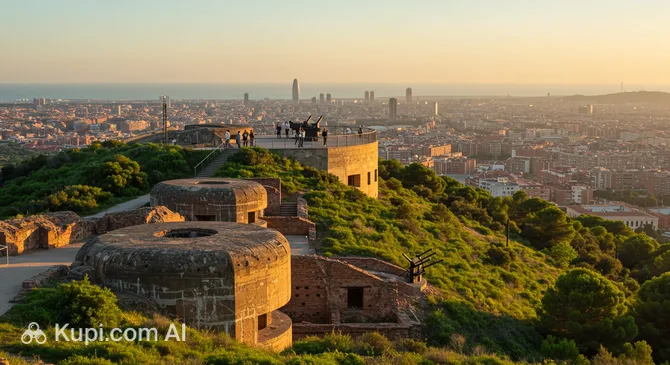
MUHBA Turó de la Rovira. Illustration.
Source: Kupi.com AI

Traveler photos:

Contacts

Since MUHBA Turó de la Rovira is part of the Barcelona History Museum (MUHBA), it is recommended to check the official website for the most up-to-date information on opening hours and events. Below are the main contact details that may be useful when planning your visit.

How to contactContact
AddressCarrer de Marià Labèrnia, s/n, Horta-Guinardó, 08032 Barcelona, Spain
Phone number+34 932 56 21 22
Websitewww.barcelona.cat

What to Do

A visit to MUHBA Turó de la Rovira offers a unique combination of historical discovery and aesthetic pleasure. The main activity here is exploring the remains of the defensive structures. You can take a close look at the anti-aircraft gun emplacements that once defended Barcelona and even descend into the underground bunker spaces. This literally lets you touch history and imagine the conditions people faced during air raids. Additionally, there are information panels and exhibits throughout the site detailing the Spanish Civil War and the city's post-war life.

Inside the museum pavilions, such as the Officers' Pavilion and the Troops' Pavilion, there is an exhibition called "Barcelona to the Limit." it covers in detail not only the period of the bombings but also subsequent urban development, including the history of the informal settlements that arose on the hill. The displays talk about life in the city and its growth since the 1960s, helping to better understand the modern face of the Catalan capital.

Beyond the historical exhibits, one of the main reasons to visit this site is the magnificent panorama of the city. The hilltop offers a breathtaking 360-degree view, allowing you to see all of Barcelona's iconic landmarks: from the Sagrada Família and the Agbar Tower to Montjuïc and the Mediterranean Sea. Many visitors come here to have a picnic, take impressive photos, or simply enjoy the sunset over the city, making a visit to MUHBA Turó de la Rovira an unforgettable experience.

Getting There

Reaching MUHBA Turó de la Rovira is a small adventure in itself, as the museum is located at the top of a hill. However, the effort is well worth it for the stunning views. The main ways to reach this historic site are by public transport, taxi, or on foot for those with more stamina.

The most popular way is to use Barcelona's public transport. You can take the metro Line L4 (yellow line) to Alfons X station. From there, you can either walk for about 25–30 minutes, following the signs uphill, or take a bus. You can also take buses No. 24 or No. 92, which stop closer to the hill. For example, route No. 24 runs from Plaça de Catalunya via Passeig de Gràcia, making it convenient for tourists. In any case, be prepared to cover the final part of the journey on foot up a steep slope.

If you prefer comfort or are traveling with young children, a taxi or ride-sharing service is a convenient option. A driver can drop you off much closer to the top than public transport stops, minimizing the need for a long climb. This is especially relevant in hot weather. Just tell the driver "Bunkers del Carmel" or "Turó de la Rovira," and you will be taken almost to the entrance of the viewing platform.

Nearest city: Barcelona

History & Facts

The history of Turó de la Rovira hill dates back to ancient times, long before the famous bunkers appeared. This site has been continuously inhabited since the Iberian era (4th century BC). In 1932, archaeologist Josep Colominas i Roca conducted excavations here and discovered the remains of an ancient settlement, including part of a wall and other artifacts confirming the rich past of this height. Thus, even before the hill gained strategic importance in the 20th century, it was already an important part of the region's history.

A key turning point in the history of Turó de la Rovira occurred during the Spanish Civil War. The republic's anti-aircraft defense authorities determined that, thanks to its location and panoramic views, the hill was an ideal site for building an anti-aircraft battery. This battery played a vital role in protecting Barcelona from air raids, becoming one of the key elements of the city's defense system. The remains of these powerful structures are still the main historical evidence of those dramatic events today.

After the war ended, the abandoned structures did not remain empty. They served as a refuge for people, and a shantytown known as "Els Canons" (The Cannons) grew spontaneously around them, lasting until the 1990s. In 2010, this historical space was fully restored and opened to the public as part of the Barcelona History Museum (MUHBA). In 2014, the area received official status as a protected cultural heritage site, finally securing its role as a unique open-air museum where different eras of city life intertwine.

Time Needed

When planning a visit to MUHBA Turó de la Rovira, you should allow approximately 1.5–2 hours. This is enough time to explore the entire area at a leisurely pace, examine the remains of the anti-aircraft battery, read the informational displays of the open-air museum, and, of course, fully enjoy the panoramic views of Barcelona. During this time, you'll be able to take many impressive photos and feel the unique atmosphere of this historic site.

The duration of your visit may vary depending on personal interests. If you just want a quick look at the city from above, one hour might be enough. However, many visitors prefer to stay longer to leisurely study the museum exhibits or simply have a small picnic. Sunset is an especially popular time to visit, when the city is bathed in warm tones—in this case, a visit can easily take 2–3 hours or more.

Working Hours

When planning a visit to MUHBA Turó de la Rovira, it is important to note that the opening hours of this unique open-air museum can vary depending on the season, and access to the site is now regulated. Entrance to the main viewing platform, known as the Carmel Bunkers, is free. During the summer period (approximately from May to September), the site is open to visitors from 9:00 to 19:30. During the winter months, the hours are shorter, with access open from 9:00 to 17:30. These measures were introduced to preserve the historical heritage and ensure comfort for local residents.

The museum's indoor exhibition pavilions have a more limited schedule, which also depends on the season and is usually limited to specific days of the week. Since exact hours can vary and the viewing platform itself may be temporarily closed due to unfavorable weather conditions, such as high winds, to ensure visitor safety, it is highly recommended to check the most up-to-date information on the official Barcelona History Museum (MUHBA) website before your trip. Advance booking for a standard visit is generally not required but may be necessary for organized guided tours.

DayOpening hours
MondayClosed
TuesdayClosed
Wednesday10:00 – 14:00
ThursdayClosed
FridayClosed
Saturday10:00 – 14:00
Sunday10:00 – 14:00

Nearby

A visit to MUHBA Turó de la Rovira is an opportunity to see Barcelona at a glance, but your exploration of the city shouldn't end with this panorama. Its location at the top of the hill in the Carmel district makes it an excellent starting point for further exploration of the surroundings. Descending back down, you can dive deeper into the atmosphere of the Catalan capital, discovering both world-famous masterpieces and cozy corners hidden from the main tourist routes.

When planning your route, it's worth noting that many iconic landmarks are within a few kilometers. This allows you to combine your historical immersion at Turó de la Rovira with a visit to architectural wonders or simply a pleasant walk through the parks. Below is a list of interesting places nearby that will help make your trip even more fulfilling.

NameDistance
Casa Vicens2 km
CosmoCaixa Science Museum2.6 km
Vivo Tapas2.7 km
Casa Milà2.7 km
Casa Batlló3.1 km
Bobby's Free3.4 km
Bali Spirit Luxury Art Spa3.4 km

Have you reached the end of the page?

So the route has been studied inside and out