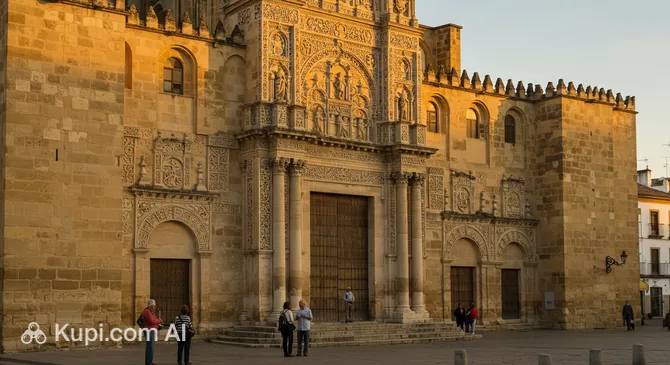
Located in picturesque Córdoba, the Palacio de la Merced (Palace of Mercy) is a magnificent example of Andalusian Baroque. This historic building, once a monastery for the Mercedarian Order, is today an important administrative and cultural hub where spiritual heritage and the modern life of Spain are harmoniously intertwined.
Palace of the Merced. Illustration.
Source: Kupi.com AI
Traveler photos:
The palace's architectural ensemble is striking in its scope: a strict rectangular plan is complemented by an elegant church and spacious covered galleries. The 18th-century building is famous for its red-and-white facade and its magnificent inner courtyard — a cloister considered one of the most beautiful in the region thanks to its harmonious arcades.
Today, the palace is open to visitors not only as an architectural monument but also as a venue for exhibitions and conferences. Its high rating among travelers confirms that this is a must-visit location for those who want to feel the true spirit of southern Spain and see how carefully history is preserved here.
Contacts
For details about special events or temporary exhibitions, you can use the official communication channels.
The highlight of your visit will be the Baroque church, built in the shape of a Latin cross. Inside, pay close attention to the exquisite decoration of the transept and the altar area, which showcase the mastery of 18th-century Spanish architects. The temple's peaceful atmosphere provides a perfect escape from the city noise.
Be sure to look into the inner cloister. Its precise geometric forms and circular arches provide an ideal backdrop for photographs. Here, you can take a slow walk through the galleries, observing the play of light and shadow on the ancient walls. These corridors often host temporary art or historical exhibitions.
Archaeology enthusiasts will enjoy seeing evidence of ancient eras: Roman artifacts and the remains of a Visigothic crypt are preserved on the palace grounds. This combination of different historical layers within a single building makes a walk through the Palacio de la Merced a true journey through time.
Getting There
Finding this architectural monument is easy, as it is located at Plaza de Colón, 15, in the heart of the city. If you are already strolling through the historic quarters, the walk from the famous Mezquita or the Alcázar will take about 15–20 minutes at a leisurely pace.
For those who prefer public transport, several city bus routes stop in the Plaza de Colón area. If you arrive in the city by high-speed train, the journey from AVE Córdoba-Central station to the palace takes about 15 minutes on foot or just a few minutes by taxi.
Arriving by private car can be challenging due to the limited number of parking spaces in the city center. The best solution is to leave your car in one of the park-and-ride lots and enjoy a walk to fully experience the atmosphere of the ancient streets.
Nearest city: Cordoba
History & Facts
The history of this site dates back to ancient times. Archaeological excavations on the grounds have uncovered Roman foundations and fragments of a medieval baptistery. It is believed that the Visigothic Basilica of Saint Eulalia once stood here, dating back to the 6th century during the reign of King Reccared I.
The founding of the monastery itself is traditionally associated with St. Peter Nolasco. After King Ferdinand III of Castile reconquered the city in the 13th century, he granted the remains of the ancient basilica to the Mercedarian Order. However, the majestic appearance we see today was acquired much later — in the 18th century, when a large-scale Baroque reconstruction began.
Construction of the palace's main church took place from 1716 to 1745, and the magnificent inner courtyard (cloister) was completed in 1752. Over the centuries, the building transitioned from a religious residence to an administrative center, while maintaining its status as one of the most important monuments of Andalusian heritage.
Time Needed
For a thoughtful tour of the complex, 1–2 hours is usually sufficient. This time is enough to admire the facade, step into the courtyard, see the church interiors, and browse any current cultural exhibitions.
If you plan to study the archaeological finds in detail or happen upon a temporary exhibition, your visit may last longer. In any case, this site fits perfectly into a morning itinerary before lunch at one of the nearby restaurants.
Working Hours
When planning your visit, keep in mind that the palace operates primarily in the first half of the day on weekdays. The building is open to visitors from Monday to Friday, 09:00 to 14:00. The complex is closed to tourists on Saturdays and Sundays.
Day
Working hours
Monday
9:00 – 14:00
Tuesday
9:00 – 14:00
Wednesday
9:00 – 14:00
Thursday
9:00 – 14:00
Friday
9:00 – 14:00
Saturday
Closed
Sunday
Closed
Nearby
Its central location makes a visit here an excellent starting point for further exploration of the region's culture. Many iconic sites are concentrated nearby, helping you form a complete picture of Andalusia's history.
A walk through the surrounding area will allow you to see both ancient ruins and magnificent examples of Medieval and Renaissance architecture, all within walking distance.