Support

La Graciosa

About

La Graciosa is a true hidden gem of the Canary archipelago and a place where time seems to have stood still. This small island, administratively part of Spain, offers travelers an experience that is radically different from the bustling resorts of the neighboring islands. An atmosphere of absolute tranquility, seclusion, and harmony with wild nature reigns here.

Geographically, the island is located just a few kilometers north of Lanzarote, separated from it by the El Río strait. The climate here is mild and sunny year-round, making it perfect for a holiday in any season. La Graciosa is the most sparsely populated of the region's inhabited islands, with a population of only about 750 people. Almost all residents live in the cozy fishing village of Caleta del Sebo, which serves as the "gateway" to the island.

The main feature that immediately catches the eye is the complete absence of paved roads. Even in the main village, the streets are covered with sand, and there are very few cars. This isolation and loyalty to tradition have preserved a unique way of life, shaped by the historical heritage of La Graciosa over centuries, turning the island into a sanctuary of silence.
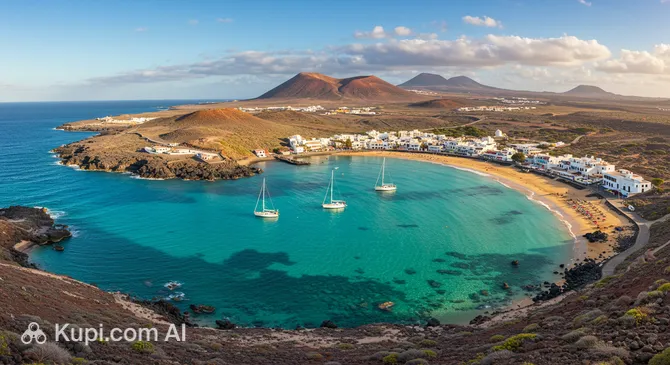
La Graciosa. Illustration.
Source: Kupi.com AI

Tourists are drawn here primarily by the incredible natural beauty. The entire island is a protected natural area, famous for its golden beaches and crystal-clear water, which is ideal for snorkeling and swimming. Popular activities include catamaran trips, cycling along deserted trails, and lunches featuring the freshest seafood with views of the Atlantic.

If you dream of escaping the urban bustle, forgetting about traffic, and dissolving into the sound of ocean waves, La Graciosa will be your ideal refuge. This place is worth visiting to feel like an explorer and enjoy a luxury that is rare these days — absolute silence and the beauty of an untouched world.
Weather Overview

The climate of La Graciosa can safely be called one of the mildest and most stable in the world. The island delights guests with sunny weather almost year-round, reminiscent of eternal spring. Thanks to the influence of the Atlantic Ocean, there is no exhausting heat in summer or piercing cold in winter. The detailed weather in La Graciosa will help you choose the ideal dates for your trip, although it is almost impossible to go wrong with the season here.

The winter months, from December to February, bring comfortable coolness with average temperatures around 17–18°C. Nights remain mild, with temperatures rarely dropping below 16°C. Precipitation occurs at this time of year, but it is brief: usually only 2–3 rainy days per month are recorded. Spring on the island passes smoothly, with the air gradually warming to 19°C by May, and the probability of rain tends toward zero.

Summer and early autumn are the warmest times. From June to October, the average air temperature stays in the range of 20–22°C, peaking in August and September (around 23°C during the day). Expect a dry, sunny summer without precipitation and very mild winters with variable cloudiness. Even in November and December, it is warm enough here for walking and enjoying nature, with temperatures at a comfortable 19–20°C.

Average monthly temperature

Average monthly precipitation

Interesting Facts

In addition to its main attractions, La Graciosa holds many fascinating features that make this island truly unique. Here, nature dictates its own rules, and the usual way of life gives way to traditions and harmony with the environment.
  • An island without asphalt. La Graciosa is the only inhabited island in the Canary archipelago where paved roads are completely absent. Movement here is carried out exclusively along sandy paths, which not only emphasizes its status as a biosphere reserve but also gives any journey the spirit of a real adventure.

  • Largest marine reserve. The island is part of the Chinijo Archipelago Marine Reserve — the largest protected marine area in Europe. The waters around the island are characterized by incredible biodiversity, attracting snorkeling enthusiasts, while rare species of seabirds find refuge on land.

  • A muse for creators. The island's unusual landscapes, combining rugged volcanic hills and golden sand beaches like the famous Playa de las Conchas, serve as a source of inspiration for many artists and photographers. The contrast of the emerald Atlantic waters and the desert-like landscapes creates a unique palette.

  • A fisherman's soul. Despite its popularity with tourists, La Graciosa still retains the atmosphere of an old fishing village. The main occupation of local residents remains fishing, and traditional boats can often be seen on the streets of Caleta del Sebo, with the fresh catch delivered daily to the kitchens of local homes and restaurants.

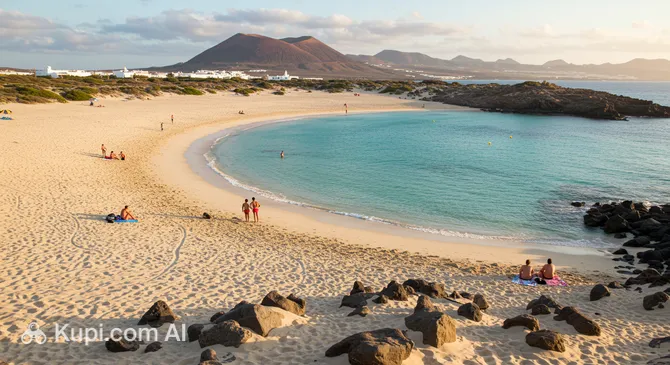
Playa de las Conchas. Illustration.
Source: Kupi.com AI

Traveler photos:

How to Get There

Getting to the secluded island of La Graciosa is a small adventure in itself. Since there is no airport on the island and no roads connecting it to the mainland, the path here always lies through the neighboring island of Lanzarote. You can find out all the ways to get to the city and the island in more detail, but the main route always includes a flight and a ferry crossing.

The nearest and most convenient hub is Lanzarote Airport (IATA: ACE), located in the city of Arrecife. There is no airport in the town of La Graciosa itself, so tourists fly into Arrecife, which is about 35 km away in a straight line (though the journey by land and water takes longer). From the airport, you will need to take a taxi or bus to the port of Órzola (in the north of Lanzarote), which takes about 30–40 minutes, and then catch a ferry to La Graciosa (another 25 minutes in transit). This is the most popular route for travelers.

Another important transit point can be Gran Canaria Airport (IATA: LPA) in the city of Las Palmas. This is a major international hub receiving many flights from all over the world. It is located on a neighboring island, about 235 km from La Graciosa. If you fly here, you will need to transfer to a domestic flight to Lanzarote or take a long ferry journey between the islands.

For convenience, here is a summary of the main airports in the region:

AirportPassenger trafficDistance
Lanzarote Airport8.7 mln35 km
Fuerteventura Airport6.4 mln96 km
Hassan I Airport255 610235 km
Gran Canaria Airport14.0 mln235 km
Tenerife North Airport6.1 mln290 km

There is no rail service in the Canary Islands, including La Graciosa and neighboring Lanzarote. Due to the complex volcanic terrain and small size of the islands, trains do not run here. The main ground transportation remains buses and taxis, which will take you from the airport building to the ferry terminal in the port of Órzola.

The final stage of the journey is always the ferry. Regular services connect the port of Órzola on Lanzarote and the port of Caleta del Sebo on La Graciosa. Tickets can be purchased in advance online or at the port's ticket office. This is the only way to set foot on the soil of this amazing island.

Main Attractions

The main attractions of La Graciosa are not man-made monuments or grandiose structures, but masterpieces created by the wind, the ocean, and volcanic activity. The entire island is a unique natural park where every beach and every mountain deserves separate attention. A journey here is a chance to see the Canary Islands as they were before the arrival of mass tourism.

The undisputed jewel of the island is Playa de las Conchas, located in the northern part of La Graciosa. This place is stunning in its wild beauty: a wide strip of golden sand contrasts with the azure waters of the Atlantic and the reddish hue of the nearby Montaña Bermeja volcano. From the shore, there are breathtaking views of the uninhabited islands of Montaña Clara and Alegranza. Due to strong currents, swimming here is often dangerous, but a walk along this beach will give you some of the most vivid impressions and photographs of your life.

Playa de las Conchas. Illustration.
Source: Kupi.com AI

Traveler photos:

Another iconic spot that is definitely worth a visit is Playa Francesa (French Beach). It is located on the southern coast, not far from the village of Caleta del Sebo. Unlike the northern beaches, the water here is calm and crystal clear, making it an ideal place for swimming and snorkeling. This is where catamarans and yachts often come to drop anchor in a picturesque bay overlooking the majestic cliffs of neighboring Lanzarote.

Fans of unusual landscapes should head to the foot of the Montaña Amarilla (Yellow Mountain) volcano. It got its name from the unique color of the rock, shimmering from ochre to bright yellow. Nestled next to the volcano is the small beach of Playa de la Cocina. It is a secluded cove protected from the winds by cliffs, where you can enjoy the silence and a sense of complete isolation from the outside world.

One cannot overlook the island's second settlement — Pedro Barba. Today it is more of a vacation village that only comes to life during the holiday season, but its architecture is noteworthy. Neat white houses surrounded by palms and gardens preserve the traditional Canarian style. A walk through the deserted streets of Pedro Barba creates a wonderful sense of calm and allows you to see a different, more private side of life on La Graciosa.

Local Cuisine

The culinary life of La Graciosa is a real treat for lovers of seafood and authentic island simplicity. Since fishing has remained the main occupation of locals for centuries, the menu is based on the freshest fish and octopus, caught literally just off the island's shores. In local taverns, you will be offered Atlantic treasures prepared without frills to preserve their natural flavor — most often grilled or in the form of hearty stews.

Among the main dishes that are definitely worth trying is the traditional Canarian seafood paella. This filling dish is so popular that it is often prepared right on board catamarans during boat trips. An integral part of any meal is the famous side dish "papas arrugadas" — small potatoes boiled in their jackets in very salty water until a crust forms. They are served with the signature mojo sauce: red (spicy) or green (herb-based).

All the island's gastronomic life is concentrated in the village of Caleta del Sebo. Here you can find cozy establishments like the bar Rosa La Lia, where it's pleasant to have a snack after a day at the beach. Gourmets should also pay attention to the stewed fish dish "salmorejo" and unusual seaweed salads that occasionally appear on menus.

As for drinks, the perfect accompaniment to the local food is a glass of ice-cold sangria or local beer, which is very refreshing on a hot day. Canarian wines, often brought from neighboring Lanzarote, are also popular here. The food culture on the island is very informal: there are no pretentious restaurants with dress codes. Tourists and locals eat side by side in simple cafes, often at tables standing right on the sand.

If you're lucky, you might catch one of the gastronomic festivals that periodically take place on the island. On such days, locals organize outdoor feasts, treating guests to their best dishes. Additionally, in popular spots like Casa Enriqueta, or at small impromptu markets, you can find delicious homemade cheeses, fresh vegetables, and fragrant honey.

Travel Tips

La Graciosa is an island where civilization gives way to wild nature, and gold sand replaces asphalt, so preparing for a trip here is more important than anywhere else. To ensure your holiday goes smoothly and without logistical difficulties, we have gathered the main recommendations to help you quickly adapt to the unique rhythm of life in this protected corner.

  1. Clothing and Essentials: forget the heels. The main rule of the wardrobe on La Graciosa is maximum comfort. Since all the streets and roads are sandy, the only correct choice is comfortable sneakers, trainers, or sports sandals; high-heeled shoes are absolutely useless here. Given the constant Atlantic winds, even in summer, it's worth bringing a light windbreaker or hoodie for the evenings. Also mandatory are a wide-brimmed hat (there is little shade on the island) and sunscreen with a high protection factor.

  2. Transport: bicycles instead of cars. There is no usual car rental (Rent-a-Car) on the island, and your own car cannot be brought here without a special permit. The best way to get around is to rent a mountain bike (or e-bike) at rental points in the port. For trips to remote beaches, use licensed jeep-taxis, but agree on the return transfer time in advance, as "catching" a car on a wild beach is impossible.

  3. Finances: cash is your best friend. The currency is the Euro. Although many restaurants and shops in Caleta del Sebo have terminals, connectivity on the island can be intermittent, making card payments impossible. There are very few ATMs on the island (usually only one or two), and they may run out of cash. Always have a supply of bills, especially for paying for taxis and small purchases. Tips of 5–10% are welcome but remain at your discretion.

  4. Health and Safety: personal first aid kit. There is a pharmacy and a first aid point on the island, but their working hours may be limited, and the assortment basic. We strongly recommend bringing necessary medications, motion sickness pills (for the ferry), and band-aids. In terms of crime, the island is absolutely safe; the main threat is nature: be careful with strong ocean currents and do not overestimate your strength when swimming.

  5. Communication and Connectivity. The main language is Spanish. Staff in the tourism sector often speak basic English, but knowing simple phrases like "Hola" (Hello) and "Gracias" (Thank you) will endear you to the locals. Wi-Fi is available in most apartments and cafes, but mobile internet in remote parts of the island (for example, near Mount Amarilla) can disappear. We recommend downloading offline maps of the area in advance.

  6. Local Etiquette: "Slow life." Life on La Graciosa flows very slowly. It is not common to rush, shout loudly, or demand instant service. Be polite, greet passersby in the village, and respect the silence. Locals value the tranquility of their home, so noisy street parties are not accepted here.

  7. What to Avoid: swimming in prohibited areas. The most common mistake tourists make is attempting to swim at Playa de las Conchas. Despite its beauty, the currents there are so powerful that it is deadly dangerous even for experienced swimmers (pay attention to the red flags). It is also strictly forbidden to walk on sand dunes outside the paths and to leave any trash — the island is a protected biosphere reserve.

  8. Important Logistics Tip. Outside the village of Caleta del Sebo, there are no shops, water stalls, or toilets on the island. When heading to the beach or for a day-long walk, be sure to buy enough water and food at the port supermarket before heading out. The sun here is active, and the risk of dehydration is high.

La Graciosa offers a rare opportunity to disconnect from the outside world and feel like a real Robinson Crusoe, but with comfort. By following these simple tips, you can avoid minor troubles and fully focus on contemplating the incredible landscapes and the sound of the ocean.

Entertainment & Nightlife

If you are looking for noisy nightclubs, neon signs, and parties until dawn, La Graciosa will surprise you — none of that exists here. Nightlife on the island fully complies with the concept of "slow life." This is a place where entertainment consists of long dinners, leisurely conversations to the sound of the ocean, and contemplating an incredibly starry sky. The main and only center of evening activity is the village of Caleta del Sebo.

All social life after sunset centers around the port and the few sandy streets of the village. There is no strict division between restaurants, bars, and clubs. Most establishments function as universal meeting places: people have lunch here during the day and gather in the evening to drink wine or local beer. The atmosphere is extremely informal and relaxed. There is no dress code whatsoever: shorts and sandals are appropriate everywhere, and high heels would simply be inconvenient on the sandy streets.

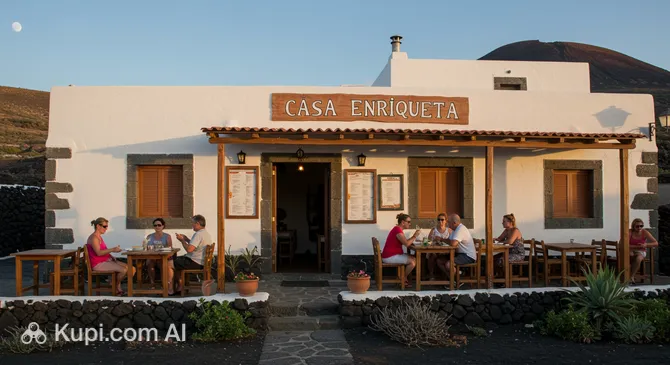
For a pleasant evening, it's worth stopping by Casa Enriqueta. This establishment is popular with both locals and tourists thanks to its authentic atmosphere and the chance to try traditional snacks in a casual setting. Here you can feel the true rhythm of life of the islanders, which hasn't changed for decades.

Casa Enriqueta. Illustration.
Source: Kupi.com AI

Traveler photos:

Another point of attraction is Rosa La Lia. This place is great for relaxing after a busy day spent on the beaches or hiking. The crowd here is mixed: travelers share their impressions, while locals discuss the day's news. Prices on the island are quite moderate; a glass of wine or beer will cost less than in the major resorts of mainland Spain.

An important feature of La Graciosa at night is the lighting. Street lighting in Caleta del Sebo is soft and dimmed, and outside the village, there is none at all. This is done intentionally to preserve its status as a dark sky sanctuary. Therefore, one of the main "nightclubs" here is nature itself: take a blanket, walk a little away from the houses, and a stunning view of the Milky Way will open up to you.

In terms of safety, La Graciosa is one of the calmest places in the world. You can walk at any time of night without concern. However, remember the practical aspect: taxis do not run at night, and there is nowhere much to go anyway, as everything is within walking distance. Be sure to have a flashlight (or a charged phone) with you if you plan to walk along the water's edge to avoid tripping in the dark. Daytime activities here smoothly transition into evening ones: after a sunset spent at Playa de las Conchas, tourists return to the village to end the day in the peace and coziness of local bars.

Parks & Museums

La Graciosa is a unique case in the world of tourism, where the concept of a "park" covers the entire territory of the island, and the streets and landscapes themselves serve as an open-air "museum." You won't find the usual city squares with benches or huge museum complexes with audio guides here. Instead, the island offers immersion in the pristine nature of a biosphere reserve and an encounter with the living history of the fishing lifestyle.

The main natural attraction is the island's status itself as part of the Chinijo Archipelago Natural Park. This is a protected area where the volcanic landscape meets the power of the ocean. One of the most impressive natural zones of the park is the famous Playa de las Conchas in the north of the island. It's not just a place to sunbathe, but a real natural amphitheater overlooking neighboring uninhabited islands, where golden sand borders the red slopes of the Montaña Bermeja volcano.

Playa de las Conchas. Illustration.
Source: Kupi.com AI

Traveler photos:

Another significant natural area is the surroundings of the Montaña Amarilla volcano. This place attracts travelers with its surreal landscapes: yellow and ochre layers of volcanic rock create an amazing contrast with the turquoise water. A walk here feels like a journey to another planet, where the silence is only broken by the sound of the wind and the surf.

As for cultural institutions, there are no classic museums on La Graciosa; however, the Church of the Virgin del Carmen (Iglesia de la Virgen del Carmen) in Caleta del Sebo serves as a cultural center. This modest temple, with an altar in the shape of a boat, is the heart of the islanders' spiritual life and a tribute to the sea that feeds the locals. Here you can see elements of nautical decor and feel the population's deep connection to the ocean.

Another peculiar "museum" is the tiny Chinijo Museum (Museo Chinijo), which occasionally opens its doors to enthusiasts. While it is more of a small exhibition than a full-scale museum, you can learn about the flora, fauna, and marine life of the reserve, as well as the history of salt mining and fishing in the region. The main exhibition of history and daily life unfolds directly on the sandy streets of the village.

From an architectural standpoint, the settlement of Caleta del Sebo itself is of interest. Its white houses with blue or green shutters, standing right on the sand without asphalt, create a unique ensemble. It is a living monument to Canarian architecture, where the absence of road markings and traffic lights takes us back into the past.

For those who want to feel the authentic atmosphere of the island, we advise not looking for "museum" signs, but visiting local establishments that preserve the spirit of old La Graciosa. For example, the bar Rosa La Lia or the colorful Casa Enriqueta are places where decades of local family histories are hidden behind the walls. Chatting with the residents here will replace any tour, allowing you to learn the legends of the island firsthand.

Getting Around

The public transport system in La Graciosa is unique and fully dictated by the island's status as a natural reserve without paved roads. Here you won't find the usual buses, subways, trams, or shuttle taxis in the classic sense. Transport logistics are adapted to off-road conditions and sandy tracks.

The only type of motorized "public" transport is the licensed jeep-taxis (usually spacious Land Rover Defenders). They are based in the port of Caleta del Sebo and meet arriving ferries. These vehicles operate on fixed routes, taking tourists to remote beaches such as Playa de las Conchas or La Francesa, and also offer sightseeing tours around the island.

The payment system here is as simple and conservative as possible: there are no travel tickets, transport cards, or mobile apps for payment. Payment is made directly to the driver, and preference is given to cash in euros. Although some drivers may have terminals, due to unstable connections in remote parts of the island, you shouldn't rely on cashless payment. The cost of the trip is usually fixed per car or per person depending on the destination.

The most popular alternative to taxis is bicycle rental. Many rental points are located right by the pier and on the main streets of the village. Given the sandy surface of the roads, tourists are offered mountain bikes or models with wide tires (fat bikes), as well as electric bikes, which significantly facilitate movement over the terrain. Rentals are arranged by the day, prices are reasonable, and an identity document is often sufficient for a deposit.

It is important for tourists to remember a few practical rules. First, the number of jeep-taxis on the island is strictly limited. During high season, it is recommended to arrange a transfer immediately upon the ferry's arrival. Second, if you are heading to a distant beach, be sure to agree on an exact return pick-up time with the driver. Mobile service does not work everywhere on the island, and calling a car spontaneously while on a wild beach may be impossible.

There are no usual car-sharing services or classic car rentals (Rent-a-Car) on La Graciosa, and bringing in cars rented on other islands is prohibited. Within the single residential village of Caleta del Sebo, transport is not required at all: all shops, restaurants, and apartments are within walking distance, and movement is carried out exclusively on foot along the sandy streets.

Accommodation

Accommodation on La Graciosa is fundamentally different from what tourists are used to in the major resorts of Spain. Here you will not find huge hotel chains, high-rise buildings with pools, or all-inclusive hotels. All the island's housing is harmoniously integrated into the landscape and consists mainly of private apartments, guest houses, and traditional white cottages. This allows guests to feel not just like tourists, but like temporary residents of this cozy fishing world.

When choosing a place to stay, you have two main location options, each offering a completely different experience:

Caleta del Sebo is the "capital" and heart of the island. This is where the vast majority of travelers stay. The main advantage of this area is its proximity to infrastructure. Since there is no asphalt on the island, dragging suitcases through the sand for long distances can be tiring, so housing near the port is considered the most convenient. All the supermarkets, restaurants, bicycle rentals, and the island's only bank are also located here. Living in Caleta del Sebo allows you to be in the center of things and enjoy the village's evening atmosphere.

Pedro Barba is the island's second settlement, located a few kilometers to the east. This is a former fishing village transformed into an exclusive vacation settlement. Luxurious villas and spacious houses for large groups are rented out here. It is important to note that there are no shops, restaurants, or any services in Pedro Barba. This is a place for those seeking total isolation, silence, and privacy, but who are prepared to reach civilization by jeep-taxi or bicycle.

For lovers of maximum immersion in nature, there is a third option — camping in the Playa del Salado bay. This is the only place on the island where pitching tents is officially allowed. The campsite is free, equipped with showers and toilets, but requires a mandatory advance permit obtained through the official Spanish national parks website. Free camping in other locations (for example, on Playa de las Conchas) is strictly prohibited and punishable by fines.

Booking tips and prices:

The demand for housing on La Graciosa significantly exceeds the supply, especially during the summer months, Easter, and the Christmas holidays. We strongly recommend booking apartments 3–6 months before your trip. Attempting to find a place to stay upon arrival ("on the spot") will most likely end in failure.

The price range varies from medium to high. There are practically no budget hostels here. The cost of renting small apartments starts from 60–80 euros per day, while renting a villa in Pedro Barba can cost several hundred euros. Booking is available through popular international online platforms, but many good options are rented through local real estate agencies or directly by owners, whose contacts can be found on local travel forums.

Nearby Cities

For those who want to explore the surrounding area, La Graciosa serves as an excellent starting point for day trips to several interesting nearby locations:

The absolute leader for a short visit is Arrecife — the capital of the neighboring island of Lanzarote. Located just a few dozen kilometers away (including the ferry crossing and road journey), this city offers a sharp contrast to the silence of La Graciosa. Here, travelers will find historic fortresses like Castillo de San Gabriel, the picturesque Charco de San Ginés lagoon with its fishing boats and restaurants, as well as the opportunity for shopping on León y Castillo street.

Although other major centers of the archipelago, such as Las Palmas on Gran Canaria or Santa Cruz de Tenerife, are located much further away and require a flight or a long sea journey, they remain important cultural landmarks of the region. However, it is Arrecife that, thanks to its proximity, is ideal for leaving in the morning and returning to the seclusion of La Graciosa in the evening.

CityPopulationDistance
Orzola3006 km
Teguise23 41129 km
Arrecife64 49733 km
La Oliva27 94583 km
Puerto del Rosario42 02491 km

These nearby destinations provide insight into the diverse culture and landscapes of the region.

Shopping & Souvenirs

General Overview

Shopping on the island of La Graciosa has little in common with the usual shopping sprees in large tourist centers. Here you will not find brand boutiques, outlets, or chain clothing stores. Trade on the island is primarily oriented toward meeting the basic needs of residents and guests: food, beach supplies, and household goods. Nevertheless, this minimalism gives the shopping process a special charm, allowing you to focus on finding authentic trifles and chatting with friendly sellers in a relaxed atmosphere.

Main Shopping Areas/Streets

All commercial life on the island is concentrated in the single settlement — Caleta del Sebo. There are no designated shopping streets or promenades; small shops are scattered along the sandy roads of the village, mainly in the port area and the central square. Walking through the center, near popular meeting spots like Casa Enriqueta, you will find several supermarkets and shops where you can buy everything needed for a holiday, from fresh fruit to sunglasses.

Shopping Centers

There are no shopping centers or large department stores on La Graciosa. The local trade format consists of small family shops (tiendas), where the assortment can range from fresh bread to fishing gear. If you need serious shopping, a wardrobe update, or electronics, it's better to plan this on the neighboring island of Lanzarote or in the major cities of mainland Spain.

Markets

There are no classic organized markets with rows of stalls in the usual sense here. However, in the mornings at the port, you can find local fishermen offering their fresh catch right from the boats. This is a kind of spontaneous fish market where you can buy ocean treasures caught just a couple of hours ago. Also, in local bakeries (panadería), you can always buy the freshest pastries, which are famous for their quality among tourists.

Souvenirs

Despite the island's modest size, you can bring back unique keepsakes from here. Special attention should be paid to traditional straw hats — "sombrero graciosero", which have protected locals from the scorching sun for centuries. Also popular are ceramic items, jewelry made from shells and volcanic stone, as well as cosmetics based on Canarian aloe vera. Souvenir shops often feature t-shirts and accessories with the island's symbols, which will serve as a great reminder of the trip.

Opening Hours and Payment

Shops on La Graciosa live in the traditional rhythm of the siesta. They are usually open from 9:00 to 13:00 or 14:00, and then reopen in the evening around 17:00 until 20:00. On Sundays, many shops may be closed or work on a significantly reduced schedule. It is extremely important to have cash in euros. Although some supermarkets accept cards, terminals may not work due to connectivity issues, and there are very few ATMs on the island.

Tax Free (if applicable)

The Canary Islands are part of a special economic zone with preferential taxation (IGIC instead of VAT), so prices for many goods here are lower than in continental Europe. However, due to the absence of large stores and expensive brands, the Tax Free refund procedure is practically not applied on La Graciosa itself. The low prices already include this benefit, so issuing special checks on the island is generally not relevant.

Reached the end of the page?

That means the route is fully explored