Support

Plaza de Toros de la Maestranza

About

The Plaza de Toros de la Maestranza, whose full name is the Plaza de Toros de la Real Maestranza de Caballería de Sevilla, is one of the oldest and most revered bullrings in Spain. It is more than just a structure; it is a true symbol of Seville and an integral part of its cultural heritage. Located in the heart of the city on the banks of the Guadalquivir River, the arena attracts visitors with its rich history and unique architecture.

Construction of the arena began in the mid-18th century and lasted nearly 120 years, which is reflected in its majestic appearance. The building is an impressive example of Late Baroque architecture, finished in the region's characteristic white and gold tones. Its facade facing the waterfront and its unusual 30-sided polygonal shape make the Maestranza one of the most beautiful and recognizable structures in the country.
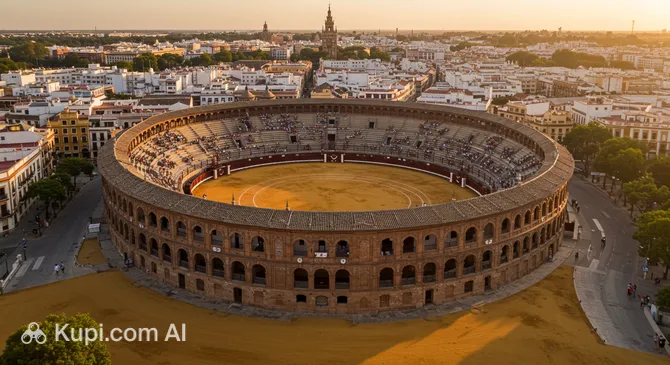
Plaza de Toros de la Maestranza. Illustration.
Source: Kupi.com AI

Traveler photos:

The Maestranza arena remains an active venue today, accommodating up to 14,000 spectators. It hosts the most significant events in the world of bullfighting, particularly during the famous April Fair. Statues of renowned bullfighters stand at the entrance, emphasizing its high status in the culture of tauromachy.

For tourists wishing to dive deeper into the history of this site, the Bullfighting Museum (Museo Taurino) is located on the premises. Its halls display a collection of historical costumes, posters, portraits, and other artifacts telling the story of bullfighting traditions. Of particular interest is a cape painted by Pablo Picasso. Visitors can also take a guided tour of the arena itself, peek into the chapel where matadors pray before a fight, and see other interior areas.

Contacts

For up-to-date information on opening hours, ticket prices, and tour schedules for the Plaza de Toros de la Maestranza, we recommend consulting official sources. You can contact the administration via their official website.

How to contactContact
AddressP.º de Cristóbal Colón, 12, Casco Antiguo, 41001 Sevilla, Spain
Phone number+34 954 21 03 15
Websitevisitaplazadetorosdesevilla.com

What to Do

A visit to the Plaza de Toros de la Maestranza offers a unique opportunity to experience one of Spain's most famous and spectacular traditions. The bullring's main claim to fame is, of course, bullfighting, which takes place here from April to October. This traditional Spanish spectacle draws thousands of spectators, especially during the annual Feria de Abril (April Fair), when the atmosphere at the arena becomes truly unforgettable. Attending such a performance means witnessing a vibrant and emotional event that is a vital part of Seville's culture.

Even if you do not plan to attend a bullfight, the arena offers other ways to explore its rich history. To dive deeper into the world of tauromachy, we recommend visiting the Bullfighting Museum and taking a tour of the arena, both of which were mentioned earlier. This will give you the chance not only to see unique exhibits but also to look into parts of the complex usually hidden from the public, such as the bullfighters' chapel. You can conclude your walk at the entrance, where statues of key figures from bullfighting history are located.

Getting There

The Plaza de Toros de la Maestranza is conveniently located in the historic heart of Seville, in the El Arenal district. It sits on Paseo de Cristóbal Colón, right by the Guadalquivir River. Thanks to its central position, it is easily reachable on foot from most of the city's tourist areas. For instance, a walk from iconic landmarks such as the Seville Cathedral or the Alcázar will take no more than 10–15 minutes.

For those who prefer public transport, several city bus routes stop near the bullring, making the trip quick and accessible from various parts of the city. Additionally, you can always use a taxi, which will take you right to the entrance without any trouble. Another pleasant way to reach the Maestranza is by renting a bike and taking a scenic ride along the waterfront, enjoying the views.

Nearest city: Seville

History & Facts

The history of the Plaza de Toros de la Maestranza is a true saga of construction that spanned more than a century. Work began in 1749 on the site of an old rectangular arena, with major construction starting in 1761 under the direction of architects Francisco Sánchez de Aragón and Pedro Vicente de San Martín. The process dragged on for almost 120 years, and the bullring was finally completed only in 1881. This long construction period is reflected in its unique appearance, which combines grandeur with a rich history.

One of the arena's most remarkable features is the Prince's Box (Palco del Príncipe), built in 1765. It was intended for the Spanish royal family and high nobility, emphasizing the arena's high status from the very beginning. This magnificent box, consisting of two parts—the gates for the bullfighters' entrance and the box itself for honorary guests—remains a central element of the architectural ensemble today. Its creation was a key milestone in shaping the identity of the Maestranza as one of Seville's main symbols.

The construction of the arena was not always smooth and was closely tied to the history of bullfighting in Spain. For example, in 1786, King Carlos III temporarily banned bullfighting, leading to a halt in the work on the arena's sculptural decorations. Despite such difficulties and interruptions, the construction was eventually finished, and the Maestranza evolved into more than just a venue for spectacles—it became a true cultural and architectural monument that has preserved its historical and cultural significance through the centuries.

Time Needed

To fully explore the Plaza de Toros de la Maestranza, visitors usually need 1 to 2 hours. This is typically enough time for a complete tour of the arena and the Bullfighting Museum as part of a standard visit. You will be able to study the architecture without rushing, walk through key areas like the arena floor and the bullfighters' chapel, and immerse yourself in the atmosphere of this iconic site.

Keep in mind that this time does not include attending an actual bullfight. If you plan to see a corrida, the total time spent at the arena will increase significantly depending on the event's duration. Therefore, a couple of hours are sufficient for a standard tourist visit, but a deeper dive into the culture of tauromachy in Seville will require more time.

Working Hours

The Plaza de Toros de la Maestranza and its museum are generally open to the public daily. From April to October, the opening hours are typically from 9:30 AM to 9:00 PM or 9:30 PM, and from November to March, from 9:30 AM to 7:00 PM. It is important to remember that on bullfighting days, which mostly fall on Sundays between April and October, the arena is only open for tours until 3:00 PM. The schedule may also change on public holidays.

To ensure your visit goes smoothly, it is strongly recommended to check the current schedule on the official website immediately before your trip. Tour tickets can be purchased at the ticket office on-site or in advance online, which helps avoid queues, especially during the high tourist season in Seville. Guided tours are available in Spanish and English every 20–30 minutes.

9:30 – 21:30

Nearby

Visiting an iconic landmark like the Plaza de Toros de la Maestranza is a highlight in itself. However, to truly feel the atmosphere of Seville, it is worth spending some time exploring its surroundings. The area around the bullring is rich in historical monuments and interesting sites, all located just a few minutes' walk away.

A stroll through the nearby streets will not only expand your impression of the city but also show you how history and modernity harmoniously coexist in this corner of Spain. Below is a list of nearby attractions that can complement your itinerary.

NameDistance
Bar Postiguillo Tapas0.3 km
Tower of Gold0.4 km
Triana District0.4 km
Puerta de Jerez0.5 km
General Archive of the Indies0.5 km
Filo0.5 km
Seville Apartments0.5 km

Have you reached the end of the page?

So the route has been studied inside and out