Support

Comoros

Cities in the country

About the Country

The Comoros is a charming archipelago in the Indian Ocean, nestled between the east coast of Africa and Madagascar. These so-called "Islands of the Moon" attract travellers with their untouched nature, a unique cultural fusion of African, Arab, and French traditions, and an atmosphere of genuine tranquillity. Impressive volcanic landscapes, lush tropical vegetation, and a pleasant warm climate await guests all year round.

As a member of the Arab League and the Organisation of Islamic Co-operation, the Comoros holds a special significance for travellers from the UAE. The nation's capital, Moroni, is located on the largest island of the archipelago, Grande Comore (Ngazidja). This city is not only the administrative but also the main economic and cultural centre of the country. The official state religion is Islam, and Arabic is one of the three official languages, alongside Comorian and French. Moroni has retained the charm of its old Arab quarters with their narrow, winding streets and colourful markets, where you can fully experience the authentic spirit of the islands and purchase local souvenirs. The local cuisine is a delightful blend of Arab, African, and French influences, with an abundance of fresh seafood and spices, and is inherently halal.
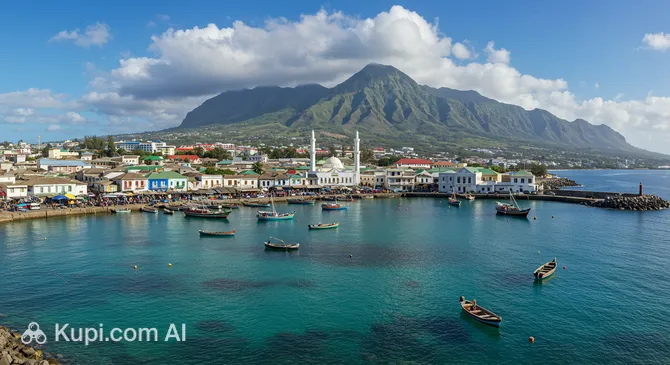
Moroni. Source: Kupi.com Binoculars

The Comoro Islands are a true paradise for enthusiasts of ecotourism and quiet, secluded holidays. Here, you can explore the slopes of the active volcano, Mount Karthala, enjoy relaxing on uncrowded white-sand beaches with crystal-clear water, and go diving or snorkelling among rich coral reefs. Besides the capital, other towns are also worth visiting, such as Mutsamudu on the island of Anjouan, known for its historic centre. The Comoros offers travellers a rare opportunity to discover a truly unexplored and distinctive destination, far from the bustling tourist crowds.

Currency

The national currency of the Comoros is the Comorian franc (KMF). The Comorian franc is pegged to the euro, which provides a degree of stability. Banknotes in circulation are available in denominations of 500, 1,000, 2,000, 5,000, and 10,000 francs. These notes often feature images of local flora, fauna, cultural symbols, or famous figures, reflecting the rich heritage of the islands. Coins are also used for smaller transactions.

It is advisable to exchange foreign currency for Comorian francs at banks or official exchange offices in the capital, Moroni, or other large towns. While the UAE Dirham is convertible, the best foreign currency to carry is the euro, although US dollars are also accepted by some banks. Avoid exchanging money with street money changers due to the risk of fraud and unfavourable rates. Be aware that credit card use in the Comoros is extremely limited and generally only possible in large hotels and with some airlines. Therefore, it is highly recommended to carry a sufficient amount of cash, preferably euros, to cover daily expenses, especially if you plan to travel outside the capital.

Visa Requirements

For citizens of the United Arab Emirates, a visa for the Comoros Islands can be obtained on arrival. This allows UAE passport holders to receive a visa for a stay of up to 45 days directly at the port of entry.

To receive the visa upon arrival, you will need a passport valid for at least six months from your arrival date, a confirmed return or onward ticket, and proof of accommodation. It is also advisable to carry proof of sufficient funds for your trip. For residents of the UAE holding other passports, it is recommended to check the specific visa requirements for your nationality, as you may need to apply for a visa in advance.

Although obtaining a visa on arrival is a straightforward process for many, visa regulations can change. Therefore, it is highly recommended to confirm the latest entry requirements with the nearest diplomatic mission of the Comoros Islands before travelling.

We'll tell you if you need a visa

Specify where you are going, or
Your citizenship
Destination

Time Zones

The official time zone is East Africa Time (EAT), which corresponds to UTC+3. For travellers from the UAE, this means the local time in the Comoros is one hour behind UAE time. The time is consistent across all the islands, including in the capital, Moroni.

How to Get There

The Comoros is an island nation in the Indian Ocean, so the primary and most convenient way to get there is by air. The country's main gateway is Prince Said Ibrahim International Airport (HAH), located near the capital, Moroni. This airport handles the majority of international flights.

For travellers from the UAE, there are no direct flights to the Comoros. However, several airlines offer connecting flights from Dubai (DXB) to Moroni (HAH). Popular options include Ethiopian Airlines, Kenya Airways, and Air Tanzania. The average flight duration with one stop is typically over 10 hours. Flights are also available from other African countries such as Tanzania, Kenya, and Ethiopia, as well as through major European hubs like Paris.

As the Comoros is an archipelago, there is no way to reach it by land. Regarding sea travel, regular international passenger services are not well-developed and do not serve as a primary means of arrival for most tourists. Occasionally, cargo ships sailing to the ports of the Comoros may take passengers on board, but this is an exception rather than the rule. Cruise liners might include the Comoros on their Indian Ocean itineraries, offering a chance to visit the islands as part of a tour package, but this is not a form of regular transport. When planning your trip, especially during the peak tourist season, it is highly recommended to book your flights in advance to secure the best prices and ensure availability.

For clarity, here is a summary of the main airports:

Airport Name City Passenger Traffic
Prince Said Ibrahim International AirportMoroniMedium
Ouani AirportOuaniLow

The Comoro Islands, a charming archipelago of volcanic origin, offer travellers both lively urban centres and secluded resort retreats. The heart of the archipelago is its capital, Moroni, located on the largest island, Grande Comore (Ngazidja). This city serves as the main gateway to the country and attracts tourists with its colourful markets, ancient Medina with narrow, winding streets, and the famous Old Friday Mosque. As a significant place of worship, visitors are reminded to dress modestly when visiting the mosque and its surroundings. Moroni is also an excellent starting point for exploring the island's natural beauty, including its pristine beaches and the active volcano, Mount Karthala.

Moroni. Source: Kupi.com Binoculars

Besides the capital, the Comoros boasts other interesting towns. Mutsamudu, the second-largest town and the main port of the island of Anjouan (Ndzuani), captivates with its historic citadel and picturesque old town. Here, you can immerse yourself in the local culture, which is deeply rooted in Islamic traditions, and enjoy breathtaking views of the harbour. On the island of Mohéli (Mwali), the smallest of the main islands, lies Fomboni, offering a more tranquil and relaxed holiday. This town is the gateway to the Mohéli Marine Park, renowned for its sea turtle nesting sites and rich underwater world, making it a paradise for snorkelling and diving enthusiasts.

Another noteworthy destination is Domoni on the island of Anjouan. This town has a rich history, having been a former capital and an important trading port. Its old-world architecture and quieter atmosphere provide a pleasant contrast to the larger towns of the archipelago. Each of these destinations reveals a unique facet of the Comoro Islands' diverse character, inviting further exploration.

Top Attractions

The Comoros – a volcanic archipelago in the Indian Ocean – captivates travellers with its pristine natural beauty and unique culture. There is something for everyone here, from climbing active volcanoes and relaxing on white sandy beaches to exploring the rich underwater world.

One of the most impressive attractions is Mount Karthala, located on the island of Grande Comore. At 2,361 metres, it is not only the highest point in the Comoro Islands but also one of the world's largest active volcanoes. Ascending Karthala is an unforgettable adventure for trekking enthusiasts, rewarding them with stunning views over the island and ocean, as well as the chance to peer into its enormous crater.

Of course, the Comoros are primarily about heavenly beaches. On the island of Grande Comore, beaches such as Mitsamiouli and Chomoni particularly stand out. They are renowned for their white sand, crystal-clear turquoise waters, and tranquil atmosphere, perfect for relaxation, swimming, and snorkelling.

To immerse yourself in the history and culture of the Comoro Islands, a visit to the Medina in Moroni, the nation's capital, is a must. This ancient Arab quarter is captivating with its narrow, winding alleys, old houses with carved doors, small mosques, and bustling markets where you can find local souvenirs and spices. A stroll through the Medina is a true journey back in time. Visitors should consider dressing modestly when exploring this area out of respect for the local culture and religious sites.

Fans of diving and snorkelling should definitely head to Mohéli Marine Park. As the first national park in the Comoros, it is a vital habitat for green sea turtles that come ashore to lay their eggs. Here, you can also spot dolphins, whales (in season), and marvel at the colourful coral reefs teeming with rich marine life.

Best Time to Visit

Choosing when to travel to the Comoros depends on your preferences and plans. The climate on the islands is tropical maritime, with two main seasons. The high season generally lasts from May to October-November. During this time, the weather is drier and cooler, with air temperatures around +25-28°C, making it ideal for beach holidays, diving, snorkelling, and exploring the islands. The ocean is calm, and underwater visibility is excellent. The downsides can include higher prices for accommodation and more tourists, although the Comoros has not yet experienced excessive tourist numbers.

The low season, or rainy season, runs from December to April. It becomes hotter and more humid during this period, with frequent but usually short-lived downpours, especially in the afternoon. Temperatures can reach +30°C and higher. There is also a risk of tropical cyclones, particularly from January to March. The advantages of this period include fewer tourists, lower prices, and lush, vibrant green vegetation. However, some roads may be washed out, and sea excursions are sometimes cancelled due to the weather. It is worth noting that the islands are particularly picturesque during this wet season.

When planning your trip, also consider local holidays such as Independence Day (6th July) and Islamic festivals like Eid al-Fitr and Eid al-Adha, the dates of which change annually according to the lunar calendar. As the Comoros is a fellow Muslim nation, these periods offer a unique opportunity to witness interesting and familiar cultural events. For nature lovers, certain months may also be more favourable for watching sea turtles, which come ashore to lay their eggs (often from May to October, but it is best to check for the latest information before your trip). Although the climate is similar across all islands in the archipelago, slight local variations are possible. Therefore, it is always useful to check the forecast for the specific island you plan to visit, whether it be Grande Comore with its capital Moroni, Anjouan with the city of Mutsamudu, or Mohéli.

Traditions

The Comoros is a country with deep cultural traditions, where respect for elders and warm hospitality play a key role. When greeting local people, especially those of an older generation, it is customary to show reverence. A handshake is a common form of greeting, particularly between men, often accompanied by warm words and questions about health and family. During a conversation, eye contact is usually maintained and is considered a sign of sincerity. Comorians are renowned for their hospitality; an invitation to their home is a sign of great respect. Although a gift is not strictly obligatory, a small souvenir from your country or sweets for the children will be warmly received. It is customary to offer guests food and drink, and it is considered polite to accept the refreshments.

When visiting the Comoro Islands, it is important to be mindful of dress codes, especially in public places and when entering places of worship. It is recommended to choose modest clothing that covers the shoulders and knees, for both men and women. When visiting mosques, women may be required to cover their heads with a scarf. At the dining table, especially if food is served on a communal dish, it is customary to eat with the right hand. One of the most important holidays is Eid al-Fitr, which marks the end of the holy month of Ramadan and is celebrated with prayers, festive meals, and exchanging visits. To avoid causing offence to local residents, try to avoid public displays of affection, always ask for permission before photographing someone, and remember that the left hand is traditionally considered 'unclean', so you should use your right hand to pass items or food.

Entertainment

The Comoros is a true paradise for lovers of active holidays, especially water sports. The crystal-clear waters of the Indian Ocean create ideal conditions for diving and snorkelling, revealing a magical world of coral reefs and rich marine fauna to travellers. Boat trips and fishing are also popular. For those who prefer adventures on land, the volcanic landscapes of the islands offer fascinating hiking routes, including the opportunity to ascend the active Karthala volcano.

Cultural entertainment in the Comoro Islands is closely intertwined with local traditions. While there may not be large theatres or concert halls in the conventional sense, you can immerse yourself in the authentic atmosphere by visiting local festivals or listening to traditional music. As for shopping, it is mainly centred on colourful markets where tourists can buy unique handmade crafts, aromatic spices, the famous local vanilla, and essential oils, especially ylang-ylang, which is the signature of the islands. The main shopping spots can be found in the capital, Moroni, as well as in other towns such as Mutsamudu.

Nightlife in the Comoros is calm and peaceful, offering a relaxing evening's leisure rather than noisy parties. It mainly consists of dinners in cosy restaurants that serve Creole cuisine and the freshest seafood, often with ocean views. As the Comoros is a predominantly Muslim country, halal food is widely available in most establishments. There are not many loud nightclubs. For a family holiday, the islands offer magnificent, uncrowded beaches where children can play and swim safely, as well as the chance to get acquainted with unique flora and fauna while exploring the natural beauty of the Comoros.

Currency rates

Planning a trip? Wonderful! To ensure the financial aspects of your journey do not come as a surprise, it is important to remember that currency exchange rates are constantly changing. Therefore, we strongly advise monitoring the current rates both before departure and throughout your trip. You can use the data provided below for this purpose; we monitor exchange rates 24/7 and strive to offer the most up-to-date information.

Reached the end of the page?

That means the route is fully explored