Support

Pyrgos

About

Pyrgos is one of the most impressive and atmospheric villages on the island of Santorini, often undeservedly remaining in the shadow of more famous resorts. Built like an amphitheater on the slopes of a hill, this town offers travelers something more than just beautiful photos: here, the spirit of authentic Cycladic life prevails, where time flows at its own special, measured pace. It is a place where medieval architecture harmoniously intertwines with traditional lifestyle, creating a unique atmosphere of comfort and grandeur.

Geographically, Pyrgos occupies a strategically important position in the center of the island, being the highest settlement in Santorini. Thanks to this, it offers breathtaking 360-degree panoramic views: from the vineyards at the foot of the hill to the blue expanse of the Aegean Sea washing the shores for which Greece is so famous. The climate here is typically Mediterranean, but due to the altitude, the air is often fresher than on the coast, making walks comfortable even in the summer heat.

Strolling through the winding cobbled streets, it is impossible not to notice traces of past greatness. Until the beginning of the 19th century, this settlement was the administrative center of the island, and the rich history of Pyrgos still lives within the walls of old mansions. There is none of the bustle typical of Fira or Oia here, allowing you to fully enjoy the authenticity of the moment.
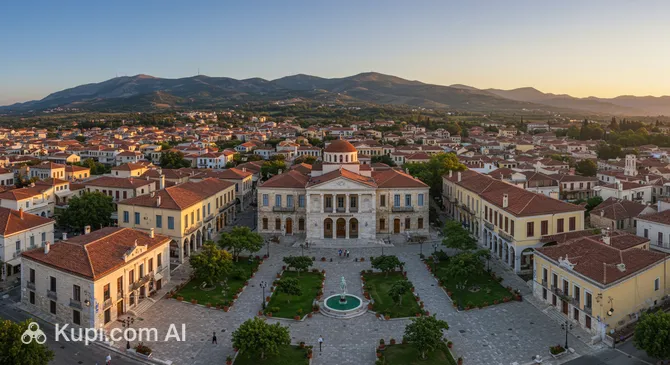
Pyrgos. Illustration.
Source: Kupi.com AI

The heart of the town and its main landmark is the famous Venetian Castle (Kasteli), located at the very top of the hill. Houses are grouped in a tight ring around it, forming a natural fortification that once protected residents from pirates. Another hallmark of Pyrgos is its numerous churches with characteristic blue domes, creating that very recognizable postcard view against the backdrop of whitewashed walls and blue sky.

If you are looking for a place to watch the famous Santorini sunsets in peace and solitude, Pyrgos is an ideal choice. Visit this charming corner to see a "different" Santorini — proud, calm, and infinitely beautiful. This journey will give you memories that will stay with you for a lifetime.
Weather Overview

The climate of Pyrgos can be characterized as typically Mediterranean, making it attractive to visit at almost any time of year. Summer here is hot and sunny: in July and August, the average temperature rises to 26°C, with maximum values reaching 27.6°C. During this period, precipitation is practically impossible — at the height of the season, zero rainy days are recorded, guaranteeing clear skies for your walks and photo shoots.

Winter in the region is mild, without severe frosts, but is characterized by higher humidity. The coolest months are January and February, when the air warms up to an average of 13.2–13.5°C. At this time, you should be prepared for precipitation: for example, in January, there are about 13 rainy days. If you are planning a trip during the shoulder season, detailed weather in Pyrgos will help you choose the best dates, as spring (especially May at 19.4°C) and early autumn offer an ideal balance of warmth and freshness.

Overall, expect a hot dry summer, perfect for a beach holiday, and a moderately cool winter with occasional rain, creating a cozy atmosphere for exploring the architecture.

Average monthly temperature

Average monthly precipitation

Interesting Facts

Beyond the main attractions, Pyrgos holds many fascinating secrets that make it one of the most mysterious and atmospheric places in Santorini. Here are a few facts that will allow you to look at this town in a new way:
  • Lost Capital Status. Many tourists are surprised to learn that it was Pyrgos, not Fira, that was the island's capital until the beginning of the 19th century. This historical status explains the grandeur of the local mansions and the special, proud atmosphere that reigns in its streets.

  • "Fiery" Good Friday. The town is famous throughout Greece for its unique Easter tradition. On Good Friday, residents light thousands of aluminum cans with fuel on the roofs of houses and the fortress walls. From a distance, it looks as if the entire hill is engulfed in flames, reminiscent of the island's volcanic origin — a sight for which photographers from all over the world flock here.

  • Defensive Network. Pyrgos is one of the five "kasteli" (fortified towns) of Santorini. Its architecture is closely linked to the island's defensive system of that time. A striking example of similar architecture in this region is also the Venetian Castle of Emporio, located nearby. By studying both sites, one can understand how cleverly the islanders protected themselves from pirate raids.

  • Labyrinth for Pirates. The town's streets were designed this way for a reason. The chaotic, narrow, and intertwining passages were created specifically to disorient invaders. Local residents knew the secret paths and could easily hide or launch an ambush, while enemies got lost in the stone labyrinths.

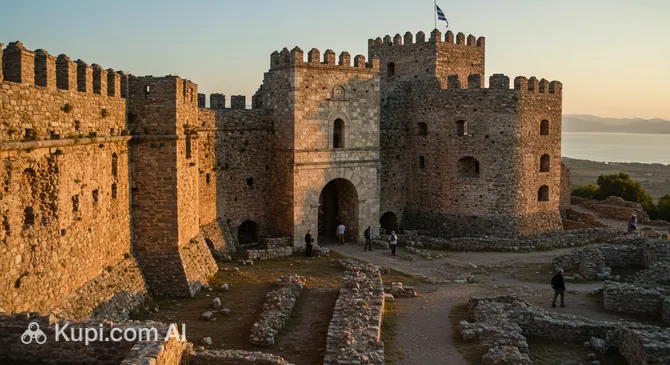
Venetian Castle of Emporio. Illustration.
Source: Kupi.com AI

Traveler photos:

How to Get There

When planning a trip to this picturesque corner of Santorini, it is worth considering the route in advance. Since Pyrgos is located on an island, the main ways to get here are by flight or ferry. You can learn more about how to get to Pyrgos by studying all available options, but the air route remains the fastest and most popular.

The closest and most convenient hub is Santorini International Airport (JTR). It handles both regular flights from Athens and many charters from European cities during the summer season. The airport is not located in Pyrgos itself, but near the town of Fira, just 3.3 km from your destination's center. Thanks to such close proximity, a taxi or transfer ride will take literally 10–15 minutes, making the journey as comfortable as possible after a flight. Passenger traffic here is high, so the infrastructure is well-developed.

Another option is to fly to the neighboring large island of Crete, to Heraklion Airport (HER). It is located in the city of Heraklion, about 118 km from Pyrgos by sea. This is a major international hub with huge passenger traffic. By choosing this path, you can combine a visit to two islands, getting from Crete to Santorini by high-speed ferry or catamaran. Travel time by ferry is about 2 hours, after which you can get from the port of Santorini to Pyrgos by bus or taxi.

For clarity, here is a summary of the main airports through which you can build your route:

AirportPassenger trafficDistance
Santorini International Airport2.9 mln3 km
Paros Airport250 00077 km
Naxos Airport180 00078 km
Milos Airport77 50194 km
Heraklion Airport9.4 mln118 km

In addition to air travel, sea transport plays an important role. If you are already in Greece, for example in Athens, you can reach the island by ferry from the port of Piraeus. Upon arrival at the port of Athinios in Santorini, Pyrgos can be reached by local KTEL buses or taxis. The road from the port climbs a steep serpentine and offers breathtaking views, setting the right mood from the first minutes of your stay on the island.

Main Attractions

Pyrgos, the former capital of Santorini, offers travelers not only breathtaking views but also unique sites steeped in history and local flavor. A walk through its streets is a true immersion into the atmosphere of medieval Greece. Among the must-visit places, several particularly interesting ones stand out.

One of the most significant historical monuments in the vicinity is the Venetian Castle of Emporio. This well-preserved medieval fortification served as protection against pirate raids. Its narrow labyrinthine streets, tiny houses built directly into the fortress walls, and old churches create a sense of traveling back in time. A visit to the castle allows you to touch the island's history and take impressive photographs.

Venetian Castle of Emporio. Illustration.
Source: Kupi.com AI

Traveler photos:

For those seeking cultural experiences, the Symposion Cultural Center is a mandatory stop. Located in a former winery, this center offers a unique immersive experience into the world of music and mythology. Here you can listen to live performances on reconstructed ancient Greek instruments, such as the lyre and cymbals, as well as participate in workshops. It is the perfect place to take a break from the heat and get to know the island's intangible heritage.

After strolling through historical sites, it is pleasant to relax in one of the authentic establishments. For example, the Pentozali restaurant offers guests traditional Cretan and Santorini dishes in a cozy atmosphere. And to enjoy the sunset with a glass of local wine, you can stop by the Alisachni bar, which offers beautiful views of the island.

Local Cuisine

The gastronomic scene in Pyrgos is the quintessence of Santorini flavors, where cooking traditions are closely intertwined with the unique properties of the volcanic soil. Here, away from the hustle of coastal resorts, you can enjoy authentic Greek cuisine, which is famous for its simplicity, fresh ingredients, and rich flavors. Local products, grown on arid land without artificial irrigation, have an incredibly concentrated aroma.

Among the dishes that are definitely worth trying, the king of the table is fava — a delicate puree of yellow split peas, served here with onions, capers, and a generous portion of olive oil. Another hallmark of the region is tomatokeftedes (domatokeftedes). These are aromatic fried patties made from local cherry tomatoes, which have a sweet and rich flavor thanks to the volcanic soil. Also, pay attention to white eggplants, which, unlike the usual purple ones, have almost no bitterness and have a sweetish flesh.

The food culture in Pyrgos encourages leisurely meals. Locals and tourists prefer to dine in cozy family taverns or on restaurant terraces with panoramic views. If you are looking for a place that honors the island's culinary traditions, it is worth stopping by the Pentozali restaurant. Here you can get acquainted with classic recipes in a homey atmosphere, enjoying the hospitality for which Greece is so famous.

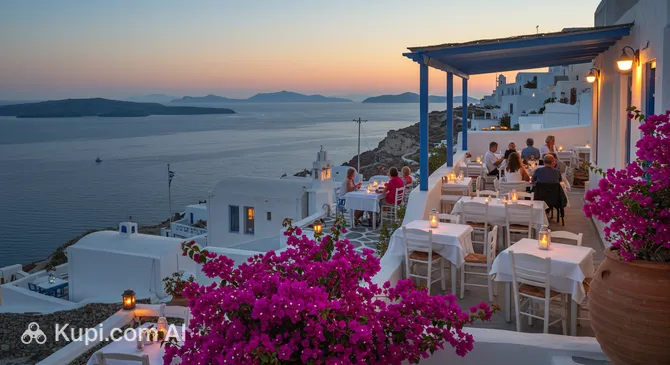
The Postcards of the Aegean. Illustration.
Source: Kupi.com AI

Traveler photos:

For those who want to combine gastronomic discoveries with a modern approach and spectacular views, the Postcards from the Aegean restaurant would be an excellent choice. This establishment offers an interesting take on Mediterranean cuisine, where familiar ingredients are revealed in new combinations. Such places are ideal for a romantic dinner at sunset, when the entire island is painted in golden tones.

Speaking of drinks, it is impossible not to mention local wines, as Pyrgos is surrounded by vineyards. Be sure to order a glass of Assyrtiko — a dry white wine with characteristic minerality and acidity, which pairs perfectly with seafood. For a digestif, try the sweet Vinsanto, produced from sun-dried grapes. An excellent place to get acquainted with the island's wine list is the Alisachni bar, where tastings can be supplemented with exquisite snacks.

Travel Tips

Pyrgos is a place where medieval charm meets island serenity, but its specific hilly terrain requires a little preparation from the traveler. To make your acquaintance with the former capital of Santorini as comfortable as possible, we have gathered practical recommendations that will help you avoid minor troubles and enjoy your holiday.

  1. Clothing and Footwear. Since Pyrgos is located on a mountainside and abounds with steep stairs, comfortable flat shoes are your main ally; heels will be not only out of place but also dangerous. In summer, prefer light natural fabrics, but be sure to bring a windbreaker or a wrap: it can be windy at altitude in the evenings. Modest clothing covering shoulders and knees is required for visiting churches.
  2. Transport. The historic town center is entirely pedestrian, so be prepared to walk a lot. To travel around the island, you can use KTEL buses (the stop is on the main square), but they can be overcrowded in season. The best option for freedom of movement is renting a small car or an ATV, as catching a taxi on the street here is extremely difficult, especially in the evening.
  3. Finance. The currency is the Euro (€). Most taverns and shops accept cards, but carrying cash (small denomination bills) is a must: it will be useful for paying bus fares, buying water at kiosks, and tipping. Tipping is not mandatory but welcomed — usually, 5–10% of the bill is left or the amount is simply rounded up.
  4. Health and Safety. Pyrgos is a very safe place, but due to the abundance of steps and uneven paving, watch your step, especially at dusk. Pharmacies (Farmakeio) are available in neighboring large settlements and Fira, so it's better to have a basic first-aid kit (plasters, motion sickness remedies, sunscreen with high SPF) with you.
  5. Communication and Language. The official language is Greek, but almost all staff in the tourism sector speak English fluently. Wi-Fi is available in almost every cafe. If you need mobile internet, it's better to buy a SIM card (Cosmote, Vodafone) upon arrival at the airport or in the city of Fira, as there may be no communication stores in Pyrgos itself.
  6. Local Etiquette. Greeks are very hospitable and appreciate politeness. Greet locals with "Kalimera" (good morning) or "Yassas" (hello). Observe silence during the siesta (roughly from 14:30 to 17:30), when many shops close and residents rest.
  7. What to Avoid. It is categorically forbidden to climb on church roofs, domes, and private houses for an effective photo — this is considered gross disrespect to local residents and religious traditions. Also, avoid donkey rides in the heat — many tourists decline this entertainment for animal welfare reasons.
  8. Insider Tip. Don't rush to the popular Oia for the sunset. In Pyrgos, from the top of the Venetian castle or from the terrace of "Franco’s" cafe, the view of the setting sun is just as good, but you will enjoy the moment in silence, without crowds of tourists pushing you with their elbows.

Pyrgos rewards those who are ready for leisurely walks and respect local traditions. By following these simple tips, you can feel confident here and take away only the warmest memories of true Greek hospitality.

Entertainment & Nightlife

Nightlife in Pyrgos is strikingly different from the noisy parties in Fira or the glamorous glitz of Oia. Here, you won't find huge nightclubs with pounding music until dawn. Instead, the town offers an atmosphere of refined romance, quiet conversations under the stars, and enjoying wine on terraces with panoramic views of the island at night. It is an ideal place for those seeking tranquility and authenticity after sunset.

The center of evening attraction is the village's main square and the winding streets leading up to the castle. This is where cozy bars and restaurants come to life at twilight. The crowd here is respectable: couples, wine connoisseurs, and travelers who prefer the "slow life." The dress code in most establishments is relaxed smart casual; it is better to leave heels at home due to the cobbled streets and steep climbs.

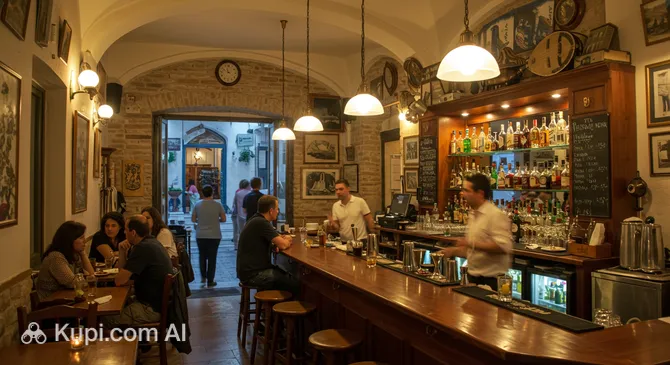
For starting the evening, the Alisachni wine bar and art gallery is ideal. This atmospheric spot allows you to taste the best varieties of Santorini wines to the sounds of light jazz. The establishment is famous for its hospitality and cozy terrace hidden from the winds. If you want to combine dinner with a stunning view of the caldera and the sunset, look into the Postcards from the Aegean restaurant. This place offers not only exquisite cuisine but also an excellent cocktail list, making it a popular spot for evening relaxation.

Alisachni. Illustration.
Source: Kupi.com AI

Traveler photos:

Practical Tips and Prices: The average price for a cocktail in Pyrgos bars ranges from 12 to 18 euros, while a glass of wine costs between 7 and 10 euros. The best time to visit is around 19:30 to catch the sunset, but it's better to book a table in advance. An important logistical point: buses from Pyrgos to Fira or other parts of the island stop running quite early (around midnight, and sometimes earlier depending on the season). Finding a taxi on the street at night is almost impossible, so be sure to have local taxi service numbers with you or arrange a transfer in advance.

In terms of safety, Pyrgos is one of the calmest places in Santorini. You can walk safely here at any time of day. The only real "danger" is the steep steps and occasionally insufficient lighting in the labyrinths of the old town, so the flashlight on your phone will come in handy.

Although Pyrgos comes alive in the evening, daytime entertainment here is contemplative. Tourists visit church museums, wander through the ruins of the Kasteli fortress, or go for tastings at nearby wineries. However, it is in the evening that the magic of this high-altitude settlement fully reveals itself, turning an ordinary dinner into an unforgettable event.

Parks & Museums

Pyrgos is a veritable open-air museum where every stone breathes history, and the surrounding landscapes replace traditional city parks. Although you won't find classic green alleys with fountains here due to the island's arid climate, the town and its surroundings offer unique natural areas and rich cultural collections that will allow you to understand the soul of Santorini more deeply.

Speaking of natural attractions, it is impossible not to mention Mount Profitis Ilias (Prophet Elias). This is the highest point of the island, rising above Pyrgos. The slopes of the mountain represent a unique nature reserve where rare species of local flora can be found, including wild orchids in spring. It is an ideal place for hiking: the trails here are picturesque and offer breathtaking panoramas of the entire archipelago. The summit of the mountain is a kind of "park in the clouds," where silence is broken only by the wind and the ringing of church bells.

Another important "green" zone is the famous vineyards of Santorini, which surround the foot of Pyrgos in a tight ring. These are not ordinary gardens: the vines here are woven in the shape of baskets ("kouloura") to protect against winds and preserve moisture. A walk among these ancient plants, some of which are hundreds of years old, gives a sense of unity with the land and an understanding of how the islanders have adapted to the volcanic soil for centuries. This is a living agro-cultural landscape that changes its colors from season to season.

In cultural terms, Pyrgos is famous for its small but informative museums. It is definitely worth visiting the Ecclesiastical Museum, located in the restored Agia Triada church. It houses an impressive collection of rare Byzantine icons, wood carvings, ecclesiastical vestments, and sacred relics. The exhibition does not just display objects of worship but also tells about the deep faith of the local residents, which helped them survive in the difficult conditions of the island.

Venetian Castle of Emporio. Illustration.
Source: Kupi.com AI

Traveler photos:

For history buffs, the architecture of the region itself is of interest, often serving as a backdrop for studying the past. For example, just a few kilometers from Pyrgos is the Venetian Castle of Emporio. Although it is located in a neighboring village, it is often included in the cultural itinerary of Pyrgos guests as a brilliant example of Cycladic fortification architecture. This place can be viewed as a large-scale historical site where you can wander for hours studying the medieval defense system.

Another gem is the "Santorini of the Past" (Cultural Village) museum. This is a private collection turned into an ethnographic museum, where the life of islanders of past centuries is recreated. Here you can see traditional tools of winemakers, shoemakers, and craftsmen, as well as peek into a typical Santorini house. This place allows you to see the "backstage" of the beautiful postcard life and understand what the island was like before the arrival of mass tourism.

Insider tip: If you want to see the nature of Pyrgos in all its glory, come here in April or early May. During this short time, the sun-scorched hillsides and the edges of ancient trails are covered with a carpet of wildflowers — poppies, daisies, and wild herbs, creating an incredible contrast with the harsh volcanic rock and the white walls of the houses.

Getting Around

Since Pyrgos is a traditional settlement on the island, there are no subways, trams, or trolleybuses here. The basis of the public transport system is the green or gray buses operated by KTEL. Pyrgos is located at the intersection of important routes, so you can get here by buses traveling from the island's capital (Fira) toward the beaches of Perissa or to Akrotiri. The stop is usually located on the main square at the foot of the village.

The fare payment system here differs from the usual urban one. Tickets do not need to be purchased in advance at kiosks or machines. Payment is made in cash directly inside the bus to the conductor, who approaches passengers after the journey has begun. The cost of travel depends on the route and time of day, but usually ranges between 1.60 and 2.50 euros. It is highly recommended to have small cash (coins and 5-10 euro notes), as the conductor does not always have change for large banknotes.

It is important to consider the seasonality of the schedule. In summer, buses run frequently, approximately every 20–30 minutes, and operate until late evening. However, during the winter period or in the shoulder season, the number of trips is significantly reduced, and the last bus may leave quite early. The current schedule is always posted at the central bus station in Fira and is often duplicated at the stop in Pyrgos, but it is better to check it online on the local carrier's website before heading out.

A very popular alternative to public transport is renting cars, scooters, and ATVs (quad bikes). This provides freedom of movement and allows you not to depend on the schedule. In the lower part of Pyrgos, there are several free parking lots where you can leave your vehicle. Taxi services are also available, but their number on the island is limited and prices are quite high. In high season, catching a car on the street is difficult, so it is better to book a transfer in advance through the hotel or by phone.

A feature of Pyrgos itself is its pedestrian nature. The historical part of the town with its narrow streets and stairs is completely closed to any transport. You can only move around inside the old town on foot. Be prepared for the fact that you will have to climb stairs to get to your hotel or an attraction, so wheeled suitcases can be a problem, and comfortable shoes are a necessity here.

Accommodation

Accommodation in Pyrgos is a unique experience that differs significantly from staying in typical beach hotels. You won't find huge hotel complexes here; the base of the housing stock consists of cozy boutique hotels, luxury villas, and traditional "cave" houses converted into comfortable apartments. This town is ideal for those seeking privacy, an authentic atmosphere, and panoramic views of the entire island, while wanting to avoid the excessive bustle and inflated prices typical of Oia or Fira.

When choosing an area to stay, it is important to consider the terrain. The upper part of town (Kasteli district) offers the most spectacular views and a romantic atmosphere within the medieval walls. However, it's worth remembering that you cannot reach this area by taxi, and you will have to climb numerous steps with your luggage. Accommodation at the foot of the hill and near the main square is more practical in terms of logistics: it's easier to park and access shops here, although the views may be less grand.

The price range in Pyrgos varies from mid-range to high-end (luxury). There are practically no budget hostels here, but you can find affordable family guesthouses a bit further from the historical center. The cost of living here is usually lower than in hotels on the edge of the caldera in other Santorini towns, while the level of service and quality of interiors are often just as good. It is recommended to book accommodation at least 3–4 months before your trip, especially if you plan a visit during the high season (July–August), using popular online platforms to compare prices and reviews.

Nearby Cities

For those who want to explore the surroundings, Pyrgos serves as an excellent starting point for day trips to several interesting nearby locations:

One of the most popular excursion destinations is Heraklion, located on the neighboring island of Crete. It is the largest city in the region, home to the famous Palace of Knossos — the center of the Minoan civilization — and a magnificent Archaeological Museum. Thanks to regular ferry service, you can get here quickly enough to see the main attractions and return by evening.

Another wonderful city to visit is Rethymno, also located in Crete. It charms with its well-preserved Venetian architecture, narrow old town streets, and the impressive Fortezza fortress. This place is ideal for those who want to combine a cultural walk with relaxation by the sea, enjoying a special atmosphere where Venetian and Ottoman traditions blend.

A bit further away is the picturesque city of Chania, which many consider the most beautiful on Crete. Its famous Venetian harbor with a lighthouse, old mansions, and colorful quarters create a unique romantic image worth the distance.

CityPopulationDistance
Fira1 6004 km
Naxos18 00080 km
Paros13 70082 km
Naousa18 88284 km
Milos5 000100 km

These nearby destinations allow you to get a sense of the diverse culture and landscapes of the region.

Shopping & Souvenirs

Shopping

General Overview: Shopping in Pyrgos is not about chasing brands or large-scale purchases, but rather about aesthetic pleasure and the opportunity to find unique handmade items. Unlike bustling Fira with its endless rows of souvenir shops, trade here is conducted in a more measured and sophisticated way. The town is famous for its art galleries, designer clothing boutiques, and shops offering high-quality local products. It is an ideal place for those looking for authentic interior items, artisan jewelry, or gastronomic souvenirs that convey the spirit of Santorini.

Main Shopping Areas and Streets: In Pyrgos, there is no single main shopping street in the usual sense. All commercial life is concentrated along the winding cobbled streets and stairs leading from the main square at the foot of the hill to the top of the Venetian fortress. Climbing up through the labyrinth of the old town, you will encounter cozy shops literally carved into the rocks or occupying the first floors of old mansions. Such a walk allows you to combine viewing the architecture with finding interesting purchases.

Shopping Centers: Since Pyrgos is a traditional protected settlement, large shopping centers and malls are completely absent here. The retail format here is exclusively intimate: small family shops and concept stores. If you need large-scale shopping with mass-market brands, it is better to head to the island's capital, Fira, which is just a few kilometers away.

Markets: There are no classic large markets in the town, but the role of gastronomic attraction points is played by small grocery stores and delicacy shops. Here you can find the freshest local products, which often come directly from farmers. In season, stalls with seasonal fruits and the famous Santorini cherry tomatoes sometimes appear on the roadsides at the entrance to the village.

Souvenirs: From Pyrgos, you should bring back something more substantial and atmospheric than magnets. First of all, pay attention to local wine (Assyrtiko and Vinsanto varieties), as the region is surrounded by vineyards. Gastronomic specialties are also popular: fava (yellow peas), capers, and sun-dried tomatoes. Art lovers should look at handmade ceramics, volcanic stone products, and paintings by local artists who often exhibit their work directly on the streets.

Opening Hours and Payment: During the tourist season (May to October), shops in Pyrgos work late, often until 22:00 or 23:00, seven days a week. However, keep in mind that during the hot afternoon hours (from 14:30 to 17:30), many small shops may close for a siesta. In winter, most souvenir shops are closed. Bank cards are accepted almost everywhere, but for small purchases at kiosks or for buying water, it is better to have some cash euros with you.

Tax Free: Citizens of non-EU countries are entitled to a VAT refund (Tax Free) when purchasing goods for more than 50 euros in a single receipt in shops that support this system. Look for "Global Blue" or "Tax Free Shopping" stickers in the windows. Don't forget to ask the seller for a special form when paying and present your passport.

Reached the end of the page?

That means the route is fully explored