Support

Kenrokuen Garden

About

Kenrokuen Garden, located in the city of Kanazawa, is not just a park, but one of the three most beautiful and famous landscape gardens in Japan. It is rightfully considered a true masterpiece of garden art, created and perfected over several centuries. Originally the private outer garden of Kanazawa Castle belonging to the powerful Maeda clan, it was opened to the general public in the 1870s.

The name Kenrokuen literally translates as "Garden of the Six Sublimities." According to ancient Chinese landscape design theory, an ideal garden should harmoniously combine six attributes: spaciousness, seclusion, artifice, antiquity, abundance of water, and wide panoramic views. Walking along the winding paths of Kenrokuen, you can fully feel how the creators managed to bring this complex concept to life, creating a place of amazing beauty and harmony.
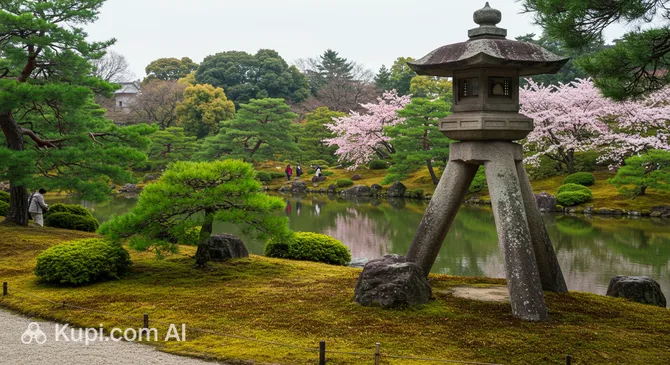
Kenrokuen Garden. Illustration.
Source: Kupi.com AI

Traveler photos:

Within the garden's vast territory, covering more than 11 hectares, visitors will find picturesque ponds with islands, streams, small waterfalls, ancient tea houses, and stone lanterns. It is home to approximately 8,750 trees and 183 plant species that transform the garden in every season. Among the park's hallmarks are Japan's oldest fountain, which operates using natural water pressure, and the unique two-legged Kotoji-toro stone lantern. A visit to Kenrokuen Garden is an opportunity to touch centuries of history and enjoy the impeccable aesthetics of Japanese landscape art.

Contacts

It is best to check the official Kenrokuen Garden website for up-to-date information on opening hours, ticket prices, and special events. You can reach the park from Kanazawa Station in about 10–15 minutes by taxi or by taking a dedicated tourist bus.

How to contactContact
Address1 Kenrokumachi, Kanazawa, Ishikawa 920-0936, Japan
Phone number+81 76-234-3800
Websitewww.pref.ishikawa.jp

What to Do

A visit to Kenrokuen Garden is, first and foremost, a leisurely stroll through a picturesque landscape where every turn of the path reveals new, carefully designed views. Guests can spend hours exploring the garden, enjoying views of numerous ponds, elegant bridges, babbling brooks, and secluded tea houses. The garden's seasonal beauty adds a special charm: plums and cherry blossoms bloom in spring, everything is lush green in summer, maples blaze with crimson in autumn, and in winter, the garden is covered in a white blanket, with the famous yukitsuri rope structures appearing on the pines to protect the branches from the weight of the snow.

Among the must-visit spots is the large Kasumi Pond, on the shores of which stands the iconic two-legged Kotoji-toro stone lantern, a symbol of both the park and the city of Kanazawa. Nearby, you can find the oldest fountain in Japan, which operates through a natural difference in water pressure. It is also worth noting the picturesque Emerald Waterfall (Midori-taki) and the ancient Yugao-tei tea pavilion, built back in 1774. A walk through the garden allows you to fully feel the harmony of the "six sublimities" and enjoy the peaceful atmosphere of this landscape masterpiece.

For a deeper immersion in the garden's atmosphere, you can visit one of the tea houses, where guests are served traditional green tea with Japanese sweets. This is a wonderful opportunity to relax while contemplating the surrounding scenery and feel like a part of the centuries-old history of this amazing place. Many visitors also find secluded corners for drawing or quiet contemplation of nature, making a visit to Kenrokuen a truly meditative experience.

Getting There

Kenrokuen Garden is conveniently located in the heart of Kanazawa, near Kanazawa Castle, making it easily accessible for tourists. The main starting point for a trip to the garden is Kanazawa Station—the city's primary transportation hub. From here, you can reach the attraction in several ways: by public transport, taxi, or even on foot, turning the journey into a pleasant walk.

The most popular and convenient way to reach the garden from Kanazawa Station is by bus. Several tourist routes depart from the station's East Exit (Kenrokuen Exit). You can take the Kanazawa Loop Bus (Right Loop from platform #7) or the dedicated Kenrokuen Shuttle (from platform #6). In both cases, the journey takes about 15–20 minutes. Regular Hokutetsu buses and JR buses also run in this direction, and travel on JR buses may be covered by the Japan Rail Pass.

If you prefer a faster mode of transport, taxis are always available at the station. The ride to the garden will take no more than 10–15 minutes, depending on traffic. For those who enjoy exploring the city on foot, the walk from Kanazawa Station to Kenrokuen Garden takes about 30 minutes. This is a great opportunity to soak up the city's atmosphere and see its streets up close.

Nearest city: Kanazawa

History & Facts

The history of Kenrokuen Garden is inextricably linked to the powerful Maeda clan, who ruled these lands during the Edo period. The creation of this landscape masterpiece was a long and painstaking process spanning two centuries—from approximately the 1620s to the 1840s. The official starting point is considered to be 1676, when the fifth ruler of the clan, Maeda Tsunanori, moved his administration to Kanazawa Castle and decided to landscape the adjacent area. It was then that the Renchigoten Villa was built on the site of a service yard, around which the future garden began to take shape.

The garden's fate was not always easy: in 1759, it was almost completely destroyed by a major fire. However, in 1774, the eleventh lord, Maeda Harunaga, began an extensive restoration. During this period, iconic elements such as the Emerald Waterfall (Midori-taki) and the ancient Yugao-tei tea house were created, which still delight visitors today. A new stage of development occurred in 1822, when the twelfth daimyo, Maeda Narinaga, installed a complex system of streams through the garden, fed by the Tatsumi Canal. It was at this time, according to one version, that the garden received its current name—Kenrokuen.

The finishing touches were added by the thirteenth ruler, Maeda Nariyasu, who expanded the famous Kasumigaike Pond and increased the number of water streams, making the landscape even more picturesque. Initially, Kenrokuen was not a public space. It served as a private garden for relaxation and banquets, where the Maeda clan hosted important guests and vassals. It was only on May 7, 1874 (according to other sources, 1871 or 1875) that this amazing corner of nature was opened to the general public, becoming a treasure not only of Japan but of the entire world.

Time Needed

When planning a visit to Kenrokuen Garden, you should allow for 1.5–2 hours for a thorough and leisurely walk. This will be enough time to cover the main routes, admire key attractions such as Kasumigaike Pond, the famous Kotoji-toro lantern, and Japan's oldest fountain, as well as fully experience the atmosphere of this amazing place. A standard tour will allow you to form a general impression and take beautiful souvenir photos.

If you are passionate about photography, want to enjoy every landscape without rushing, visit one of the tea houses for a traditional ceremony, or simply find a secluded corner for contemplation, feel free to set aside half a day—about 3–4 hours. The garden's vast territory hides many picturesque spots that only reveal themselves upon careful and unhurried exploration. The duration of your visit may also depend on the season—the spring cherry blossoms or the autumn colors of the maples may inspire you to stay longer to fully enjoy the garden's seasonal beauty.

Working Hours

Kenrokuen Garden is open to visitors year-round, though its operating hours change depending on the season. During the warm period, from March 1 to October 15, the garden welcomes guests from 7:00 to 18:00. In the colder months, from October 16 to the end of February, the hours are shorter—from 8:00 to 17:00. It is worth noting that for those who appreciate morning silence, it is possible to enter the garden even earlier during certain months, allowing you to enjoy its beauty in a peaceful setting before the main crowds arrive.

Generally, no advance ticket booking is required for a regular visit to Kenrokuen Garden; they can be purchased at the ticket office on-site. However, keep in mind that on certain days, such as the third Sunday of every month, admission to the park may be free, which attracts more visitors. Before your visit, it is highly recommended to check the official website for the latest information on opening hours, ticket prices, and potential special events to avoid any unforeseen schedule changes.

Nearby

Visiting Kenrokuen Garden is a highlight in itself, but exploring its immediate surroundings can turn a simple walk into a full cultural immersion. The garden is located in the heart of the historical and cultural district of Kanazawa, with other iconic landmarks, including the famous castle, museums, and ancient shrines, just steps away. Such a concentration of interesting sites allows for a rich, full-day itinerary.

By setting aside time to explore the area, you can gain a deeper understanding of the history and culture of this amazing corner of Japan. Many of these places are closely linked to the history of the Maeda clan, who created Kenrokuen, and they complement each other to create a complete picture of Kanazawa's past. Below is a list of attractions located in the immediate vicinity of the garden to help you plan your visit.

NameDistance
Seisonkaku0.1 km
Kanazawa Shrine0.2 km
Ishikawa Prefectural Museum of Art0.3 km
Ishiura Shrine0.3 km
Ishikawa-mon Gate0.4 km
Kanazawa Castle0.5 km
D.T. Suzuki Museum0.5 km

Have you reached the end of the page?

So the route has been studied inside and out