Support

Senso-ji

About

Senso-ji is not just a landmark, but the living heart of the historic Asakusa district in Tokyo. This Buddhist temple, whose full name is "Kinryuzan Senso-ji" (Temple of the Golden Dragon Mountain), is considered the oldest in the capital of Japan. It is dedicated to Bodhisattva Kannon, the goddess of mercy, and attracts millions of visitors from around the world with its spiritual atmosphere and rich history.
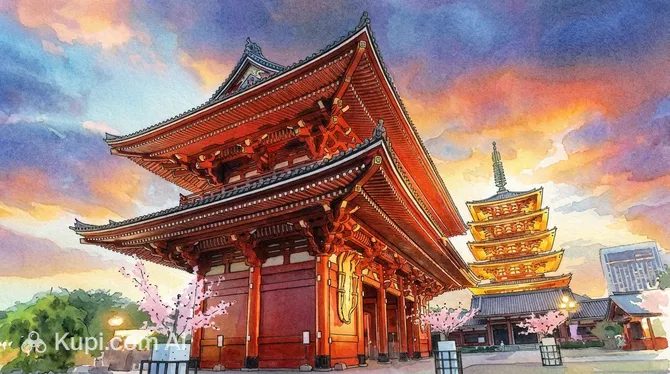
Senso-ji. Illustration.
Source: Kupi.com AI

Traveler photos:

The temple's history is steeped in legend. According to tradition, in 628, two fisherman brothers pulled a statue of the goddess Kannon out of the Sumida River. No matter how many times they tried to return it to the water, the statue miraculously returned to them. The temple was founded in honor of this event, becoming one of the country's most important religious centers. Although the complex was heavily damaged in the mid-20th century, it was carefully restored and today symbolizes peace and rebirth.

The path to the main hall begins at the famous Kaminarimon Gate ("Thunder Gate"), which is decorated with a huge red paper lantern weighing about 700 kg. Beyond the gate stretches the bustling Nakamise-dori shopping street, whose history spans several centuries. Here you can find traditional souvenirs, sweets, and crafts, immersing yourself in the atmosphere of old Tokyo. After walking through the street, visitors enter the main temple grounds with the main hall and an impressive five-story pagoda.

Visiting Senso-ji is a unique opportunity to touch ancient traditions and feel the unbroken connection of time. Here you can see how believers perform purification rituals with incense smoke, which is believed to heal ailments, or test your luck by taking an omikuji fortune. Senso-ji remains not only a place of pilgrimage but also one of Tokyo's most vibrant and memorable symbols, where spiritual tranquility harmoniously combines with the ceaseless energy of the metropolis.

Contacts

To plan your visit to Senso-ji, check current opening hours, or find information about special events, it is recommended to consult official sources. The temple is conveniently located within a few minutes' walk of Asakusa Station, which can be reached via the Ginza and Asakusa metro lines.

How to contactContact
Address2-chōme-3-1 Asakusa, Taito City, Tokyo 111-0032, Japan
Phone number+81 3-3842-0181
Websitewww.senso-ji.jp

What to Do

A visit to Senso-ji Temple begins with an immersion into the lively atmosphere of the ancient Nakamise-dori shopping street. Strolling down this 250-meter alley, which leads from the Kaminarimon Gate to the main temple grounds, is a fascinating activity in itself. The street, whose history began in the 18th century when locals were allowed to trade on the approaches to the temple, is today filled with numerous shops. You can find everything here: from traditional Japanese souvenirs such as fans, kimonos, and masks to various local sweets and snacks, like sweet odango dumplings or senbei rice crackers.

After passing through the shopping street, you will find yourself in front of a second, no less impressive gate—Hozomon ("Treasure House Gate"). Beyond it lies a spacious courtyard and the heart of the temple complex. Here, visitors can participate in traditional rituals. For example, in front of the main hall stands a large incense burner; the smoke from it is believed to bring healing and purification—you just need to direct it toward yourself with your hands. Also, you can test your luck by taking an omikuji fortune: for a symbolic donation, you receive a scroll with a prediction. Good fortunes are taken home, while bad ones are traditionally tied to special racks on the temple grounds to leave bad luck behind.

The main objects to see on the grounds are the main temple building, dedicated to the goddess Kannon, and the majestic five-story pagoda to its left. Visitors can approach the main hall to pray by throwing a coin into the offering box and bowing. In addition to the main buildings, it is worth taking time to walk around the entire area to admire the elegant architecture, see small shrines, and simply observe the pilgrims and other tourists. The atmosphere of Senso-ji is unique: it is a place where spiritual tranquility harmoniously blends with the restless energy of one of Tokyo's most popular districts.

Getting There

Getting to Senso-ji, located in the heart of the colorful Asakusa district, is very easy thanks to Tokyo's excellent public transportation system. The most convenient and popular way is to take the subway to Asakusa Station. Several lines serve this station: the Ginza line (orange), the Asakusa line (pink), and the Tobu Skytree line. From any of the station exits, it’s just about a 5-minute leisurely walk to the famous Kaminarimon Gate, which leads to the temple. The way is well-marked with signs, so it's practically impossible to get lost.

Note a small detail: there are actually four stations in the Asakusa area with the same name, belonging to different railway companies. Three of them—the Ginza, Asakusa, and Tobu line stations—are in close proximity to each other and the temple. The fourth station, belonging to the Tsukuba Express line, is located a bit further away, about a 10-minute walk from Senso-ji. For most tourists traveling from central areas like Shibuya, Ginza, or Ueno, the direct Ginza line will be the easiest and fastest route.

Besides the subway, there are other ways to reach the temple. For example, you can use city buses—many of them stop at the "Asakusa Kaminarimon" stop, right next to the main entrance. For those who want to turn the trip into a mini-journey, the Tokyo Water Bus running along the Sumida River is an excellent option. This is not only a convenient but also a very scenic way to get to Asakusa, enjoying views of the city from the water. Of course, you can always take a taxi, which is particularly convenient for travelers with children or heavy luggage, though this option will be significantly more expensive compared to public transport.

Nearest city: Tokyo

History & Facts

As the oldest temple in Tokyo, Senso-ji has more than 1,300 years of history, which is closely intertwined with the key eras of Japan's development. The temple gained a special role during the Edo period (1603–1867), when the first shogun, Tokugawa Ieyasu, granted it his patronage. Senso-ji was designated as a place for the shogunate's official prayers, emphasizing its high status in both the religious and political hierarchy of the time. This made it a magnet for pilgrims from all corners of the country and contributed to the prosperity of the entire Asakusa district.

The temple's journey has been marked not only by prosperity but also by challenging events. Over the centuries, it suffered from fires and was nearly destroyed several times. However, each time it was lovingly restored through donations from believers across the country. It was the mid-20th-century reconstruction that marked an important turning point in its history: before then, Senso-ji belonged to the Tendai school of Buddhism, but after its revival in 1950, it became the main temple of the independent Shokannon school.

This amazing capacity for rebirth makes Senso-ji not just a historical monument, but a living symbol of the resilience and faith of the Japanese people. Its history—from being the patron temple of the powerful Tokugawa clan to a modern spiritual center open to all—reflects the very essence of Tokyo: a city that carefully preserves its past while always looking toward the future.

Time Needed

When planning a visit to Senso-ji, you should expect that exploring it will take an average of 1 to 2 hours. This time is quite sufficient for a leisurely walk through the main grounds, a visit to the main hall, and taking photos at the famous Kaminarimon and Hozomon gates. Such a visit will give you a general impression of the temple complex and allow you to feel its atmosphere.

If you want to dive deeper into the atmosphere of this place, it's worth planning for about 3-4 hours. This extra time will allow you to stroll unhurriedly through the entire Nakamise-dori shopping street, picking out souvenirs and trying local delicacies. You can participate in traditional rituals: wash your hands before entering the temple, use incense for health, and even get an omikuji fortune. Additionally, the complex features other interesting structures, including a five-story pagoda and small shrines that also deserve attention. In the evening, the temple is beautifully illuminated, creating a completely different, peaceful atmosphere, so some tourists prefer to come here after sunset.

Working Hours

Senso-ji Temple is open to visitors all year round, and the good news is that entry to its grounds is completely free. It is important to distinguish between the opening hours of the main grounds and the main hall. The temple grounds themselves are accessible for walks 24/7, allowing you to enjoy the peaceful atmosphere and beautiful illumination of the buildings in the evening and at night. The main hall, which houses the primary sanctuary, operates on a schedule: from April to September it is open from 6:00 AM to 5:00 PM, and from October to March from 6:30 AM to 5:00 PM.

No advance ticket booking or registration is required to visit Senso-ji. You can come at any time convenient for you during the main hall's opening hours or stroll through the grounds even at night. If you want to dive deeper into the history and culture of this place, you can book a separate guided tour, but this is not mandatory for a self-guided visit.

Nearby

A visit to Senso-ji is an immersion into the spiritual heart of old Tokyo, but the Asakusa district and its surroundings have much more to offer. Exploring nearby attractions will allow you to see the contrast between ancient traditions and the ultra-modern life of Japan's capital, enriching your trip with new experiences. Unique museums, famous structures, and other iconic sites await just a few minutes' walk or a short subway ride away.

Strolling around Senso-ji is an opportunity to get a more complete and multifaceted view of the city. You can not only enjoy the tranquility of the temple gardens but also see the metropolis panorama from a bird's-eye view, get acquainted with art and science, or dive into the world of sumo. Each of these locations reveals the character of Tokyo in its own way, making your visit truly unforgettable.

NameDistance
Kaminarimon0.4 km
National Museum of Nature and Science1.8 km
Tokyo National Museum1.9 km
The National Museum of Western Art1.9 km
Tokyo Imperial Palace5.1 km
Nijubashi Bridge5.5 km
Kidzania Tokyo6.5 km

Have you reached the end of the page?

So the route has been studied inside and out