Support

Nippon Budokan

About

The Nippon Budokan (Japanese: 日本武道館) is a famous indoor multipurpose arena located in the heart of Tokyo, in the picturesque Kitanomaru Park near the Imperial Palace. This iconic venue is considered the main center for Japanese martial arts and serves as a true symbol of harmony between body and spirit, attracting both masters and enthusiasts of traditional Japanese culture.
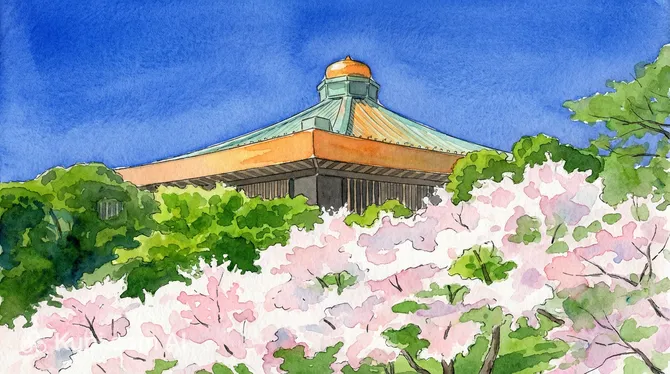
Nippon Budokan. Illustration.
Source: Kupi.com AI

Traveler photos:

The history of the Nippon Budokan is inextricably linked with world-class sports. The arena was specially built for the judo competitions of the XVIII Summer Olympic Games in 1964. Since then, it has not only maintained its status as an important sporting venue but has also become one of the country's most recognizable cultural attractions, hosting events of various scales.

The architectural appearance of the Nippon Budokan impresses with its monumentality and symbolism. The building is an octagonal structure 42 meters high, whose design was inspired by the ancient Yumedono (Hall of Dreams) at Horyu-ji Temple in Nara. With its impressive capacity of over 14,000 spectators, the arena is ideal for both national martial arts championships and grand concerts by world stars, making it a truly versatile venue for significant events.

Contacts

For the most up-to-date information on events, schedules, and visiting opportunities at the Nippon Budokan, it is recommended to consult official sources. You can contact the arena administration by phone or visit their website.

How to contactContact
Address2-3 Kitanomarukōen, Chiyoda City, Tokyo 102-8321, Japan
Phone number+81 3-3216-5100
Websitewww.nipponbudokan.or.jp

What to Do

At the Nippon Budokan, visitors can witness thrilling sporting events and touch the rich culture of Japan. The arena regularly hosts major international competitions in various martial arts such as judo, karate, aikido, and kendo. Guests can see national championships, impressive demonstrations, and festivals dedicated to traditional Japanese martial arts. This is a unique opportunity for enthusiasts of Eastern practices to immerse themselves in the authentic atmosphere of Budo and observe the skill of the world's best athletes.

In addition to its role as a temple of martial arts, the Nippon Budokan is famous as one of Japan's most prestigious concert venues. Since the 1960s, many world music legends have performed on its stage, including The Beatles, Bob Dylan, Queen, and Eric Clapton. The arena remains immensely popular with both Japanese and international performers, and a concert at the Budokan is considered an important milestone in a musical career. Attending such a concert will provide an unforgettable experience and allow you to feel the special energy of this legendary hall.

Thus, depending on the event schedule, visitors to the Nippon Budokan can either dive into the world of traditional Japanese martial arts by watching competitions and demonstrations or enjoy a performance by their favorite musical artists at one of the world's most iconic concert venues. In either case, a visit to the Budokan promises vivid emotions and an introduction to an important part of Tokyo's cultural life.

Getting There

Getting to the Nippon Budokan is quite easy, as the arena is conveniently located in the central part of Tokyo. The most common and convenient way is to use the subway. The nearest station to the arena is Kudanshita. It is served by three lines: Tokyo Metro Tozai, Hanzomon, and Toei Shinjuku. From the station exits, the Nippon Budokan is just a few minutes' leisurely walk away, making this a very attractive option for visitors.

In addition to Kudanshita Station, other transport hubs are within walking distance of the arena. For example, you can take the subway to Takebashi Station. Major railway stations such as JR Tokyo are also relatively close, from where you can easily reach the Budokan by taking the subway or a taxi. This variety of public transport options makes it easy to plan a route from almost anywhere in the city and its surroundings.

If you prefer to travel by taxi or private car, your main landmarks will be Kitanomaru Park and the Imperial Palace — the Nippon Budokan is located in the immediate vicinity of these famous Tokyo attractions. However, it is worth noting an important point: during large events, concerts, or competitions, traffic in the arena area can be significantly congested, and the number of available parking spaces can be very limited. Therefore, when planning a trip by car, it is recommended to think this aspect through in advance and perhaps consider alternative parking or arrival options.

Nearest city: Tokyo

History & Facts

The Nippon Budokan was built in record time and officially opened on October 3, 1964. Its primary and main purpose was to host the Olympic judo competitions as part of the Tokyo Olympics. The project for this iconic structure was designed by architect Mamoru Yamada, and the construction was entrusted to the renowned Takenaka Corporation. Thus, from the very beginning of its history, the Budokan has been closely linked to the world of major sports.

The architectural appearance of the Nippon Budokan is deeply symbolic and refers to traditional Japanese temples, emphasizing its cultural significance. One of the most notable details is the "giboshi" – a symbolic sacred jewel crowning the center of the roof. It is believed to protect the building and everyone inside from evil spirits. The interior of the arena is a harmonious blend of traditional Japanese style elements and modern design solutions, reflecting respect for history and openness to new trends.

Soon after its opening, the Nippon Budokan moved beyond being a purely sporting venue, becoming an important cultural site. A historic event was the concert by the legendary band The Beatles in 1966 – this was their first performance in Japan, which caused an incredible stir and left a deep mark on the country's musical history. This moment marked the beginning of a new era for the Budokan as a prestigious venue for world stars.

To this day, the Nippon Budokan maintains its status as one of Japan's main and most respected arenas. It hosts not only major sports competitions and concerts by famous artists but also important state ceremonies, solemn university graduation ceremonies, and other events significant to Japanese society. This makes the Budokan more than just a building, but a true symbol uniting sports, culture, and national traditions.

Time Needed

When planning a visit to the Nippon Budokan, you should expect a duration of 1.5 to 3 hours. This amount of time is generally sufficient if your visit coincides with an event and you want to not only see the arena itself from the outside and the surrounding area but also to immerse yourself in the atmosphere of the event inside.

If you plan to simply familiarize yourself with the architecture of the Nippon Budokan, take a walk through Kitanomaru Park where it is located, and take a few photos, you might need less time, perhaps about an hour. However, if your visit includes attending a concert, sports competition, or another long event, the total stay time will naturally be determined by its duration. In this case, you should add some time for entering, getting settled, and exiting the arena to the duration of the event itself.

Thus, for a full experience of the Nippon Budokan, especially if you want to attend an event, it's best to set aside at least 2-3 hours. This will allow you to enjoy the atmosphere of this iconic place in Tokyo without rushing.

Working Hours

The working hours of the Nippon Budokan depend directly on the schedule of events being held at the arena. Typically, the doors open for visitors 1–2 hours before the start of a concert, sports competition, or other event. Since the arena does not have standard daily hours for general public visits, it is strongly recommended to check the current schedule and start time of the event you are interested in on the official Nippon Budokan website or with the organizers.

To attend most events at the Nippon Budokan, you will need to purchase tickets. It is recommended to do this in advance, especially for popular concerts or significant sports events, as tickets can sell out quickly. Information on the need for pre-booking, costs, and ways to purchase tickets should also be checked on official resources or from distributors. The arena operates year-round, and its availability to the public is determined by the calendar of scheduled events.

9:30 – 17:30

Nearby

Visiting the Nippon Budokan is undoubtedly an exciting event, but Tokyo offers much more, and exploring the nearby attractions can significantly enrich your experience. Exploring the surroundings will allow you to dive deeper into the atmosphere of this amazing city, see the contrast between modern and traditional Japan, and make your trip even more fulfilling.

The area around the Nippon Budokan, Kitanomaru Park, and the adjacent territories is rich in historical and cultural sites. A short walk can lead you to iconic places that tell more about the history and culture of Japan's capital. Below is a list of some interesting places located nearby.

NameDistance
Tokyo Imperial Palace0.9 km
Nijubashi Bridge1.5 km
Suga Shrine2.5 km
The National Museum of Western Art3.4 km
teamLab Borderless3.5 km
National Museum of Nature and Science3.5 km
Tokyo National Museum3.7 km

Have you reached the end of the page?

So the route has been studied inside and out