Support

Tokyo Skytree

About

Tokyo Skytree, or the "Sky Tree," is an ultra-modern broadcasting tower and one of the most recognizable symbols of not only Tokyo but all of Japan. Since opening in 2012, this futuristic structure has quickly become a key landmark, attracting travelers from all over the world. The tower is located in the Sumida district and serves not only for broadcasting but also as a large-scale entertainment complex.

The tower's height is 634 meters, making it the tallest broadcasting tower in the world and the second tallest structure on the planet. This number was not chosen by chance: in Old Japanese, the numbers 6 (mu), 3 (sa), and 4 (shi) together sound like "Musashi"—the historical name of the region where modern-day Tokyo is located. Thus, the tower's height is a tribute to the history of these lands. The sophisticated design, inspired by the shape of a traditional Japanese sword and the columns of ancient temples, is capable of withstanding even strong earthquakes.

Tokyo Skytree is more than just a tower. At its base lies the large Tokyo Solamachi shopping and entertainment complex, with over 300 shops and restaurants, as well as a planetarium and an aquarium. The main point of attraction for tourists is the two observation decks located at heights of 350 and 450 meters, offering breathtaking panoramic views of the vast metropolis. On a clear day, you can even see the famous Mount Fuji from here.
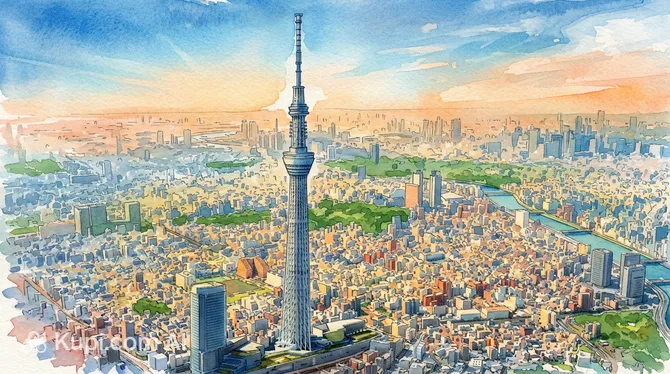
Tokyo Skytree. Illustration.
Source: Kupi.com AI

Traveler photos:

Contacts

If you are planning to visit Tokyo Skytree, it is useful to have contact information handy. On the official website, you can always find up-to-date opening hours, ticket prices, and announcements for special events. All the essential contact details are gathered in the table below.

How to contactContact
Address1-chōme-1-2 Oshiage, Sumida City, Tokyo 131-0045, Japan
Phone number+81 570-550-634
Websitewww.tokyo-skytree.jp

What to Do

To get the most out of your visit to Tokyo Skytree, it's worth planning ahead. The main tip is to buy your tickets online. This will not only save you time by avoiding long queues at the ticket office but also allow you to choose a time slot that suits you. This is especially relevant if you want to catch the sunset and see the daytime Tokyo turn into a sea of night lights—this is the most popular time. For the clearest views, when Mount Fuji can be seen in the distance, the morning hours during the cold season are best.

While you're at the top, don't limit yourself to just panoramic shots. On the lower observation deck, test your bravery by walking on a section with a sturdy glass floor. On the upper deck, in the gallery, you can take a leisurely stroll along a spiral ramp, enjoying the sensation of "walking in the sky." Additionally, the observation decks often host themed exhibitions and events, such as those dedicated to popular anime, which adds interactivity to the visit. There are also cafes where you can enjoy coffee and dessert at a dizzying height.

After coming back down to earth, dedicate some time to exploring the Tokyo Solamachi shopping and entertainment complex at the base of the tower. You can spend several hours here browsing unique souvenirs: from tower-themed merchandise and traditional Japanese crafts to exclusive items from stores dedicated to popular characters like Harry Potter or Snoopy. The gastronomic options are also impressive: dozens of restaurants occupy several floors, offering both authentic Japanese cuisine (from sushi and okonomiyaki to signature miso soups) and dishes from around the world. And if you still have energy, you can visit the modern planetarium or the large Sumida Aquarium to make your day at the "Sky Tree" truly fulfilling.

Getting There

Getting to Tokyo Skytree is easy thanks to Tokyo's excellent public transport system. The most convenient way is to take the train or subway. The tower is located in close proximity to two key stations. The first is Tokyo Skytree Station on the Tobu Skytree Line. The second is Oshiage Station, which is a major hub serving several lines: Tokyo Metro Hanzomon, Toei Asakusa, and Keisei Oshiage. From both stations, the entrance to the "Sky Tree" complex is just a few minutes' leisurely walk away.

For those who prefer walking, there is a great option to reach the tower on foot from the popular tourist district of Asakusa. This walk takes about 20 minutes and allows you to enjoy views of the Sumida River and the cityscape. Travelers by car can use the parking facilities; however, it's worth noting that finding a free spot can be difficult during peak hours and weekends due to the landmark's high popularity. Therefore, using public transport is still the recommended way to visit the tower.

Nearest city: Tokyo

History & Facts

The history of Tokyo Skytree is closely linked to technological progress and the urban landscape of Tokyo. By the beginning of the 21st century, the old Tokyo Tower, built in 1958, could no longer fulfill its primary task. Due to the emergence of numerous skyscrapers, its height was no longer sufficient to provide high-quality digital television and radio signals across the metropolis. Consequently, the decision was made to build a new, much taller structure. Work began in July 2008, and the official public opening took place on May 22, 2012.

One of the most remarkable facts about the "Sky Tree" is its incredible seismic resistance, which is a vital characteristic for Japan. During design, engineers combined cutting-edge technology with principles borrowed from traditional Japanese five-story pagodas, which have proven their earthquake resistance over centuries. At the center of the tower's structure is a powerful reinforced concrete core—the "shinbashira"—which is not rigidly connected to the outer frame. During tremors, it moves in counter-phase, damping up to 50% of the vibrations. This system performed brilliantly during the massive earthquake in March 2011, when the tower under construction suffered no damage.

Since its opening, Tokyo Skytree has become more than just a technological facility; it is a true cultural phenomenon and a symbol of renewal. It breathed new life into the Sumida district, turning it into one of the city's main tourist hubs. The emergence of the tower and the adjacent massive shopping and entertainment complex, Tokyo Solamachi, contributed to the area's economic growth and created a new point of attraction for both locals and visitors from around the world.

Time Needed

When planning a visit to Tokyo Skytree, it is important to budget your time correctly to enjoy everything the complex has to offer. If your goal is simply to go up to the observation decks and admire the Tokyo panorama, it may take about 1.5–2 hours. This is enough time to view the sights from both platforms without rushing, take photos, and perhaps have a coffee at the high-altitude cafe. However, keep in mind that during peak hours and weekends, waiting times for elevators can extend your visit.

For a more complete and immersive experience, you should set aside significantly more time. A full visit, which includes not only ascending to both observation decks but also a walk through the massive Tokyo Solamachi shopping center at the base of the tower, will take at least 3–4 hours. This shopping complex features hundreds of shops, souvenir stalls, and restaurants where you can have lunch or dinner. Additionally, if you wish to visit the Sumida Aquarium or the planetarium located on-site, feel free to add another couple of hours to your plan. Thus, a visit to the "Sky Tree" can easily turn into a half-day adventure.

Working Hours

Tokyo Skytree is open to visitors year-round, making it easy to include in your travel plans. Generally, the tower's observation decks are open daily from 10:00 to 21:00. It is important to remember that the last entry is one hour before closing, at 20:00.

While the basic schedule is stable, opening hours may change due to special events, weather conditions, or depending on the season. Therefore, before your visit, it is highly recommended to check the current information on the official "Sky Tree" website. To avoid long queues, especially if you plan to visit at a popular time like sunset, it is best to book your tickets online in advance. This will not only save you time but also guarantee your visit during your chosen slot.

DayOpening hours
Monday10:00 – 22:00
Tuesday10:00 – 22:00
Wednesday10:00 – 22:00
Thursday10:00 – 22:00
Friday10:00 – 22:00
Saturday9:00 – 22:00
Sunday9:00 – 22:00

Nearby

Visiting Tokyo Skytree is a highlight in itself, but exploring its surroundings will make your trip even more fulfilling and memorable. The tower is located in the Sumida district, which combines the charm of old Tokyo with the dynamics of modern life. A walk through this area will allow you to dive deeper into the culture and daily life of the Japanese capital, discovering both tourist spots and authentic corners of the city.

Historical temples, bustling markets, museums, and cozy parks are all just a few minutes' walk or a short ride away from the "Sky Tree." This proximity makes it easy to combine a visit to the ultra-modern observation deck with an immersion into a traditional atmosphere. Below is a list of nearby points of interest that are definitely worth including in your itinerary.

NameDistance
Kaminarimon1.3 km
Tokyo National Museum3.2 km
National Museum of Nature and Science3.2 km
The National Museum of Western Art3.2 km
Tokyo Imperial Palace5.9 km
Nijubashi Bridge6.1 km
Kidzania Tokyo6.2 km

Have you reached the end of the page?

So the route has been studied inside and out