Support

Kanda Myojin Shrine

About

Kanda Myojin Shrine is one of the oldest and most significant Shinto shrines in Japan, located in the heart of Tokyo. Its history spans nearly 1,300 years, having been founded in 730 AD, in the first half of the 8th century. Over its long history, the temple has become more than just a religious site; it is a true symbol protecting the city and its residents.

The shrine honors three deities (kami): Daikokuten, Ebisu, and Taira no Masakado. The first two belong to the "Seven Lucky Gods" and are considered patrons of business, trade, and family well-being. The third deity, Taira no Masakado, is the deified spirit of a powerful samurai, making the temple a unique place of worship. Due to such patronage, Kanda Myojin is particularly popular among entrepreneurs who come here to pray for business success.

The modern shrine building, reconstructed in 1934 after the devastating 1923 earthquake, is an exact replica of the original structure. Built in a traditional style, the temple draws attention with its vibrant vermilion-red color, and its interiors are richly decorated with lacquer and gold leaf. The grand two-story Zuishin-mon Gate, rebuilt in 1995 from cypress wood, serves as the main entrance to the grounds.
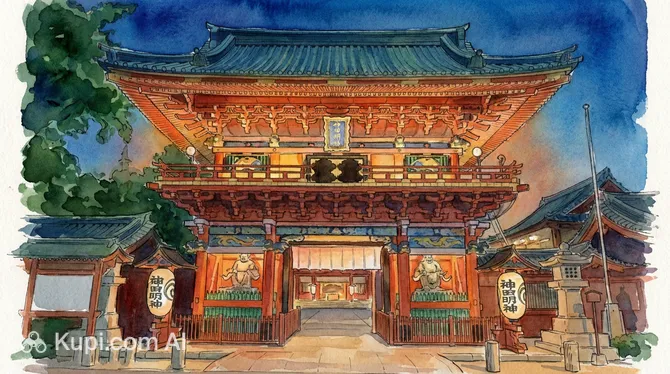
Kanda Myojin Shrine. Illustration.
Source: Kupi.com AI

Traveler photos:

Interestingly, despite its ancient history, Kanda Myojin is also closely linked to modern culture. Because of its proximity to the famous Akihabara electronics district, the shrine has become popular among fans of technology and anime, and you can even purchase special amulets here for protecting electronic devices.

Contacts

For the most accurate and up-to-date information regarding opening hours, special events, and services at the sanctuary, it is recommended to visit the official website or contact the administration directly. Key contact details are provided below.

How to contactContact
Address2-chōme-16-2 Sotokanda, Chiyoda City, Tokyo 101-0021, Japan
Phone number+81 3-3254-0753
Websitewww.kandamyoujin.or.jp

What to Do

Visiting Kanda Myojin Shrine is an immersion into ancient traditions in the very center of modern Tokyo. The first thing that greets guests at the entrance is a beautiful dragon-shaped washbasin, where everyone can perform a purification ritual before entering the sacred grounds. Moving further in, you will see stone guardian lion figures, which, according to belief, protect visitors from evil spirits, as well as a small picturesque waterfall that adds tranquility to the site. The serene shrine gardens create a pleasant contrast to the city bustle, offering a cozy spot for reflection and rest.

The sanctuary is an important spiritual center, especially for entrepreneurs and business people. It is dedicated to the deities Daikokuten and Ebisu, who are considered patrons of trade and business. Many come here to pray for commercial success and receive a blessing for prosperity. Visitors can take part in traditional Shinto rituals or simply observe them to better understand Japan's religious customs. There is also a museum on the temple grounds with exhibits showcasing its rich history.

Kanda Myojin is not only a place for prayer, but also a hub of cultural life. Various festivals and ceremonies are held here regularly, such as the Shichi-Go-San children's festival, which attracts many families. One of the largest events is the Kanda Matsuri festival, held every two years and considered one of Tokyo's three great festivals. Additionally, at the temple shop, you can purchase various amulets and charms (omamori) for good luck, protection against misfortune, or even for protecting electronic devices—a unique feature of this sanctuary.

Getting There

Kanda Myojin Shrine is conveniently located in the central part of Tokyo, making it easily accessible for tourists. The simplest way to reach it is by public transport. The nearest station to the shrine is Ochanomizu, which can be reached via the JR Chuo and Sobu lines, as well as the Marunouchi subway line. It is just a 5-7 minute leisurely walk from the station to the sanctuary. Suehirocho Station on the Ginza subway line is also nearby, and a walk from there takes about 5 minutes.

Given its proximity to the famous electronics district, walking from Akihabara Station is an excellent option. This allows you to combine a visit to the ancient shrine with an immersion into Japan's modern pop culture. The walk from Akihabara takes no more than 7-10 minutes. Although the sanctuary is associated with the Kanda district, the station of the same name is a bit further away—about a kilometer—but still within walking distance.

Nearest city: Tokyo

History & Facts

The history of Kanda Myojin Shrine dates back centuries, making it one of the oldest in Tokyo and all of Japan. Founded over 1,200 years ago in the first half of the 8th century, it was originally located in the small fishing village of Shibasaki. This ancient temple has witnessed a humble settlement transform over time into a giant metropolis, and its history is closely intertwined with the fate of the city itself.

One of the most intriguing facts in the shrine's history is linked to the spirit of the powerful samurai Taira no Masakado. According to legend, after his death in the 10th century, a terrible epidemic broke out in the vicinity of future Edo (the old name for Tokyo). Locals believed it was the samurai's vengeful spirit seeking retribution for being forgotten. To appease him, they restored his burial site and built a sanctuary dedicated to the deified spirit of Taira no Masakado-no-Mikoto. This act turned Kanda Myojin into a unique place where not only gods of fortune but also a warrior's spirit are worshipped.

A major turning point in the shrine's history occurred in the early 17th century when Shogun Tokugawa Ieyasu began constructing his castle. Wary of such a powerful and strong-willed deity nearby, he ordered the sanctuary moved to its current location. At the same time, to avoid incurring the wrath of the kami, the Shogun took the temple under his patronage. In 1923, the original building was destroyed by the Great Kanto Earthquake, but by 1934 it was meticulously restored according to the original design using what was then innovative reinforced concrete. Thanks to this, today Kanda Myojin is not only an important cultural heritage site but also continues to play a significant role in the capital's spiritual life.

Time Needed

For a standard tour of Kanda Myojin Shrine, most visitors will need 1 to 2 hours. This is enough time to stroll leisurely through the picturesque grounds, admire the beauty of the main Zuishin-mon Gate and the main hall, take memorable photos, and soak in the peaceful atmosphere of this historic site. If you are short on time, even 30-40 minutes is enough to get a general impression by viewing the key structures and feeling the spirit of the sanctuary.

If you plan to delve deeper into the shrine's culture and history, it's worth allocating extra time. There is a small museum on the grounds housing artifacts from Kanda Myojin's nearly 1,300-year history; you should set aside at least another 30-60 minutes for this. Additionally, your visit might be extended if you choose to relax at the EDOCCO cultural complex, which features cafes and souvenir shops where you can purchase unique amulets, including the famous charms for protecting electronic devices.

Thus, an hour is sufficient for a brief introduction, while a more thoughtful and unhurried visit including the museum is best planned for about 2-3 hours. It's also worth noting that during major festivals, such as the biennial Kanda Matsuri, the sanctuary attracts huge crowds, and a visit can turn into a half-day event.

Working Hours

Kanda Myojin Shrine is open to visitors year-round, making it accessible to tourists at any time. The temple grounds themselves are open 24/7, allowing guests to enjoy its atmosphere even during an evening stroll. However, please note that the operating hours of specific facilities on the grounds, such as souvenir shops, the museum, and offices for ordering prayers or receiving a temple stamp (goshuin), are limited. They are typically open to visitors during the day, from approximately 9:00 AM to 5:00 PM.

No advance booking or ticket purchase is required for a standard visit and tour of the sanctuary—entry to the grounds is free. Exceptions may include special events, ceremonies, or tours organized by the EDOCCO cultural complex on the temple grounds. If you plan to visit the museum, please note that there is an admission fee. To get the most accurate and current information on the operating hours of all services and any potential schedule changes, especially during festival days, it is recommended to check the official shrine website.

Open 24 hours

Nearby

Visiting Kanda Myojin Shrine is a wonderful opportunity to experience the history and culture of Japan, but you shouldn't stop there. The sanctuary's location in one of Tokyo's most vibrant districts makes it easy to combine a spiritual pilgrimage with exploring other iconic city landmarks. The shrine is close to the famous Akihabara electronics quarter, which in itself creates a fascinating contrast.

Exploring the surrounding area will enrich your journey, allowing you to see different facets of this multifaceted city—from quiet gardens and world-renowned museums to modern sports arenas. Within walking distance of the shrine, there are many interesting sites that deserve your attention and will help you form a more complete picture of Tokyo.

NameDistance
The National Museum of Western Art1.6 km
National Museum of Nature and Science1.8 km
Tokyo National Museum2 km
Tokyo Imperial Palace2.3 km
Nijubashi Bridge2.7 km
Kaminarimon2.8 km
Suga Shrine4.4 km

Have you reached the end of the page?

So the route has been studied inside and out