Support

Convent of San Esteban

About

The Monastery of San Esteban is a majestic Dominican convent located in the heart of the ancient city of Salamanca. It is one of the most significant religious monuments representing Spain, famous for its unique architectural appearance and deep history.
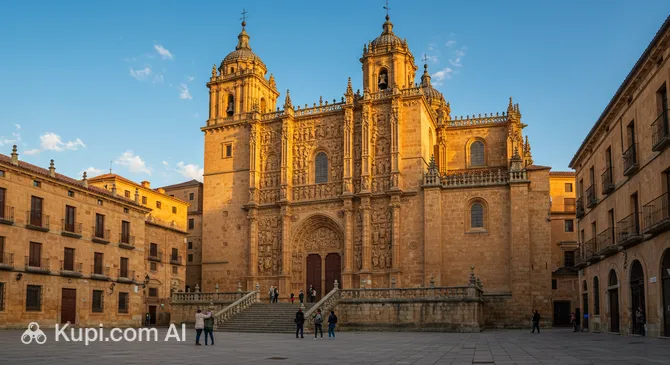
Convent of San Esteban
Convent of San Esteban. Иллюстрация. Источник: Kupi.com AI

The main treasure of the monastery is considered to be its western façade, executed in the exquisite Plateresque style. The finest stone carving resembles the work of a jeweler, turning the wall of the building into a true work of art. This grandiose structure harmoniously combines elements of Late Gothic, Renaissance, and lush Baroque, reflecting the change of eras throughout the four centuries of its construction.

The monastic complex occupies a vast territory and includes not only the majestic church but also picturesque inner courtyards (cloisters), a sacristy, and monks' cells. Today, it is not just a historical site, but a place that attracts thousands of travelers wishing to touch the rich cultural atmosphere of one of Europe's most beautiful cities.

Contacts

To plan your visit and check current information, you can use the official communication channels of the monastery. The administration of the complex is always ready to help visitors with rules and guidelines.

How to contactContact
AddressPl. del Concilio de Trento, s/n, 37001 Salamanca, Spain
Phone+34 923 21 50 00
Websitewww.conventosanesteban.es

What to Do

Start your discovery of the monastery by examining its famous façade, where scenes of the martyrdom of Saint Stephen are captured in stone. Once inside, you will be struck by the scale of the church: the height of the central nave reaches 27 meters. Pay attention to the magnificent altarpiece and the artistic canvases, among which works by Antonio Palomino and the famous Peter Paul Rubens stand out.

Special attention should be given to the Kings' Cloister (Claustro de los Reyes)—a two-story Renaissance inner courtyard. Walking under its vaults, you can admire the original wooden ceilings and elegant arches. Don't forget to find the legendary Soto Staircase, built in the mid-16th century: its unique cantilevered construction seems to be floating in the air, as it has no visible supports.

It is worth ending your walk with a visit to the 17th-century sacristy with its classical Corinthian columns and quiet chapels where valuable items of religious art are kept. The atmosphere of peace and grandeur of this place allows you to temporarily forget the city bustle and immerse yourself in the contemplation of history.

Getting There

The monastery is located at Plaza del Concilio de Trento, in the very heart of Salamanca's historic center. If you arrive in the city by train, the distance to the landmark is about 2 kilometers. This path can be easily covered on foot in 20–25 minutes while enjoying the charm of the ancient streets, or you can use taxi services or local bus routes.

For travelers arriving at Salamanca Airport (located 15 km from the city), the most convenient option is to take a taxi or book a transfer. For those traveling by car, it is important to remember that the historic part of the city is primarily pedestrianized. It is best to leave your car in one of the paid parking lots near the center and continue on foot—the monastery is easy to recognize by its magnificent façade, located near the Cathedral.

Ближайший город: Salamanca

History & Facts

The history of the Dominican Order in Salamanca began in the mid-13th century; however, the construction of the majestic building we see today started in 1524 at the initiative of Cardinal Juan Álvarez de Toledo. The project was designed by the prominent architect Juan de Álava, and later, masters like Rodrigo Gil de Hontañón, whose genius created the transept and the dome of the church, worked on the monastery's construction.

For centuries, the Monastery of San Esteban was not only a spiritual center but also an intellectual one. It was closely linked to the University of Salamanca: in the 14th century, Dominicans headed key theology departments. Within these walls, profound scientific discussions took place that shaped the intellectual face of the era, and the main altar was later decorated with a work by José Benito de Churriguera, which became a benchmark of Spanish Baroque.

Interestingly, the monastery was visited by many iconic historical figures, including the famous mystic saint Teresa of Avila. The convent reached its maximum expansion by the beginning of the 19th century, carefully preserving the architectural heritage of different eras. Today, it is a living testament to the Golden Age of Spanish culture, attracting the attention of researchers and travelers from all over the world.

Time Needed

To leisurely explore the main parts of the complex, including the church, sacristy, and magnificent cloisters, an average visitor will need about 1.5–2 hours. This time is quite enough to appreciate the architectural details and soak in the solemn atmosphere of the place.

If you are an art connoisseur and want to study every sculpture on the famous façade in detail, examine the paintings by Antonio Palomino, and enjoy the silence of the Kings' Cloister, we recommend setting aside 2.5 to 3 hours for the visit. A calm pace will allow you to fully appreciate the mastery of the builders and artists of the past.

Working Hours

The doors of the Monastery of San Esteban are open to visitors daily. The working schedule is divided into morning and evening hours: from 10:00 to 14:00 and from 16:00 to 20:00 from Monday to Sunday. This allows guests of the city to conveniently fit a visit into their excursion route.

Since this is an active religious site, opening hours may vary slightly during church holidays or special services. Before visiting, it is recommended to check the current schedule to ensure your visit goes as smoothly as possible.

10:00 – 14:00, 4:00 – 20:00

Nearby

Salamanca is a city literally saturated with history, and a walk around the Monastery of San Esteban will be an excellent continuation of your day. Most iconic sites are located within walking distance, allowing you to create a rich walking itinerary through the old town.

NameDistance
Vinodiario0.1 km
Pozo de las Nieves0.2 km
Cave of Salamanca0.2 km
Calixto and Melibea Garden0.2 km
Palace of Anaya0.3 km
Casa Lis Art Nouveau and Art Deco Museum0.3 km
Salamanca Cathedral0.3 km

Reached the end of the page?

That means the route is fully explored