Support

Frog of Salamanca

About

Upon arriving in the city of Salamanca, many travelers' first priority is to find a tiny yet legendary character. The Frog of Salamanca (Rana de Salamanca) is a small stone sculpture perched on one of the skulls atop the facade of the main building of the oldest university in Spain. This detail has become a true symbol of the city and a must-see on any tourist's itinerary.
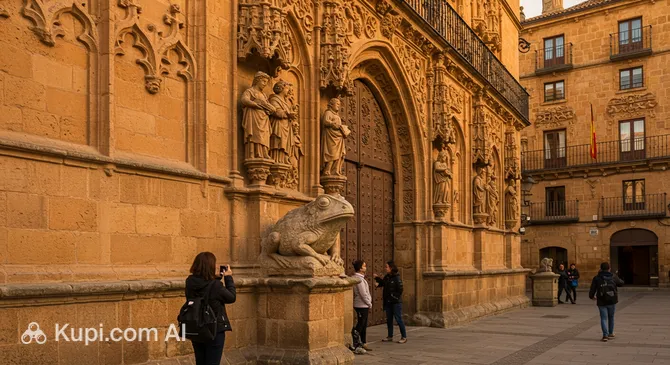
The Frog of Salamanca
The Frog of Salamanca. Иллюстрация. Источник: Kupi.com AI

Located on the facade of the building at C. Libreros, 19, the frog is part of the complex and rich Plateresque-style decor created in the 16th century. Finding it on your own is no easy task, as the figure is perched quite high on a parapet among many other ornaments. This turns a simple sightseeing stop into an engaging game of observation.

For locals and students, this little amphibian holds special meaning. According to an old superstition, any student who can find the frog on the facade on their own, without help, will pass all their exams and graduate. Today, tourists believe that finding it brings good luck in business, so you can always see a crowd of people in front of the university building, staring intently at the ancient masonry.

Contacts

To find out more about visiting the university complex, which includes the facade with the legendary figure, you can use the official contact details of the University of Salamanca.

Below is the current contact information and the exact address of the site:

How to contactContact
AddressC. Libreros, 19, 37008 Salamanca, Spain
Phone+34 923 29 44 00

What to Do

The main highlight here is, of course, finding the frog. Be prepared to stand before the university facade for a few minutes, carefully scanning every inch of the stone carvings. A little secret: look for a group of skulls on one of the pilasters on the right side of the facade—the frog sits proudly on the second skull from the left.

Beyond this exciting quest, visitors should take time to examine other details of the facade. Here you can find a magnificent medallion depicting the Catholic Monarchs and many symbolic figures. It is a perfect spot for architectural photography, as the light at different times of day highlights the relief of the ancient stone in various ways.

Once you have caught the frog (well, with your eyes), be sure to take a stroll through the Plaza de las Escuelas. The atmosphere here is uniquely academic, and the surrounding buildings of the UNESCO-listed historic center provide a perfect backdrop for a walk. Many travelers also visit the nearby souvenir shops, where the frog is represented in every possible form—from figurines to jewelry.

Getting There

Finding this famous landmark is easy, as it is located in the heart of the historic center at C. Libreros, 19. If you are already walking through the city, the walk from the central Plaza Mayor or the cathedral will take only 5–10 minutes at a leisurely pace.

For those who prefer public transport, city buses such as routes C1 and C2 run nearby. If you are arriving by high-speed train from Madrid (a journey of about 1.5 hours), you can walk from Salamanca Railway Station to the university in 15–20 minutes or take a taxi.

If you are traveling by car, keep in mind that the historic center is a pedestrian zone with restricted traffic. It is most convenient to leave your car in one of the underground parking lots near the central area and continue on foot, enjoying the ancient architecture.

Ближайший город: Salamanca

History & Facts

The history of this tiny figure is inextricably linked to the University of Salamanca itself, founded back in 1218. The facade, executed in the exquisite Plateresque style, was added later in the 16th century by order of the Catholic Monarchs, Ferdinand and Isabella. Amidst the incredible number of stone swirls, saints, and coats of arms, the architects hid the very frog that has become the subject of many legends over the centuries.

One of the most popular versions suggests that the frog sitting on a skull serves as a warning to students against vice and a dissolute life, reminding them of the brevity of existence. Another interpretation links the composition to a royal family tragedy: the three skulls on the facade may symbolize the monarchs' deceased children, while the frog represents the "imposter doctor" who failed to save them.

The university where the figure is located was the site of truly global events: Christopher Columbus presented his project for a voyage to the Indies here, and professors debated human rights. Over time, the Frog of Salamanca has evolved from a minor decorative detail into a full-fledged symbol of the city and one of the most recognizable souvenir icons in all of Spain.

Time Needed

Usually, tourists spend 30 to 60 minutes finding the frog and admiring the magnificent facade. This time includes the "quest" to find the figure among hundreds of details, as well as the chance to take high-quality photos and examine other decorative elements, such as the medallion of the Catholic Monarchs.

If you plan to go inside the university building to visit its ancient lecture halls and famous library, we recommend setting aside 1.5–2 hours. This will allow you to immerse yourself in the atmosphere of one of Europe's oldest educational institutions and enjoy the ensemble of the Plaza de las Escuelas at a leisurely pace.

Working Hours

Since the Frog of Salamanca is a decorative element on the exterior facade of the building, it is available for viewing 24/7. You can try your luck at finding this city symbol at any time that suits you—from early morning to late evening.

According to official data, the site is open to visitors 24 hours a day, seven days a week (Monday to Sunday). However, keep in mind that it will be much harder to spot the small figure at height after dark, even with the city's lighting.

Круглосуточно

Nearby

Visiting the university is just the beginning of exploring the city's architectural heritage. Nearby, there are magnificent monuments that allow you to fully experience the spirit of old Castile.

A walk around the neighborhood will reveal not only austere monastery walls but also stunning civil buildings with unique decor, all located within walking distance of each other.

NameDistance
Unamuno House Museum0 km
Courtyard of the Minor Schools0.1 km
House of Shells0.2 km
Palace of Anaya0.2 km
Casa Lis Art Nouveau and Art Deco Museum0.2 km
Salamanca Cathedral0.2 km
Clerecía Church0.2 km

Reached the end of the page?

That means the route is fully explored