Support

Archaeological Buddhist Remains of Sarnath

About

The Archaeological Buddhist Remains of Sarnath is a unique museum and archaeological complex located on the outskirts of Varanasi, India. This place holds immense significance for Buddhists worldwide, as it was here, according to tradition, that Buddha Shakyamuni delivered his first sermon after attaining enlightenment. This moment is considered the "Turning of the Wheel of the Teaching" and the starting point for the spread of Buddhism. Today, Sarnath is one of the four main pilgrimage sites for followers of this religion.

The complex is a picturesque territory where ruins of ancient structures are spread among well-kept gardens and modern temples. Visitors can see the remains of ancient monasteries, stupas, and temples that testify to the former greatness of this place. A special place among them is held by the Dhamek Stupa—a massive structure about 34 meters high, built on the spot where the Buddha's first sermon is believed to have been delivered. A walk through these ancient ruins allows you to touch centuries-old history and feel the peaceful atmosphere of this holy site.
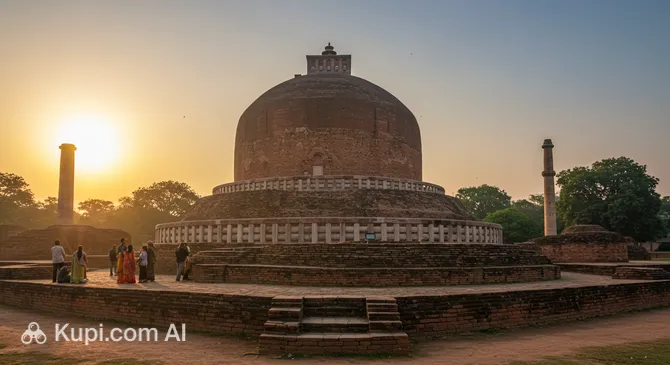
Archaeological Buddhist Remains of Sarnath. Illustration.
Source: Kupi.com AI

Traveler photos:

The Sarnath Archaeological Museum is also located within the complex, housing a rich collection of artifacts found during excavations. The museum's main treasure is the famous Lion Capital of Ashoka. This masterpiece of ancient Indian art, depicting four lions facing different directions, was created in the 3rd century BC and is now the official emblem of modern India. In addition to the capital, the museum features unique statues of the Buddha, reliefs, and fragments of ancient architecture that tell the story of the history and development of Buddhist art.

Contacts

For the most up-to-date information regarding opening hours, admission fees, and special exhibitions, it is recommended to contact the Sarnath Archaeological Museum directly, as it is a key part of the complex. You can reach the administration using the contact details provided below.

How to contactContact
Address92JF+42H, Rishpattan Rd, Sarnath, Varanasi, Uttar Pradesh 221007, India
Phone number+91 542 259 5007
Websiteasi.nic.in

What to Do

Visitors can spend several hours walking through the extensive archaeological zone, where the ruins of ancient monasteries and stupas have been preserved. The famous Dhamek Stupa, striking in its size, and the Chaukhandi Stupa, marking the meeting place of the Buddha with his first disciples, attract particular attention. It is also a must to see the Ashoka Pillar—one of the most important symbols of Indian statehood, the original capital of which, incidentally, is kept in the local museum.

To dive deeper into the history of this place, be sure to visit the Sarnath Archaeological Museum. It houses an impressive collection of Buddhist sculpture, ancient artifacts, and inscriptions spanning the period from the 3rd century BC to the 12th century AD. You can examine in detail the exquisite statues of the Buddha and Bodhisattvas, which are considered some of the finest examples of ancient Indian art.

In addition to exploring the ancient ruins, in Sarnath, you can get acquainted with modern Buddhism. Temples built by Buddhist communities from various countries—Thailand, Japan, Tibet, and others—are located on the territory of the complex, each distinguished by its unique architecture. For a more relaxing experience, you can walk through the Deer Park, which has existed here since ancient times and gave this place its original name. For those seeking a spiritual experience, meditation sessions and themed tours are offered, providing a better understanding of Buddhist philosophy.

Getting There

The Sarnath archaeological sites are located very close to Varanasi, approximately 10 kilometers northeast of the city center, making them easily accessible for visitors. The most popular way to reach the complex is to hire an auto-rickshaw or a taxi. Depending on traffic, this trip can take between 30 and 50 minutes. Car rentals are also available for independent travelers, offering more flexibility in route planning.

For those who prefer public transport, there are budget-friendly options. Local buses run regularly from Varanasi Railway Station, taking you directly to Sarnath. Additionally, the area is served by trains — the Sarnath Railway Station is within walking distance of the main attractions, and the train journey from Varanasi can take less than half an hour. This is a convenient and fast way to avoid city traffic jams.

If you are arriving from further away, the nearest airport is Lal Bahadur Shastri International Airport (VNS) in Varanasi. From there, Sarnath can be reached by taxi. Special bus tours from Varanasi are often organized for pilgrims and tourist groups, which include visits to all the key sites of the complex and the services of a guide.

Nearest city: Varanasi

History & Facts

The history of Sarnath, located near the sacred city of Varanasi, is rooted in deep antiquity. In the time of the Buddha, this place was known as Rishipattana and Mrigadaya (Deer Park). It was here in the 5th century BC that one of the key events in the history of Buddhism took place: Siddhartha Gautama delivered his first sermon after attaining enlightenment. This event, known as the "Turning of the Wheel of Dharma," marked the beginning of the spread of the teachings and transformed Sarnath into one of the most important pilgrimage sites.

Sarnath's heyday began in the 3rd century BC during the reign of the great Emperor Ashoka. Having converted to Buddhism, he turned this place into a major religious center, erecting numerous stupas, temples, and monasteries. It was Ashoka who installed the famous column with the capital featuring four lions, which became the symbol of modern India. The former grandeur of Sarnath is evidenced by the writings of Chinese pilgrims Faxian and Xuanzang, who described that at its peak, up to 1,500 monks lived here, and some stupas reached a height of one hundred meters.

Unfortunately, in the Middle Ages, the thriving complex suffered numerous destructions and lootings. By the 13th century, this sacred place had fallen into complete desolation and was practically forgotten, hidden under layers of earth and vegetation. A new chapter in the history of Sarnath began only in the 19th century, when British archaeologists led by Sir Alexander Cunningham began systematic excavations. Thanks to their painstaking work, unique monuments were rediscovered, and Sarnath once again took its place of honor on the cultural and spiritual map of the world.

Time Needed

When planning a visit to the Sarnath archaeological monuments, you should aim for a duration of 3 to 4 hours. This time is generally sufficient for a leisurely and thoughtful exploration of the main archaeological zone with its ancient ruins and stupas, as well as a visit to the Sarnath Archaeological Museum, which houses the famous Lion Capital of Ashoka. This duration will allow you to immerse yourself in the atmosphere of this historical site without unnecessary rush.

If you wish to explore this sacred place more deeply, it is worth dedicating up to half a day to the trip. The additional time will allow you not only to see the ruins but also to visit modern Buddhist temples built by communities from different countries, walk through the picturesque Deer Park, or even participate in a meditation session. Such an extended visit will provide an opportunity to fully experience the peace and spiritual significance of Sarnath.

Working Hours

The Archaeological Buddhist Remains of Sarnath, including the Archaeological Museum, are generally open to visitors daily from 9:00 AM to 5:00 PM. It is important to remember that Friday is a day off, and the complex is closed on this day. Access to the grounds is possible year-round, however, opening hours may vary slightly depending on the season, so it is highly recommended to check the current schedule on the official website or at local tourist information centers before your visit.

Special advance ticket booking for individual visitors is usually not required. You can purchase them directly at the ticket office near the entrance. However, if you plan to visit the complex as part of a large tour group or during national holidays, it is worth checking in advance if a reservation might be necessary to avoid any inconvenience.

DayOpening hours
MondayClosed
Tuesday8:00 – 18:00
Wednesday8:00 – 18:00
Thursday8:00 – 18:00
Friday8:00 – 18:00
Saturday8:00 – 18:00
Sunday8:00 – 18:00

Nearby

A visit to the archaeological complex in Sarnath is just the beginning of your acquaintance with this amazing place. To fully experience its spiritual atmosphere and historical depth, it is worth taking time to explore the surroundings. All the key attractions here are located very compactly, allowing you to easily walk around them and form a comprehensive impression of the cradle of Buddhism.

A stroll through the neighboring shrines and monuments will enrich your visit, allowing you to see not only ancient ruins but also modern temples built by followers of the teachings from various corners of the world. Each of these places complements the overall picture, telling its own part of Sarnath's great history, which began with the Buddha's first sermon.

NameDistance
Ashoka Pillar0.1 km
Dhamek Stupa0.2 km
Deer Park (Sarnath)0.4 km
Sarnath Buddhist Temple0.4 km
Welcome Garden Amusement Park2.2 km
Nadesar Palace6 km
Sant Shiromani Guru Ravidas Temple, Rajghat6.3 km

Have you reached the end of the page?

So the route has been studied inside and out