Support

Archbasilica of St. John Lateran

About

The Archbasilica of Saint John Lateran is not just one of the many churches in Rome, but its official cathedral. This church bears the title "Mother and Head of all churches in the city and the world" and ranks first in the hierarchy of Catholic churches, surpassing even Saint Peter's Basilica in status. As one of the four major papal basilicas, it holds immense historical and religious value for all of Italy.

Located on the Lateran Hill, this basilica serves as the cathedra for the Bishop of Rome—the Pope himself. His official throne is located here. The church and the adjacent palace have extraterritorial status and are the property of the Holy See, which emphasizes their unique position. Visiting this majestic site is an opportunity to touch centuries of Christian history.
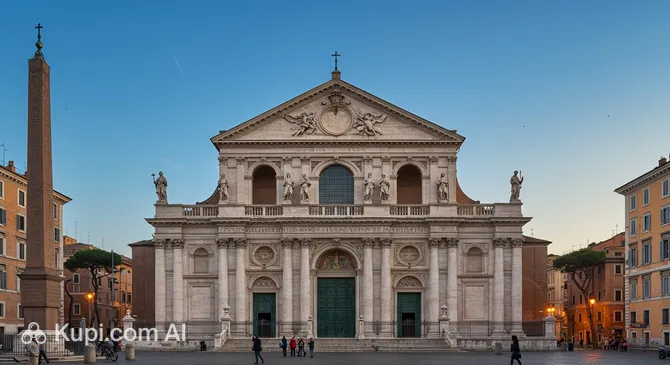
Archbasilica of St. John Lateran. Illustration.
Source: Kupi.com AI

Traveler photos:

The history of the basilica's name is interesting. Originally, in the 4th century, it was consecrated in honor of Christ the Savior. Later, in the 9th century, the name of John the Baptist was added to the dedication, and in the 12th century, John the Evangelist. Although the church is widely known today as Saint John's Basilica, its full official name is the Archbasilica of the Most Holy Savior and Saints John the Baptist and John the Evangelist at the Lateran, and Christ the Savior is still considered its primary patron.

Contacts

For the most accurate and up-to-date information regarding opening hours, mass schedules, and potential changes in access, it is recommended to consult the official sources of the Archbasilica of Saint John Lateran. Below are the primary contact details to help you plan your visit.

How to contactContact
AddressP.za. San Giovanni In Laterano, 00184 Roma RM, Italy
Phone number+39 06 6988 6433
Websitewww.basilicasangiovanni.va

What to Do

A visit to the Archbasilica of Saint John Lateran is an immersion into the world of art and architecture. Inside, you will be greeted by a majestic interior that was once so luxurious that the basilica earned the nickname "Golden Basilica" (Basilica Aurea). Although time and numerous reconstructions have altered its original appearance, the interior still impresses with its magnificence today. Of particular note are the invaluable mosaics preserved in the apse, and the magnificent sculptures and frescoes created by prominent masters of various eras.

The architectural appearance of the basilica is a true chronicle in stone. Over the centuries of its existence, the church has been restored numerous times, allowing it to incorporate features of different styles, from Early Christian to Baroque. Be sure to stop by the Lateran Baptistery, located next to the cathedral. It is one of the oldest baptismal structures in Rome, built in the 4th century under Emperor Constantine, and it has preserved its unique octagonal shape and special atmosphere.

While standing in the square in front of the basilica, it is worth remembering a famous landmark whose history is closely linked to this place. We are talking about the bronze equestrian statue of Emperor Marcus Aurelius. For a long time, it was located right here, on the Lateran Hill, and was only moved to the Capitoline Hill in 1538. Although the statue is no longer in the square today, knowing this fact adds another interesting layer to the perception of this historically significant site.

Getting There

The Archbasilica of Saint John Lateran is located on the Lateran Hill in the southeastern part of Rome, making it easily accessible for travelers. There are various ways to reach this iconic site, but the most convenient and popular option remains public transportation, which is well-developed in the capital of Italy.

The fastest and easiest way to reach the basilica is by using the Rome Metro. You will need Line A (orange), getting off at the "San Giovanni" station. The basilica is just a few minutes' walk from the metro exit, making this route very convenient for tourists who want to save time and energy.

In addition to the metro, you can reach the Lateran Basilica by one of the city's many buses. Numerous bus routes running through the city center include a stop near this landmark. Furthermore, the stop at the cathedral is often part of hop-on-hop-off tour bus programs. For those who value comfort, a taxi ride from the historic center will also not take much time.

Nearest city: Rome

History & Facts

The history of the Archbasilica of Saint John Lateran dates back to ancient times, when the estate of the noble Laterani family was located on this site in Rome. The fate of these lands changed dramatically in 65 AD. Following the discovery of a conspiracy against Emperor Nero, in which one of the family members, Plautius Lateranus, was involved, all their holdings were confiscated by the treasury. Centuries later, in 312, Emperor Constantine the Great, seeking to strengthen the position of Christianity, gifted the Lateran Palace and the surrounding land to the Bishop of Rome.

This generous gift became the starting point for the construction of the first great Christian church. Emperor Constantine ordered the basilica to be built to fulfill a vow he made after his famous victory at the Milvian Bridge in 312. Construction began as early as 313, and on November 9, 318 (or 324, according to other sources), Pope Sylvester I consecrated the new church in honor of Christ the Savior. At that time, the central part of the city was still under the influence of pagan traditions, so the Lateran Hill became a safe and important center for the young Christian community and the official residence of the Popes for many centuries.

Throughout its long history, the basilica has endured many trials. It repeatedly suffered from destruction and looting, but rose from the ashes each time. In 455, the church's treasures were plundered by Vandals, after which Pope Leo I restored it in 460. One of the most severe tests came in 897, when a powerful earthquake almost completely destroyed the building. However, the church was reconstructed again with great effort, demonstrating incredible resilience and significance for the faithful.

Over time, the dedication of the basilica also changed, which is reflected in its modern name. While it was initially dedicated to Christ the Savior, in the 10th century under Pope Sergius III, it was re-consecrated in honor of Saint John the Baptist. In the 12th century, Pope Lucius II added Saint John the Evangelist to the church's patrons. Thus, having passed through centuries of destruction, reconstruction, and renaming, the church attained its current status and full name, remaining a vital symbol of the Christian world in the capital of Italy.

Time Needed

When planning a visit to the Archbasilica of Saint John Lateran, you should budget for 1–2 hours. This time is usually sufficient for a complete and leisurely tour, allowing you to form a general impression of the grandeur and beauty of this unique place. During this period, you will have time not only to explore the main nave of the basilica but also to notice the details of its rich decoration.

The recommended two hours include the opportunity to visit the sites adjacent to the basilica, which are an integral part of the entire historical complex. In particular, it is worth taking time to see the famous Lateran Baptistery, one of the oldest in Rome, as well as other significant buildings. If you have a deep interest in history, architecture, or religious art, be prepared for the fact that a detailed study of all the mosaics, sculptures, and frescoes may require more time.

Working Hours

The Archbasilica of Saint John Lateran in Rome is open to visitors year-round. The main church can be visited for free, generally daily from 7:00–7:30 AM to 6:30 PM. Entrance to the basilica itself is free, and no prior reservation is required. However, it is worth remembering that there are other sites within the complex where access may be paid and follow a separate schedule. For example, a separate ticket may be required to visit the picturesque cloister or the Basilica Museum.

The opening hours for individual parts of the complex, such as the cloister, museum, and the Lateran Baptistery, may differ from the opening times of the basilica itself. For example, the museum may open later and close earlier. Given that schedules can change, especially on religious holidays or during official events, it is strongly recommended to check for current information on the official website or other reliable sources before your visit. This will help you plan your visit and avoid any surprises.

7:00 – 18:30

Nearby

A visit to the Archbasilica of Saint John Lateran is just the beginning of a fascinating journey through the historic heart of Rome. To fully experience the atmosphere of the Eternal City, it is worth exploring its surroundings as well. A walk through the nearby streets will allow you to discover other iconic sites in the capital of Italy, each holding its own unique history.

Exploring the attractions located nearby will enrich your experience and help create a more complete picture of the grandeur and diversity of Roman heritage. Many of them are within a few minutes' walk, making it easy to combine their viewing with a visit to the Lateran Basilica. Below is a list of interesting sites found nearby.

NameDistance
Colosseum1.2 km
Circus Maximus1.6 km
La Nuova Piazzetta1.6 km
Roman Forum1.7 km
Ice Club Roma1.7 km
Altare della Patria2.1 km
Capitoline Museums2.1 km

Have you reached the end of the page?

So the route has been studied inside and out