Support

Basilica of Saint Mary Major

About

The Basilica of Santa Maria Maggiore is one of the four major papal basilicas in Rome and the largest church in the city dedicated to the Virgin Mary. Located on top of the Esquiline Hill, it is one of the most important religious, historical, and cultural monuments in Italy. This basilica is one of the few in the city that has managed to almost completely preserve its original appearance, making it particularly valuable.
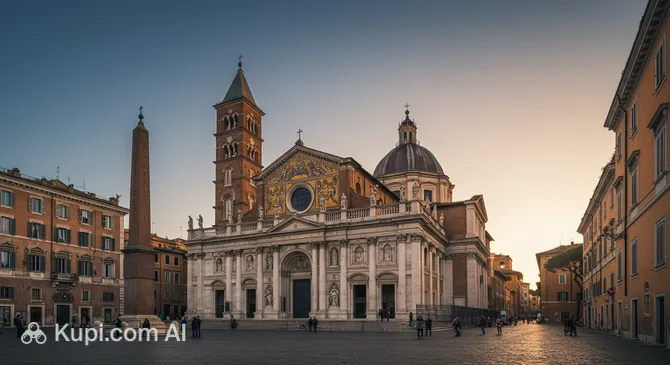
Basilica of Saint Mary Major. Illustration.
Source: Kupi.com AI

Traveler photos:

The founding of the church is associated with a beautiful legend. In the 4th century, the Mother of God appeared in a dream to Pope Liberius and a wealthy citizen named Giovanni, commanding them to build a temple where snow would fall the next morning. On August 5, snow was indeed seen on the Esquiline Hill, where the basilica was then founded. In memory of this miracle, every year on August 5, parishioners are showered with white flower petals. Therefore, the church is also known as "Our Lady of the Snows."

The basilica building impresses with its grandeur and the harmonious combination of various architectural styles—from Early Christian to Baroque. Its interior, which preserves the 5th-century layout, is decorated with unique mosaics considered some of the oldest in Rome. The central nave, divided by forty columns, and the magnificent coffered ceiling, which according to tradition was covered with the first gold brought from the New World, create an unforgettable impression. A priceless relic is also kept here—particles of the Holy Crib of Jesus.

Contacts

For up-to-date information on opening hours, service schedules, or special events, it is recommended to visit the basilica's official website or contact its representatives directly. Key contact details are provided below.

How to contactContact
AddressP.za di Santa Maria Maggiore, 00100 Roma RM, Italy
Phone number+39 06 6988 6800
Websitewww.basilicasantamariamaggiore.va

What to Do

A visit to the basilica is an opportunity to study true artistic treasures in detail. Instead of just glancing at the famous 5th-century mosaics, try to "read" them like a book. The triumphal arch depicts scenes from the childhood of Christ, created in response to the theological disputes of that time, while 36 panels with stories from the Old Testament unfold along the walls of the central nave. To better see the details, bring small binoculars or use the zoom on your phone camera. For the full effect of the coffered ceiling, covered, according to legend, with the first gold from the New World, stand right in the center of the nave.

In addition to seeing the main hall, it is worth paying attention to other important parts of the basilica. Be sure to descend into the crypt under the main altar, where fragments of the wooden manger where, according to tradition, the infant Jesus lay, are kept in a crystal reliquary. Here you will also find the kneeling statue of Pope Pius IX. Don't miss the side chapels, especially the luxurious Sistine and Pauline chapels, each of which is a masterpiece of architecture and art. The 14th-century bell tower—the tallest in Rome (75 meters)—is best photographed from the square in front of the basilica.

To dive deeper into the history of this place, visit the Basilica Museum, which houses unique liturgical objects, papal vestments, and works of art. Entry to the basilica itself is free, but a separate ticket is required to visit the museum and the loggia with 13th-century mosaics. You can also join a guided tour or simply attend a service to fully experience the spiritual atmosphere of this ancient temple. And if your trip to Italy falls on August 5, you can witness a beautiful tradition: in memory of the miraculous snowfall that led to the founding of the church, parishioners are showered with white rose petals.

Getting There

Getting to the Basilica of Santa Maria Maggiore is quite simple thanks to its prime location in the center of Rome, on the piazza of the same name. One of the most convenient ways is on foot, especially if you are near the Termini central station. A walk from the station takes no more than 10 minutes and allows you to immediately soak in the city's atmosphere.

For those who prefer public transport, the basilica is also easily accessible. Nearby is the major transport hub, Termini, where Metro lines A and B intersect, making travel quick from any part of the city. Additionally, numerous city buses stop in the immediate vicinity of Piazza di Santa Maria Maggiore, connecting it with major tourist areas and attractions.

If you plan to get around by car, it is worth noting that finding parking in the center of Rome can be difficult due to heavy traffic and limited traffic zones (ZTL). Although there are paid parking lots near the basilica, it is recommended to use the extensive public transport network for a more comfortable visit.

Nearest city: Rome

History & Facts

The history of the Basilica of Santa Maria Maggiore is inextricably linked to one of the most famous miracles in the history of Rome. According to legend, on the night of August 5, 352, the Virgin Mary appeared in a dream to the then Pope Liberius and a wealthy Roman named Giovanni Patrizio. She commanded them to build a church on the spot on the Esquiline Hill where snow would fall the following morning. When at dawn in the middle of a sweltering August, residents saw a snow-covered patch of land, it was taken as a divine sign, and the first church was founded on that very spot.

Although the original church was built under Pope Liberius, the grand appearance we see today began to take shape later. The current building was erected by order of Pope Sixtus III between 432 and 440. This construction had immense symbolic significance, as it began shortly after the Council of Ephesus in 431, which officially affirmed the dogma of the Virgin Mary as the Mother of God. Thus, Santa Maria Maggiore became one of the first and most magnificent monuments in Italy dedicated to this event.

Over the following centuries, the basilica was constantly expanded and enriched, absorbing features of different eras. For instance, in 1377, its famous bell tower was built, which remains the tallest in the city (75 meters) to this day. In the mid-18th century, specifically the 1740s, the renowned architect Ferdinando Fuga created the new Baroque facade with an elegant portico and loggia that we see today. Thanks to the patronage of many papal dynasties, the basilica became not only an architectural gem but also a treasury housing priceless relics and works of art associated with the cult of the Virgin Mary.

Time Needed

For a standard introductory visit to the Basilica of Santa Maria Maggiore, it is recommended to allow 1 to 2 hours. This time is quite enough to unhurriedly inspect the impressive central nave, study the famous 5th-century mosaics decorating the walls and the triumphal arch, and admire the magnificent coffered ceiling. During this period, you will also have time to feel the special atmosphere of this ancient place and appreciate its overall grandeur.

If you are more deeply interested in art or want to explore every corner of the basilica, you should plan a visit of about two hours. Extra time will allow you to look in detail at the luxurious side chapels, descend into the crypt to see the sacred relics, and visit the adjacent museum. Also, don't forget to take a few minutes to walk around the square in front of the church and admire its majestic facade and the tallest bell tower in Rome.

Working Hours

The Basilica of Santa Maria Maggiore is open to visitors year-round, making it accessible for a visit at any time during your trip to Rome. As a rule, the temple doors are open daily from 7:00 AM to 7:00 PM. However, it's worth remembering that exact opening hours may change depending on the season and the schedule of services or church holidays. To avoid any unpleasant surprises, it is highly recommended to check current information on the basilica's official website immediately before your visit.

Entry to the basilica itself is free, so pre-booking tickets for a standard visit is not required. You can simply come during opening hours and walk inside. Nevertheless, visiting certain parts of the complex, such as the museum, the loggia with mosaics and the Hall of the Popes, requires purchasing a ticket. During periods of high tourist activity or during major religious events, the rules may change, so checking information on official resources is a good idea.

7:00 – 18:30

Nearby

A visit to the Basilica of Santa Maria Maggiore is just the beginning of discovering the treasures of Rome. Due to its location on the Esquiline Hill, the basilica serves as an excellent starting point for further exploration of the Eternal City. A walk through the surrounding area will allow you to dive deeper into the history and culture of Italy, discovering both world-famous monuments and cozy corners hidden from the main tourist routes.

Just a few minutes' walk from the basilica are other iconic sites that are definitely worth including in your itinerary. This proximity allows you to create a packed day program, combining spiritual heritage with ancient history and the charming atmosphere of Roman piazzas. Below is a list of nearby points of interest that are easily reachable on foot.

NameDistance
Ice Club Roma0.9 km
La Nuova Piazzetta0.9 km
Colosseum1 km
Roman Forum1.2 km
Trevi Fountain1.3 km
Altare della Patria1.3 km
Piazza Venezia1.4 km

Have you reached the end of the page?

So the route has been studied inside and out