Support

Ikefukurou

About

In the heart of the bustling Toshima district in Tokyo lies a remarkable symbol of tranquility and longevity—the Ikefukuro Statue, closely linked to the legendary "owl tree" (Fukuro-no-ki). This site is considered sacred by locals, as owls in Japan have long been revered as messengers of good fortune and protectors against hardship.

The centerpiece of this corner is a majestic ancient elm (Ficus superba), which is over 400 years old. Its whimsical shape resembles the silhouette of an owl, which gave the landmark its name. The tree is included in the list of protected natural objects and serves as a living reminder of the history and development of this part of the Japanese capital.
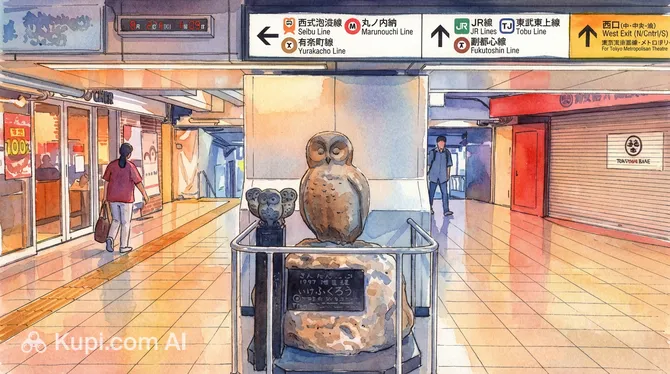
Ikefukurou Statue. Illustration.
Source: Kupi.com AI

Traveler photos:

In addition to the tree itself, visitors are drawn to a small park area with information stands. The Ikefukuro Statue serves as a popular meeting point and a point of interest for tourists wishing to experience the authentic atmosphere of old Edo, hidden among modern skyscrapers and shopping centers.

Contacts

For those planning to visit this unique local symbol, we recommend checking current access information in advance. Although the Ikefukuro Statue and the adjacent historical elm are located in a public space, it is best to verify details about local events or seasonal maintenance through official resources.

Please note that the site is managed by the Toshima Ward. Up-to-date information about the park and its attractions can be found on the official Toshima City Hall website, which will help you better plan your route through Tokyo.

How to contactContact
Address1-chōme-1-28-2 Minamiikebukuro, Toshima City, Tokyo 171-0022, Япония
Websitewww.city.toshima.lg.jp

What to Do

Visiting this site is a great opportunity to slow down and enjoy the peace. The main ritual here is viewing the ancient elm. Depending on the season, the tree changes its appearance: in spring, it delights the eye with fresh greenery, while in autumn, it turns warm golden hues, creating the perfect backdrop for memorable photos.

Many visitors come here to leave their wishes on special plaques or simply sit in the quiet of the park. It is an ideal spot to study the historical plaques that describe how the area looked hundreds of years ago. Thanks to its cozy atmosphere, the square has become a favorite place for a short break after shopping in the Ikebukuro department stores.

Don't forget to take a picture by the Ikefukuro Statue itself—it is a "calling card" of the district. After your visit, you can continue your walk by checking out the numerous themed cafes and shops located just a few minutes' walk from the park.

Getting There

Getting to this historical site in Tokyo is quite easy, as it is located within walking distance of one of the city's largest transportation hubs. The main landmark is Ikebukuro Station, which is served by the JR Yamanote, Seibu Ikebukuro, and Tobu Tojo lines.

From the station's West Exit, it is about a 10–15 minute walk heading south along Minami-Ikebukuro Street. Look for signs pointing toward the small Moto-Ikebukuro Historical Park. The exact address of the site is 1-chōme-1-28-2 Minamiikebukuro.

If you prefer taking a taxi, the trip from central districts will take approximately 20–30 minutes, depending on traffic. However, walking from the station allows you to better experience the dynamic atmosphere of the neighborhood before arriving at the quiet corner by the famous tree.

Nearest city: Tokyo

History & Facts

The history of this place is inextricably linked to the name of the district itself. The Ikefukuro Statue and the Fukuro-no-ki tree are located where the Maruike (Round Pond) once stood. It was this body of water that gave the Ikebukuro district its name, which literally translates to "pond corner."

During the Edo period, until the mid-19th century, agricultural lands stretched across this area, growing vegetables for the capital's needs. With the opening of the railway station in 1906, the landscape began to change rapidly: the area urbanized, and the pond was eventually filled in. The ancient elm remained a living witness to these massive transformations.

To preserve the memory of the past, the Moto-Ikebukuro Historical Park was established nearby in 1998. The installation of commemorative plaques and the owl statue emphasized the importance of this site as a spiritual and historical center connecting the modern metropolis with its agrarian roots.

Today, this corner is considered a "power spot." It is believed that caring for the tree and respecting the history of the site brings good luck to residents and visitors of Japan who decide to stop by this quiet oasis in the middle of bustling Toshima.

Time Needed

To see the Ikefukuro Statue and the surrounding square, it is usually enough to set aside 20 to 40 minutes. This is a compact attraction that is perfect for a short break during a busy walk around the Ikebukuro district.

In this time, you will be able to not only examine the details of the monument and the majestic elm but also read the information plaques telling the history of the site. If you plan to take artistic photos or simply relax on a bench in the shade of the branches, you might want to stay a little longer.

Working Hours

Since the Ikefukuro Statue and the historical tree are located within an open public square, they are accessible 24/7. You can visit this place at any convenient time, as there are no gates or admission fees.

However, for the most comfortable viewing and high-quality photos, we recommend coming during daylight hours. During the day, you can examine the bark texture of the ancient elm in detail and read all the information stands that tell the story of the rich past of this corner of Toshima.

Nearby

The area surrounding this attraction is famous for its eclectic atmosphere, where historical monuments sit alongside vibrant modern culture. A walk through the neighborhood will allow you to see different facets of the Japanese capital—from cozy traditional corners to bustling entertainment venues.

There are popular spots nearby where you can continue your evening. For instance, foodies can visit the Kikanbo Ikebukuro restaurant, famous for its spicy ramen. If you are looking for a more unusual experience, nearby you can find establishments such as the Muscle Girls bar or the atmospheric Moon Walk Ikebukuro.

NameDistance
Suga Shrine5.2 km
Tokyo National Museum6 km
National Museum of Nature and Science6 km
The National Museum of Western Art6 km
Studio Tour Tokyo – The Making of Harry Potter6.2 km
Tokyo Imperial Palace6.3 km
Nijubashi Bridge6.7 km

Reached the end of the page?

That means the route is fully explored