Support

San Vicente de Ávila

About

In the shadow of the majestic city walls of Ávila stands the Basilica of San Vicente—one of the most striking and significant examples of Romanesque architecture that Spain takes pride in. Built from warm, golden "caleño" granite, this church rivals cathedrals in its scale and grandeur, representing a unique transition from austere Romanesque to elegant Gothic.
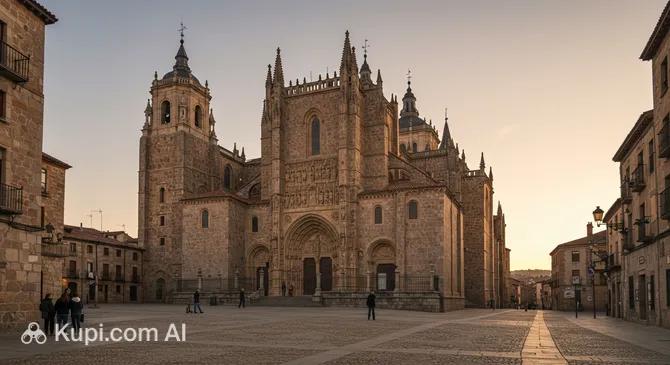
Basilica of San Vicente
Basilica of San Vicente. Иллюстрация. Источник: Kupi.com AI

The basilica is designed in the shape of a Latin cross and is striking in the harmony of its proportions. Its western facade and portals are decorated with the finest carvings, considered a pinnacle of medieval art. Consecrated in honor of the martyrs Vincent, Sabina, and Cristeta, the church is not merely a historical monument but a living testament to the faith and skill of the ancient architects who worked here over several centuries.

Since 1996, the Basilica of San Vicente has been included in the UNESCO World Heritage list. This site attracts travelers not only with its ancient crypt and unique ribbed vaults but also with a special atmosphere of tranquility that reigns just beyond the main tourist trails of the old city.

Contacts

To plan your visit to this architectural masterpiece, it is helpful to have up-to-date contact information on hand. You can always check details regarding services or special events on the official resources.

How to contactContact
AddressPl. de San Vicente, 4, 05001 Ávila, Spain
Phone+34 920 25 52 30
Websitewww.basilicasanvicente.es

What to Do

Inside the basilica, visitors can expect a true immersion into the Middle Ages. Be sure to notice the triforiums above the side aisles—a rare architectural element for Spanish Romanesque that creates a sense of airiness in the space. In the main chapel, the magnificent Baroque altar in the Churrigueresque style catches the eye, contrasting with the strict lines of the stone pillars.

Descend into the crypt, located beneath the main apse. Here lies the sarcophagus of the holy martyrs and the revered statue of the Virgin of Soterraña—the city's patroness, to whom pilgrims have come for centuries. The sculptural decoration of the southern and western portals deserves special study: detailed figures of kings and biblical scenes, such as the Annunciation, are executed with remarkable skill.

Outside, it is worth taking a slow walk around the church to appreciate the tiered semicircular apses and the elegant 15th-century gallery-portico. At different times of the day, light hits the golden granite at different angles, changing the building's appearance. History and art lovers can also attend temporary exhibitions or classical music concerts, which are periodically held within the basilica's walls thanks to its superb acoustics.

Getting There

The basilica is located at Pl. de San Vicente, 4, just steps away from the northeastern corner of the famous city walls, directly opposite the Puerta de San Vicente gate. If you are already in the historic center, the walk from the cathedral will take no more than 10–15 minutes, making the church an ideal point for continuing your walking route.

For travelers from Madrid, it is most convenient to take the train (AVE lines or regional expresses), which will get you to the city in 1–1.5 hours. From the Ávila railway station, you can reach the basilica by taking bus No. 1, calling a taxi, or walking about 2–3 kilometers while enjoying the city views.

For those who prefer bus travel, regular services from Avanza or Alsa depart from the capital and arrive at the bus station, which is about a 20-minute walk from the attraction. If you are traveling by car via the A-50 highway, there are parking zones near the basilica, although spots may be limited during the high season.

Ближайший город: Avila

History & Facts

The history of this site dates back to antiquity, to the 4th century, when Saint Vincent (San Vicente) and his sisters, Sabina and Cristeta, were martyred for their faith on this very spot. Legend has it that their bodies were left to the elements in the rocks but were miraculously preserved, making this a sacred site long before the current walls were built.

Construction of the modern building began in the 12th century, around 1109–1130, under the patronage of Count Raymond of Burgundy. The work was carried out using unique local "caleño" granite, which gives the walls a noble golden hue over time. The construction of the church spanned centuries: while the crypt and apses are executed in a strict Romanesque style, the vaults and dome already bear the features of emerging Gothic architecture.

A significant contribution to the basilica's appearance was made by Master Fruchel, whose influence can be seen in the delicate sculpture and architectural solutions. Over the centuries, new elements were added to the building: the northern portico appeared in the 15th century, and a lavish Baroque retable was added in the 18th century. Since 1882, the basilica has been recognized as a National Monument, and today it is rightfully included in the UNESCO World Heritage list as an integral part of the city's cultural landscape.

Time Needed

To leisurely admire all the architectural details, visit the crypt, and appreciate the play of light on the ancient stones, the average tourist typically needs 1 to 1.5 hours. This is enough time to walk around the exterior, study the rich carving of the portals, and spend some time in the quiet of the inner naves.

If you plan to study the sculptural compositions in detail or want to climb to the triforium for a better view of the interior, it is worth setting aside a bit more time. A visit to the basilica combines perfectly with a walk along the city walls, which are located in the immediate vicinity.

Working Hours

The basilica is open to visitors daily; however, the schedule accounts for the traditional Spanish siesta break. From Monday to Saturday, you can enter the church from 10:00 to 14:00 and in the afternoon from 16:00 to 19:00.

On Sunday, the basilica's doors open only after noon—from 16:00 to 18:00. Please remember that sightseeing may be restricted during church services, so it is best to choose a time between masses for an educational visit.

DayWorking hours
Понедельник10:00 – 14:00, 4:00 – 19:00
Вторник10:00 – 14:00, 4:00 – 19:00
Среда10:00 – 14:00, 4:00 – 19:00
Четверг10:00 – 14:00, 4:00 – 19:00
Пятница10:00 – 14:00, 4:00 – 19:00
Суббота10:00 – 14:00, 4:00 – 19:00
Воскресенье4:00 – 18:00

Nearby

The basilica's location makes it an ideal starting point for further exploration of the city. Literally across the street, the famous fortifications begin, and the concentration of historical monuments in this area allows for a truly fulfilling day.

NameDistance
Walls of Ávila0.1 km
Museum of Ávila0.2 km
Bococo Restaurant0.3 km
Avila Cathedral0.3 km
Mercado Chico Square0.4 km
Alcázar Gate0.4 km
Los Candiles0.4 km

Reached the end of the page?

That means the route is fully explored