Support

Passeig Arqueològic

About

The Archaeological Promenade (Passeig Arqueològic) is a unique walking route that runs along the majestic walls of the ancient city of Tarragona. This site represents one of the most significant monuments of Roman military architecture in modern-day Spain. Included in the UNESCO World Heritage list, these magnificent fortifications allow you to literally touch history dating back more than two millennia.
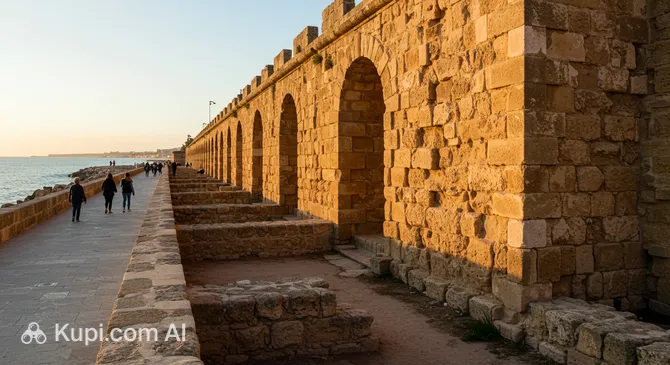
Archaeological Promenade
Archaeological Promenade. Иллюстрация. Источник: Kupi.com AI

The route follows a preserved section of the ancient walls, which originally reached a length of 3,500 meters. Today, visitors can see about 1,100 meters of fortifications, where the massive cyclopean stones of the foundation stand alongside medieval additions and powerful 18th-century bastions. This location perfectly combines the rugged power of ancient defensive structures with the tranquility of shaded gardens.

Three surviving towers are of particular value: the Minerva Tower, the Cabiscol Tower, and the monumental Archbishop’s Tower. The latter stands out for its height of 25 meters and interesting architectural details from different eras. While walking here, you can even spot ancient stonemason marks in the Iberian language, making the stroll feel like an exciting journey deep into the centuries.

Contacts

To plan your visit to the Archaeological Promenade, it's helpful to have the basic contact information at hand. The city's official tourism portal provides detailed information regarding access to the monument.

How to contactContact
AddressAv. Catalunya, 1A, 43002 Tarragona, Испания
Websitewww.tarragonaturisme.cat

What to Do

A visit to the Archaeological Promenade is, first and foremost, an opportunity to take a leisurely stroll surrounded by history. It is worth carefully examining the megalithic foundations of the walls, built from huge stone blocks without the use of mortar. Photography enthusiasts will find many excellent angles: from ancient columns and powerful fortress gates to 17th–18th-century cannons displayed on the bastions.

Be sure to look into the inner hall of the Archbishop’s Tower to appreciate its vaulted ceilings and medieval atmosphere. On the walls of the oldest section of the fortifications (built at the end of the 3rd century BC), you can spot stonemason marks—a living testimony to the labor of local Iberian tribes who assisted the Romans in the construction.

The walking route offers picturesque panoramic views of the city's historic center, making it a popular spot for the whole family to relax. The path is well-equipped and allows you to combine archaeological study with a pleasant time outdoors, while its proximity to other Roman monuments makes it easy to create a full sightseeing plan for the day.

Getting There

The site is located at Av. Catalunya, 1A, in the northern part of the Old Town. The easiest way to get here is on foot from Tarragona's central districts. A walk from the Tarragona Cathedral or the central Plaça de la Font will take no more than 5–10 minutes. If you are coming from the famous Roman Amphitheatre, the walk along the walls takes about 15 minutes.

For those who prefer public transport, buses heading to stops near Rambla Nova or the Central Market (Mercat Central) are suitable. From there, it’s about a 10-minute walk to the entrance. If you arrive from Barcelona by Renfe train, you can take city bus No. 1 or take a 20-minute uphill walk from the railway station.

Drivers can use parking lots near the city port or in the city center, as parking spaces in the immediate vicinity of the walls in the historic center are limited. Using GPS coordinates will help you quickly navigate the narrow streets and find the entrance to the promenade.

Ближайший город: Tarragona

History & Facts

The history of this site is inextricably linked to the founding of ancient Tarraco in 218 BC. During the Second Punic War, Roman troops under the command of Gnaeus Cornelius Scipio landed here to establish a strategic bridgehead. The first walls began to be built almost immediately, utilizing the labor of the local Iberian population, as evidenced by characteristic inscriptions on the stones.

During the height of the Roman Empire, Tarraco became one of the largest centers of the province. The city expanded, and its walls became part of a monumental ensemble that included the Temple of Augustus, the Circus, and the Amphitheatre. The walls were so sturdy that they continued to serve a defensive function for many centuries, undergoing only partial modifications.

The Middle Ages added its own features to the promenade's appearance: for instance, the Archbishop’s Tower was heightened in the 12th century and converted into a fortified residence with battlements and arrow slits. Later, in the 17th and 18th centuries, due to new military threats, the complex was supplemented with then-modern bastions for artillery placement. In 2000, the entire archaeological complex was officially recognized by UNESCO as a site of outstanding cultural heritage.

Time Needed

For a comfortable exploration of the Archaeological Promenade and all its key elements, most travelers will need between 1 and 2 hours. This is plenty of time to leisurely walk the entire route, study the information panels, and take memorable photos against the backdrop of the ancient towers.

If you plan to examine the stonework in detail looking for Iberian marks or are an enthusiast of historical photography, your visit may extend to 2.5 hours. This place does not require rushing and invites thoughtful contemplation of centuries-old architecture.

Working Hours

The Archaeological Promenade is open for visitors from Tuesday to Saturday from 09:30 to 20:30. On Sundays, the gates are open on a reduced schedule—from 09:30 to 14:30. Please note that the site is usually closed to visitors on Mondays.

Since the operating schedule may change depending on the season or cultural events, it is recommended to check the latest information on the city's official tourism website before your visit.

DayWorking hours
понедельникЗакрыто
вторник09:30–20:30
среда09:30–20:30
четверг09:30–20:30
пятница09:30–20:30
суббота09:30–20:30
воскресенье09:30–14:30

Nearby

The location of the Archaeological Promenade in the heart of ancient Tarraco offers tourists excellent opportunities for further exploration of the city. Within just a few minutes' walk of each other, there are monuments that together shape the character of one of the most "Roman" cities outside of Italy.

Exploring the surrounding area will help you get a complete picture of how this important ancient center functioned, from the entertainment at the amphitheatre to the business life at the forum. Below are the nearest points of interest to include in your itinerary.

NameDistance
Roman Walls of Tarragona0 km
Portal del Roser0 km
Model of the Roman City of Tarraco0.1 km
Camp de Mart0.1 km
Roman Circus of Tarragona0.3 km
Tarragona Museum of Modern Art0.3 km
The Cube Day0.4 km

Reached the end of the page?

That means the route is fully explored