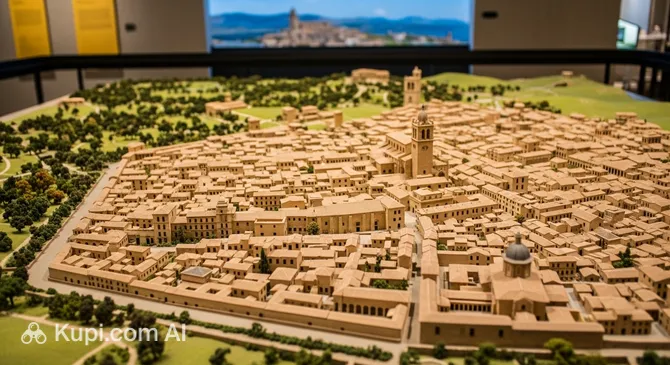
Imagine being able to take in an entire ancient capital at a single glance without leaving the room. The Model of the Roman City of Tarraco is an impressive large-scale reconstruction of the ancient settlement of Tarraco (modern-day Tarragona) as it appeared in the 2nd century AD, during its peak power in Spain.
The model is built at a scale of 1:500 and occupies an impressive area of 18 square meters, making it the second-largest model of a Roman city in Europe after the famous model of Rome. Located in the historic Volta del Pallol building, this exhibit allows tourists to visualize the complex layout of the provincial capital of Hispania Tarraconensis and appreciate the grandeur of its forums and amphitheaters.
Model of the Roman City of Tarraco. Illustration.
Source: Kupi.com AI
Traveler photos:
This is more than just a static miniature; the exhibition is enhanced by a modern video mapping system. Through light and sound, the city's key landmarks literally come to life, and the history of Tarraco is told through the eyes of a resident from that era. Best of all for travelers — entry to the hall with the model is completely free.
Contacts
To check the light show schedule and current visiting conditions, you can use the official contact details of the Tarragona city information service.
The main purpose of a visit is to gain a detailed understanding of how an ancient metropolis was organized. Be sure to wait for the start of the immersive mapping projection. For 15 minutes, light highlights the buildings on the model as they are mentioned in the audio guide, making it easy to locate the famous circus, the provincial forum, or the Pont del Diable aqueduct on the miniature layout.
After the show, it is worth spending some time studying the details on your own. By observing the streets and houses, you can get a sense of what daily life was like for the Romans. This is especially useful before heading out to see the actual ruins of Tarragona: after seeing the model, the stone foundations and remaining walls will take on new depth and meaning.
Many visitors recommend coming on weekends to catch shows with English commentary (usually around 11:00). Photography of the model is permitted, so you can capture panoramas of the ancient city from unique angles that are impossible to get when visiting the actual archaeological sites.
Getting There
The attraction is located in the pedestrian zone of the historic center at Plaça del Pallol, 3. It is easy to find by heading for the medieval Volta del Pallol building. From most key ancient monuments, such as the Roman amphitheater or the forum, the model is just a 5–10 minute walk away.
If you are using public transport, take the city buses that stop at Plaça de la Font or Mercat Central. From there, it is a short walk through the picturesque streets of the old quarter to the entrance.
For travelers arriving from Barcelona by Renfe train, it takes about an hour to reach Tarragona station. From the station, you can reach the historic center in 15–20 minutes by walking uphill or by taking a local bus. For those traveling by car, the nearest public parking is located near the Mercat Central, as traffic within the historic part of the city is strictly limited.
Nearest city: Tarragona
History & Facts
Ancient Tarraco was founded by the Romans in the 1st century BC and eventually grew into the magnificent capital of the province of Hispania Tarraconensis. It was one of the most important administrative and cultural centers on the Iberian Peninsula. The Model of the Roman City of Tarraco was created to commemorate Tarragona’s designation as a UNESCO World Heritage Site and serves as a visual guide to the urban planning of that era.
Remarkably, it took more than 8,000 hours of meticulous work to create this large-scale model. Every building, from the grand amphitheater to the residential blocks, has been recreated based on actual archaeological data. The model reflects the city's appearance in the 2nd century AD — the period of its greatest architectural glory when Tarraco boasted massive forums, a circus, and a complex system of aqueducts.
A multimedia projection adds a special atmosphere to the historical narrative. The story is narrated by Melpomene — a young slave girl who "brings the city to life" by sharing details about the daily lives of its inhabitants. This approach allows guests to do more than just look at a static model; they can feel the living pulse of the ancient capital.
Time Needed
A standard visit to the exhibition usually takes between 30 and 60 minutes. Most of this time is dedicated to watching the multimedia mapping show, which lasts about 10–15 minutes, followed by a detailed look at the model itself.
If you are an enthusiast of history and architecture, you might want a bit more time to examine the miniature details of the city quarters and compare them with the map of modern excavations. It is an excellent option for a brief but educational break while strolling through the old town.
Working Hours
The model is open to visitors throughout the week, though the schedule varies. From Monday to Friday, the doors are open from 09:00 to 20:30. On Saturday and Sunday, the hours are reduced — you can view the exhibition from 09:30 to 14:30.
Please note that the multimedia shows run on a specific schedule. To ensure you see the projection in your preferred language, it is recommended to check the session schedule in advance on the official website mappingtarraco.cat.
Day
Working hours
Monday
09:00–20:30
Tuesday
09:00–20:30
Wednesday
09:00–20:30
Thursday
09:00–20:30
Friday
09:00–20:30
Saturday
09:30–14:30
Sunday
09:30–14:30
Nearby
The Model of the Roman City of Tarraco is located in the heart of the historic quarter, making it an ideal starting point for a tour of the city's ancient heritage. Studying the model will help you get your bearings and understand the scale of the preserved ruins scattered throughout modern Tarragona.