Support

Museum of Santa Cruz

About

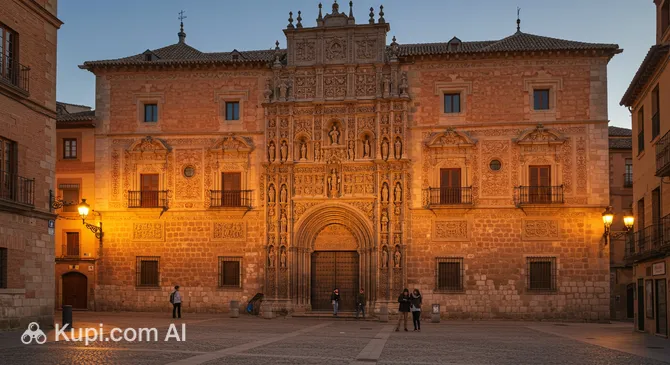
In the heart of the historic center of the ancient city of Toledo lies one of the most impressive architectural treasures Spain has given the world — the Santa Cruz Museum (Museo de Santa Cruz). Housed in a former hospital building from the late 15th to early 16th century, it is a magnificent example of the transition from Gothic to Renaissance, executed in the unique Plateresque style.
Museum of Santa Cruz
Museum of Santa Cruz. Иллюстрация. Источник: Kupi.com AI

The building, constructed of pink stone and marble, is striking in its decoration: from the richly adorned main facade by Alonso de Covarrubias to the elegant Moorish-style courtyard. The two-level gallery with arcades decorated with figures of cherubs and the coats of arms of the Mendoza family creates an atmosphere of serenity and grandeur characteristic of the Golden Age of Spanish culture.

Today, it is not just a historical monument but one of the most important cultural centers in the region. Its walls house priceless collections spanning a vast period of human history, making the Santa Cruz Museum a must-visit for every art lover exploring Castile-La Mancha.

Contacts

To plan your visit to the Santa Cruz Museum, it is helpful to check the official information in advance. Please note that the museum is located in the heart of the historic quarter and is accessible via scenic pedestrian routes.

How to contactContact
AddressC. Miguel de Cervantes, 3, 45001 Toledo, Spain
Websitecultura.castillalamancha.es

What to Do

A visit to the museum is a fascinating journey through the centuries, divided into three major sections. Start your exploration with the archaeological section, where the crypt and the surrounding courtyard display artifacts ranging from prehistoric times to the Islamic period. Here, you can see Roman sarcophagi, Visigothic jewelry, and Arabic epigraphy, all testifying to the region's rich past.

Special attention should be paid to the applied arts collection. Highlights include magnificent 15th-century Flemish tapestries, knightly weapons, and an authentic standard from the legendary Battle of Lepanto. Renaissance furniture and religious items allow visitors to imagine the daily life and rituals of the Spanish nobility in centuries past.

The main draw for tourists is the art gallery on the upper floor. The pride of the collection is more than 20 original canvases by El Greco, including the famous "Assumption of the Virgin." In addition to the great master's masterpieces, works by such outstanding painters as Goya, Luis Tristán, and Pedro Berruguete are also on display, making this one of the most significant collections in the country.

Getting There

The museum is located at C. Miguel de Cervantes, 3, literally steps away from the famous Plaza de Zocodover and the majestic Alcázar. If you are already exploring the old town, you can easily reach it on foot by following the signs to the Cathedral.

For those arriving from Madrid, the most convenient way is the AVE high-speed train, which will get you to the city's station in 30 minutes. From the station, you can take a taxi or use city buses (routes 5, 6, 7) to reach the center; the trip takes about 10–15 minutes. A walk uphill from the station is also possible and takes about 20 minutes, offering magnificent panoramic views along the way.

Driving into the historic center is not recommended due to the extremely narrow streets and lack of parking spaces. The best solution is to leave your car in one of the free parking lots on the outskirts and enter the city via escalators or on foot to fully experience its medieval charm.

Ближайший город: Toledo

History & Facts

The history of this majestic building began at the end of the 15th century at the behest of Cardinal Pedro González de Mendoza. He personally laid the foundation stone for the Hospital of the Holy Cross, which was intended to be a model charitable institution. The original project was developed by the talented Enrique de Egas, who designed the building's core in the shape of a Greek cross.

The construction process spanned decades due to a lack of funding. It wasn't until the 16th century that the famous architect Alonso de Covarrubias took over, adding the splendor of the Spanish Renaissance to the building. He designed the magnificent facade and the grand staircase, which became hallmarks of the Plateresque style.

Over the centuries, the building's functions changed, and it even fell into disrepair for a time. The building's second life began in the mid-20th century when it opened as a museum following extensive restoration. The collection's current form was finalized by 2010, bringing together treasures from archaeological funds and private collections.

Time Needed

To explore all three thematic sections without rushing and to admire the architectural details of the building itself, visitors usually need 1.5 to 2.5 hours. This is enough time to appreciate the painting collection and spend a few moments in the peaceful inner courtyard.

If you are a passionate fan of El Greco's art or archaeology, your visit might last longer. The architecture of the former hospital is an exhibit in its own right, so it is worth setting aside some extra time to contemplate the carved capitals and monumental staircases.

Working Hours

The Santa Cruz Museum is open to visitors throughout the week, but the schedule depends on the day of your visit. From Monday to Saturday, the museum's doors are open from 10:00 to 18:00. On Sunday, there is a reduced schedule from 9:00 to 15:00.

An important detail is that admission to the museum is free, though visitors still need to go to the ticket office to receive an entry ticket. It is also worth noting that photography is strictly prohibited inside the halls to ensure the preservation of the ancient paintings and artifacts.

DayWorking hours
Понедельник10:00 – 18:00
Вторник10:00 – 18:00
Среда10:00 – 18:00
Четверг10:00 – 18:00
Пятница10:00 – 18:00
Суббота10:00 – 18:00
Воскресенье9:00 – 15:00

Nearby

The museum's location in the heart of the city makes it easy to combine your visit with other iconic sites. A walk through the surrounding streets will help you dive deeper into the atmosphere of the "city of three cultures."

NameDistance
Barrio Cocktail Restaurant0.1 km
Army Museum0.1 km
Museo Cromática0.1 km
Alcázar of Toledo0.2 km
Sala Pícaro0.2 km
Alcántara Bridge0.3 km
Puerta del Sol0.3 km

Reached the end of the page?

That means the route is fully explored