Support

City of Arts and Sciences

About

The City of Arts and Sciences (Ciudad de las Artes y las Ciencias) is one of the most famous and impressive modern landmarks not only in Valencia but in all of Spain. This large-scale architectural and cultural complex, sprawling across the reclaimed bed of the Turia River, has become a true symbol of the city of the future. The project, designed by the eminent architects Santiago Calatrava and Félix Candela, captures the imagination with its futuristic shapes and snow-white structures reflected in the azure water of the pools.

The complex is a unique space where science, art, and nature merge into one. It consists of several iconic buildings, each deserving individual attention. Among them are: L'Hemisfèric, shaped like a giant eye, which houses an IMAX cinema and planetarium; the interactive Prince Felipe Science Museum, resembling a whale skeleton; and L'Oceanogràfic — Europe's largest open-air oceanographic park.
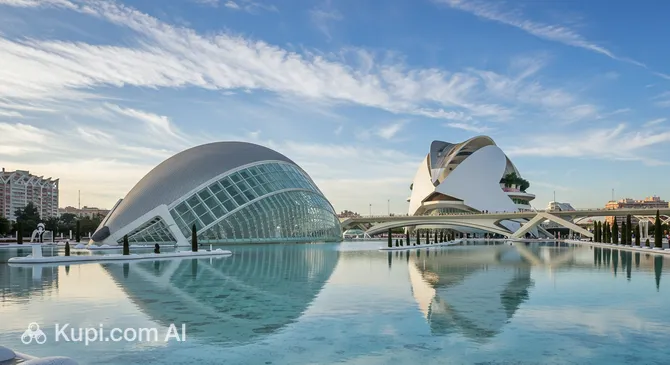
City of Arts and Sciences. Illustration.
Source: Kupi.com AI

Traveler photos:

In addition, the City of Arts and Sciences includes the Queen Sofia Palace of the Arts — an opera house with stunning acoustics; the L'Umbracle garden gallery featuring plants typical of the Mediterranean region; and the Àgora multifunctional space. A walk through this architectural marvel leaves an unforgettable impression, allowing visitors to immerse themselves in a world of innovation and beauty. This place is truly a must-visit for anyone who wants to see the architecture of the future today.

Contacts

If you are planning to visit the City of Arts and Sciences, we recommend checking the latest information on opening hours, ticket prices, and special events in advance. The most up-to-date and complete details are always available on the complex's official website. Below are the main contact details.

How to contactContact
AddressQuatre Carreres, 46013 Valencia, Spain
Phone number+34 961 97 46 86
Websitecac.es

What to Do

A visit to the City of Arts and Sciences offers guests a kaleidoscope of experiences for every taste. At L'Hemisfèric, the giant eye-shaped building, you can dive into the world of cinema thanks to IMAX screenings on a massive 900-square-meter concave screen, as well as laser shows and digital 3D projections dedicated to space and nature. The neighboring Prince Felipe Science Museum follows the motto "It is forbidden not to touch," inviting visitors of all ages to interact directly with the exhibits. Here you can conduct your own physics and chemistry experiments, explore a giant DNA molecule model, and learn about the latest scientific and technical achievements in a fun and engaging way.

One of the most exciting parts of the complex is L'Oceanogràfic — the largest aquarium in Europe, home to about 45,000 marine animals from more than 600 different species. Here, visitors can walk through underwater tunnels surrounded by sharks, see graceful belugas, dolphins, sea lions, and penguins. The oceanographic park is divided into several zones representing the planet's key ecosystems — from the Arctic to the Red Sea. In addition to observing the animals, you can attend an impressive dolphin show, as well as educational programs about the importance of marine conservation.

For lovers of fine art, the Queen Sofia Palace of the Arts offers a rich program including opera productions, ballet performances, and world-class classical music concerts. The L'Umbracle promenade is an open-air garden with exotic plants and sculptures, an ideal place for quiet relaxation. Meanwhile, the multifunctional Àgora space regularly serves as a venue for exhibitions, congresses, and cultural events. Furthermore, temporary exhibitions, workshops, and educational tours for children and adults are often organized throughout the complex, making every visit to the City of Arts and Sciences unique in its own way.

Getting There

Getting to the City of Arts and Sciences is quite simple, as it is conveniently located near the center of Valencia and is one of the city's key tourist landmarks. Many transport options are available for visitors, including buses, the metro, and taxis, as well as the possibility of walking or cycling while enjoying the scenic views of the park in the Turia riverbed.

Public transport is the most popular and budget-friendly way to reach the complex. Several city bus routes serve the area, including Nos. 13, 15, 19, 35, 95, and 40, which stop in the immediate vicinity. You can also use the metro: the nearest stations are Alameda and Colón, from which it is a short bus ride or a pleasant walk to the City of Arts and Sciences.

For those who prefer active recreation, a walk from the historic center takes approximately 30–40 minutes. Additionally, convenient bicycle paths lead to the complex, making a bike ride quick and enjoyable. If you value comfort, a taxi ride from anywhere in the city won't take long. For those traveling by private car, please note that there are dedicated parking areas near the City of Arts and Sciences.

Nearest city: Valencia

History & Facts

The history of the City of Arts and Sciences is an example of a bold dream turned into reality. The idea for its creation was born in 1989 with history professor José María López Piñero. He proposed a brilliant solution: to use the dry bed of the Turia River to build a unique cultural and scientific complex. This ambitious concept was supported by the government of Valencia, and large-scale construction work began in 1994, forever changing the face of the city.

The futuristic look of the complex was the work of the outstanding Spanish architect Santiago Calatrava, while the design of the Oceanographic Park (L'Oceanogràfic) was handled by the equally talented Félix Candela. Construction was carried out in stages, transforming the former riverbed into a city of the future. The first building to open to visitors in 1998 was L'Hemisfèric, designed in the shape of a giant eye. Gradually, the ensemble was supplemented with new structures, with the final touch being the completion of the opera house, the Queen Sofia Palace of the Arts, in 2005.

Since its opening, the City of Arts and Sciences has quickly become not just the main attraction of the region, but a true symbol of modern Spain. Its snow-white, almost alien structures have become the calling card of Valencia, attracting millions of tourists from all over the world. The uniqueness of this place lies in the harmonious combination of science, art, and nature, making it one of the most remarkable examples of 21st-century architecture.

Time Needed

When planning a visit to the City of Arts and Sciences, be prepared for it to take up a significant part of your day. To truly enjoy this futuristic complex without rushing, it is highly recommended to set aside at least half a day, and ideally an entire day. For a full tour of all the main sites, including the Oceanographic Park and the Science Museum, you will need at least 6–8 hours.

The time required for a visit depends heavily on your interests. If you only want to stroll around the grounds, admire the architecture, and take a few photos, a couple of hours might be enough. However, the true magic of the complex is hidden inside its buildings. For example, you should budget about 4 hours to visit L'Oceanogràfic, Europe's largest aquarium, especially if you plan to see the dolphin show. The interactive Prince Felipe Science Museum will require another 2-3 hours to explore its fascinating exhibits. A session at the L'Hemisfèric IMAX cinema lasts about 45-50 minutes, but including waiting time, this will add about an hour to your itinerary.

Therefore, if your time is limited, it is better to choose one or two of the most interesting sites in advance. For a family holiday, the Oceanographic Park and the Science Museum are ideal choices. If you want to get a general overview, you can combine a walk through the complex with a movie at L'Hemisfèric. In any case, even a short acquaintance with this architectural wonder will leave an unforgettable impression.

Working Hours

The City of Arts and Sciences is open to visitors year-round; however, it is important to remember that opening hours depend on the specific site within the complex and the season. On average, most pavilions, such as the Prince Felipe Science Museum and the L'Hemisfèric cinema, open at 10:00 AM and operate until 6:00 PM – 7:00 PM, while in the summer months and on holidays, they stay open until 9:00 PM. The L'Oceanogràfic oceanographic park also opens at 10:00 AM and usually closes between 6:00 PM and 8:00 PM, depending on the season.

Since schedules can change depending on the time of year and special events, it is highly recommended to check the current opening hours on the complex's official website immediately before your visit. To avoid long queues, especially during the peak tourist season, it is wise to purchase tickets online in advance. This will not only save you time but also guarantee access to the pavilions you are interested in.

DayOpening hours
Monday10:00 – 18:00
Tuesday10:00 – 18:00
Wednesday10:00 – 18:00
Thursday10:00 – 18:00
Friday10:00 – 19:00
Saturday10:00 – 19:00
Sunday10:00 – 19:00

Nearby

Visiting the City of Arts and Sciences is an unforgettable adventure in its own right, but to fully experience the atmosphere of modern Valencia, it is well worth exploring the surrounding area. This futuristic complex is located in a picturesque park set in the former bed of the Turia River, making it an ideal starting point for fascinating walks and discoveries. Within walking distance, you will find other parts of the complex itself, as well as interesting parks, shopping malls, and entertainment facilities.

Exploring the nearby attractions will allow you to get a more complete picture of this part of the city. You can easily combine your cultural program with shopping, relaxing in nature, or visiting other unique sites, complementing your impressions of Santiago Calatrava's architectural genius.

NameDistance
Principe Felipe Science Museum0.2 km
Oceanogràfic Valencia0.3 km
Oceanogràfic0.5 km
La Finestra1.9 km
Casa Montaña2.1 km
Mestalla Stadium2.3 km
Las Arenas Balneario Resort2.6 km

Have you reached the end of the page?

So the route has been studied inside and out