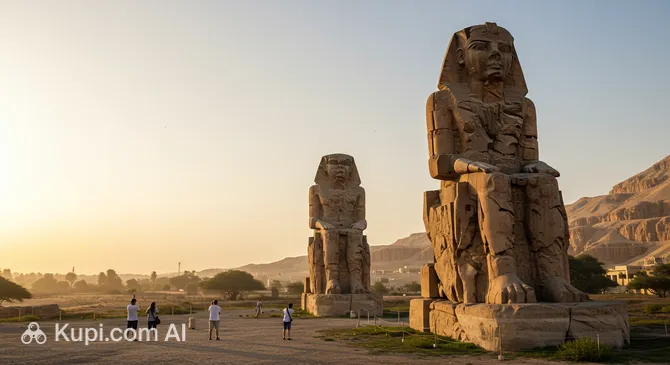
The Colossi of Memnon are two majestic stone statues rising on the West Bank of the Nile, near the city of Luxor in Egypt. These monumental sculptures depict Pharaoh Amenhotep III, ruler of the 18th Dynasty, also known as Amenhotep the Magnificent. The Pharaoh is portrayed sitting on a throne, his hands resting on his knees, and his gaze fixed eastward toward the sacred Nile River.
Traveller photos:
Each statue is a monolith carved from a single block of quartzite sandstone. This durable stone was quarried at Gebel el-Ahmar ("the Red Mountain"), located near ancient Heliopolis, and then transported with incredible effort to Thebes, the ancient name for modern-day Luxor.
In addition to the giant figure of the Pharaoh himself, smaller, skillfully carved figures can be seen at his feet on the front of the throne—his wife, Queen Tiye, and his mother, Mutemwiya. The side panels of the throne are decorated with reliefs depicting Hapi, the Nile god, symbolizing fertility and abundance. Originally, the Colossi of Memnon served not just as decoration but played a vital role as guardians, standing at the entrance to the grand mortuary temple complex dedicated to Pharaoh Amenhotep III and his divine cult.