Support

Karnak Temple

About

Karnak Temple is not just a single building, but a grand temple complex sprawling across the East Bank of the Nile in the city of Luxor. This massive architectural ensemble was one of the primary religious centers of Ancient Egypt for many centuries and today stands as one of the greatest treasures of ancient Egyptian civilization. Construction of the complex continued for nearly two millennia, with each pharaoh striving to leave their mark on its history.

The name "Karnak" comes from an Arabic word meaning "fortified village," which accurately reflects its structure. The complex is a labyrinth of numerous temples, chapels, pylons, and other structures. This site was home to the Theban Triad of deities: the supreme god Amun-Ra, his consort, the mother goddess Mut, and their son, the moon god Khonsu.
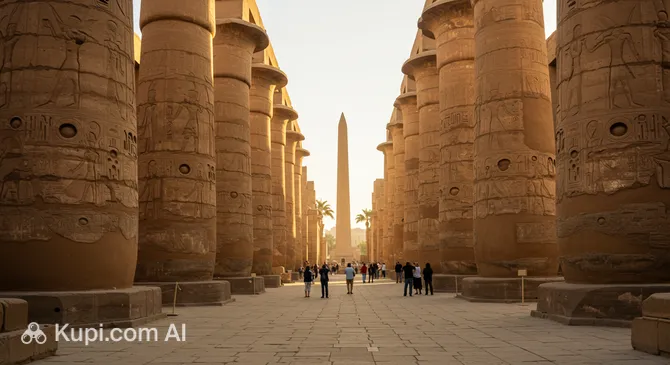
Karnak Temple. Illustration.
Source: Kupi.com AI

Traveller photos:

Visiting Karnak Temple is a true immersion into history. Walking along the famous Avenue of Ram-headed Sphinxes, viewing the colossal statues and reliefs, and visiting the enormous Hypostyle Hall with its forest of 134 giant columns leaves an unforgettable impression. This cult complex played a vital role in the lives of ancient Egyptians and continues to amaze with its grandeur and power.

Contacts

As the Karnak Temple is a massive historical complex under the open sky, it does not have a single contact phone number for visitors. For the most up-to-date information on opening hours and ticket prices, it is best to check the official websites of the Ministry of Tourism and Antiquities of Egypt or inquire directly on-site. The complex is located on the East Bank of the Nile in Luxor and is easily accessible by taxi or a traditional horse-drawn carriage (calèche) from any part of the city.

How to contactContact
AddressKarnak, Luxor, Luxor Governorate, Egypt
Phone+20 2 22617304

What to Do

Visiting Karnak Temple is an exploration of an entire city of antiquities, where every element tells its own story. Walking through the complex allows you to see numerous architectural wonders. Your journey begins at the First Pylon, erected during the 30th Dynasty, and leads through the famous Avenue of Sphinxes. Next, you will enter the Great Court, built during the 22nd Dynasty, where you can appreciate the scale and majesty of the ancient structures. Here you will also find the impressive entrance to the Temple of Ramesses III, showcasing the skillful craftsmanship of the period.

The monumental courtyard surrounded by statues, one of the most recognizable spots in Karnak, deserves special attention. You will be able to take a close look at the Hall of Caryatids—a unique architectural solution for Ancient Egypt. Traveling deeper into the complex, you will discover other historical artifacts. For instance, keep in mind that one of the oldest finds—an eight-sided column from the time of Pharaoh Intef II (11th Dynasty)—is now a valuable exhibit in the Luxor Museum.

The central and perhaps most impressive part of the complex is the Great Hypostyle Hall. It is often compared to a stone forest due to its 134 massive columns covered in ancient hieroglyphs and reliefs. Walking between these giant pillars, which still show traces of vibrant colors, makes a lasting impression. Also within the complex is the Sacred Lake, where priests performed ritual ablutions, and the famous statue of the scarab beetle, which, according to legend, grants wishes.

Getting There

Karnak Temple is located on the East Bank of the Nile, within the modern-day city of Luxor, making it very accessible for tourists. There are several ways to reach the complex from the city center or most hotels. The simplest option is to take a taxi, which takes about 10-15 minutes. You can also hire a traditional horse-drawn carriage, known as a calèche, which turns the journey into a mini sightseeing tour. For those who prefer walking, the trip from Luxor Railway Station takes about 45-50 minutes on foot.

For travelers staying at popular Red Sea resorts such as Hurghada or Marsa Alam, the most convenient way to visit Karnak is via an organized tour. Tour operators offer one-day and two-day bus trips, with the drive from Hurghada taking approximately 4-5 hours. These trips usually include not only the Karnak Temple but also other iconic sites in Luxor: the Valley of the Kings, the Temple of Hatshepsut, and the Colossi of Memnon.

Independent travelers can reach Luxor from Cairo or other cities in Egypt by train or intercity bus. Additionally, the city has an international airport (Luxor International Airport), located just 15 minutes away from the temple. This makes it possible to fly into Luxor even for a single day to explore the main ancient monuments, including the majestic Karnak complex.

Nearest city: Luxor

History & Facts

The history of Karnak Temple is a true chronicle of ancient Egyptian civilization etched in stone. Its construction spans a colossal period of time—starting around 2055 BC and continuing until 100 AD. Originally, before the 11th Dynasty, only a modest complex of small temples dedicated to an early Theban god named Montu stood on this site. The oldest artifact found here is considered to be an eight-sided column created during the reign of Pharaoh Intef II, which testifies to the religious significance of this location even at the dawn of the Middle Kingdom.

Truly large-scale construction began during the reign of Pharaoh Senusret I of the 12th Dynasty and reached its peak during the New Kingdom era. Each subsequent pharaoh considered it their duty to contribute to the expansion and decoration of Egypt's main sanctuary, leaving a legacy of their reign. Thus, the architectural explorations of the 18th Dynasty architects, aimed at creating a new type of temple, culminated in the construction of the famous Luxor Temple in the second half of the 15th century BC, which was conceptually and physically linked to Karnak.

The complex was constantly expanded and modified over the centuries, making it resemble a complex architectural organism. For example, the Great Court, which greets visitors today, was added much later, during the 22nd Dynasty. Meanwhile, the main entrance to the complex—the monumental First Pylon—actually dates back to the 30th Dynasty, one of the last dynasties of native Egyptian rulers. It was for its construction that the famous Avenue of Sphinxes, which originally stood elsewhere, was moved. These constant changes and additions have turned Karnak Temple into a unique historical monument with no equal in the world.

Time Needed

When planning a visit to Karnak Temple, be prepared for the fact that exploring it will take a significant amount of time. To fully experience this grand complex, it is recommended to set aside from a few hours to an entire day. If your time is limited, a quick tour of the main highlights, such as the Great Hypostyle Hall and the Sacred Lake, will take about 2-3 hours. However, to truly soak up the atmosphere of this place and leisurely explore its numerous courtyards, halls, and avenues, it is better to plan for at least half a day.

Keep in mind that a visit to Karnak Temple is often part of comprehensive tour itineraries. For example, it is regularly included in one-day or two-day excursions around Luxor. There are also longer, 12-hour tours that cover other important ancient monuments. By choosing this option, you get a packed program, but the time to explore Karnak itself may be limited. Therefore, if you want to explore the complex without rushing, it is best to allocate dedicated time for it in your Egypt travel schedule.

Working Hours

Karnak Temple is open to visitors year-round, making it easy to include in your travel plans at any time. The complex is typically open daily from early morning until evening. Standard operating hours are from 6:00 AM to 5:30 PM, though they may vary slightly depending on the season, so it is recommended to check current information before your visit. Visiting early in the morning not only helps avoid the intense midday heat but also allows you to enjoy the views in a more peaceful setting before the large tour groups arrive.

Tickets to Karnak Temple can be purchased at the entrance ticket offices or online via specialized websites to avoid queues. Pre-booking is not strictly mandatory but can be convenient, especially during the high tourist season. You can also hire a guide at the entrance to help you dive deeper into the history of this grand site. In addition to daytime visits, the temple hosts an evening Sound and Light show, which requires separate tickets.

6:00 – 17:30

Nearby

A visit to Karnak Temple is just one part of a grand journey through the ancient capital of Egypt. Luxor is a true open-air museum, and many of its treasures are located in the immediate vicinity of Karnak, often just a short walk away. Exploring the surrounding areas will allow you to dive deeper into the history and culture of Ancient Thebes and gain a more complete understanding of the city's grandeur.

Many iconic sites, including other temples, museums, and even the famous Avenue of Sphinxes that connects the Karnak Temple complex with Luxor Temple, are located nearby. When planning your route, you can easily combine several visits into one day to make the most of your time and gain unforgettable impressions from your encounter with the heritage of the pharaohs.

NameDistance
Temple of Mut0.8 km
Luxor Resort & Spa1.3 km
Luxor Museum1.8 km
Mummification Museum2.5 km
Luxor Temple2.6 km
Abu Haggag Mosque2.7 km
Luxor Temple2.8 km

Reached the bottom of the page?

Looks like you know this route inside out