Support

Meiji Jingu

About

Meiji Jingu is more than just a landmark; it is a vital spiritual center of Tokyo, dedicated to Emperor Meiji and his consort, Empress Shoken. It is the city's largest Shinto shrine, established as a tribute to the rulers under whom Japan transitioned into the modern era. Located in the bustling Shibuya district, the shrine serves as an island of peace and quiet, providing a striking contrast to the noise of the metropolis.
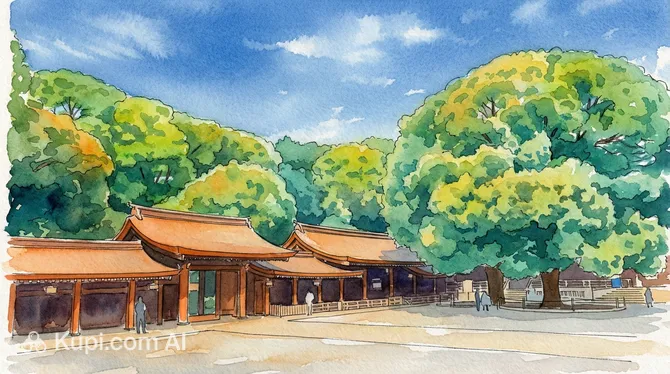
Meiji Jingu. Illustration.
Source: Kupi.com AI

Traveler photos:

The complex is situated in the heart of a vast evergreen forest covering approximately 700,000 square meters. Its most notable feature is the dense woodland consisting of over 100,000 trees, which were donated by people from all corners of the country. A walk along its shaded paths allows you to forget the city's frantic pace and immerse yourself in an atmosphere of calm and harmony with nature.

The architecture of the shrine is designed in the traditional nagare-zukuri style. Precious Japanese cypress was used to construct the main buildings. The path to the main complex passes through massive wooden torii gates, symbolizing the transition from the secular to the sacred. In addition to the main hall, the grounds feature inner and outer gardens, each beautiful in any season.

Meiji Jingu is a place where you can touch the history and spiritual traditions of the country. It is equally popular with locals, who come here to pray and participate in ceremonies, and tourists eager to see one of the capital's most iconic sights. A visit to the shrine leaves a deep impression and offers a profound sense of serenity.

Contacts

Meiji Jingu Shrine is a major public and spiritual center, so it is recommended to visit the official website for the most up-to-date information on opening hours, accessibility, and events. The shrine is easily accessible by public transport: it is located within a few minutes' walk of Harajuku Station on the JR Yamanote Line and Meiji-jingu-mae Station on the Chiyoda and Fukutoshin subway lines.

Below are the key contact details to help you plan your visit.

How to contactContact
Address1-1 Yoyogikamizonochō, Shibuya, Tokyo 151-8557, Japan
Phone number+81 3-3379-5511
Websitewww.meijijingu.or.jp

What to Do

A visit to Meiji Jingu begins with a leisurely walk along picturesque forest paths leading to the heart of the sanctuary. Along the way, you will pass through majestic wooden torii gates, which symbolize the transition from the mundane world into sacred space. This walk is a meditative experience in itself, allowing you to leave the noise of Tokyo behind and settle into a peaceful frame of mind.

There are several special spots within the complex. Be sure to visit the Inner Garden, where the famous Kiyomasu-no-Ido well is located—according to legend, it is one of the city's powerful "energy spots." For a deeper look at history, visit the Treasure Museum, which houses personal belongings and artifacts from the era of Emperor Meiji. To fully immerse yourself in the culture, you can relax at the teahouse and enjoy traditional Japanese tea.

Meiji Jingu is an active shrine, so you may have the chance to witness authentic Shinto rituals. Traditional wedding ceremonies, purification rites, and seasonal festivals are frequently held here. You can gain particularly vivid impressions by visiting the shrine during major Japanese holidays. For instance, on New Year's, millions of people come here for hatsumode—the first shrine pilgrimage of the year—turning the site into the center of the capital's cultural life.

Getting There

Reaching Meiji Jingu Shrine is very easy, as it is conveniently located near several of Tokyo's major transport hubs. The simplest and most popular way is to use the city's extensive public transport system. The shrine is in the immediate vicinity of Harajuku Station on the JR Yamanote loop line, as well as Meiji-Jingumae Station, which is served by the Chiyoda and Fukutoshin subway lines. The walk from either of these stations to the shrine complex's main gates takes between one and five minutes.

In addition, Meiji Jingu can be reached via city buses that run throughout the Shibuya district and other parts of the city. For those who prefer comfort and privacy, taxi services are always available to drop you right at one of the complex entrances. You can also walk from Sangubashi Station (Odakyu Line) or Yoyogi Station (JR Yamanote, JR Sobu, and Toei Oedo lines), which takes about 5-10 minutes.

The main gates of the shrine are located on the side of the famous Yoyogi Park, providing a wonderful opportunity to combine your visit with a stroll through one of Tokyo's largest green oases. Many tourists prefer this route: starting the day with a leisurely walk through the park before immersing themselves in the peaceful and spiritual atmosphere of Meiji Jingu.

Nearest city: Tokyo

History & Facts

The history of Meiji Jingu Shrine is inextricably linked to the Japanese people's deep respect for their rulers. The idea for its creation arose as a public initiative following the passing of Emperor Meiji in 1912 and Empress Shoken in 1914. People sought to immortalize the memory of the monarchs who led the country to prosperity. Construction began in 1915, and by 1920, the shrine was solemnly consecrated, with the official public opening taking place in 1926.

The significance of this site is largely defined by the personality of Emperor Meiji himself. His reign was marked by an era of fundamental change known as the "Meiji Restoration." During this period, Japan ended centuries of self-isolation and implemented large-scale political, economic, and social reforms. Thanks to these transformations, the country modernized rapidly and became one of the world's leading powers, forever securing Emperor Meiji's status as a great reformer.

The shrine's fate took a dramatic turn during the mid-20th century when the original buildings were completely destroyed. However, for the Japanese people, restoring the sanctuary became a matter of national pride. Thanks to donations collected both domestically and abroad, Meiji Jingu was fully restored to its former glory in 1958. This achievement highlights how deeply the shrine is rooted in the cultural and spiritual consciousness of the nation, serving as a symbol not only of Tokyo's imperial heritage but also of the resilience of the national spirit.

Time Needed

To fully enjoy the atmosphere of Meiji Jingu Shrine, it is recommended to set aside 1.5 to 3 hours for your visit. This will be enough time to walk leisurely through the picturesque grounds, view the main buildings, and feel the peaceful atmosphere of this iconic Tokyo landmark. Even a short visit will provide a break from the city bustle and a chance to connect with the spiritual traditions of Japan.

In an hour and a half, you can walk along the main path from the majestic torii gates to the main hall, where you can observe rituals and appreciate the scale of the complex. If you have up to three hours, you can dive deeper into the history and nature of the site. This extra time allows for a visit to the Inner Garden (Gyoen), famous for its iris field and Kiyomasu's Well, as well as a look inside the Meiji Jingu Treasure Museum. Your visit may also be unexpectedly extended if you are lucky enough to witness a traditional Shinto wedding procession, which is a common sight here.

Working Hours

Meiji Jingu Shrine is open to visitors year-round, but its operating hours are unique—they depend directly on sunrise and sunset times. Generally, the complex opens at dawn, around 5:00–6:00 AM, and closes at dusk, around 4:00–6:00 PM. Since the exact times change every month, it is highly recommended to check the current schedule on the shrine's official website before your visit to plan your trip effectively.

Admission to the main grounds of Meiji Jingu is free, and no advance booking is required for a standard visit. This allows you to freely enjoy a walk through its peaceful paths. Please note that certain sites on the grounds, such as the Inner Garden (Gyoen) and the Meiji Jingu Museum, have separate operating hours and require an admission fee.

Nearby

Visiting Meiji Jingu Shrine is an immersion into an atmosphere of tranquility and spirituality. However, to make your journey through Tokyo even more rewarding, it is worth exploring the surrounding areas. Located in the heart of a vibrant district, the temple is surrounded by many other points of interest—from modern shopping centers and trendy neighborhoods to quiet parks and unique establishments. This is a perfect opportunity to see the contrast between traditional and ultra-modern Japan.

Exploring nearby attractions will allow you to gain a fuller understanding of the multifaceted nature of this area. Just a few minutes' walk or a short ride away, you will find iconic landmarks that will complement your experience of visiting one of the country's most important Shinto shrines. Below is a list of some of these locations, along with their distance from Meiji Jingu.

NameDistance
Shibuya Coffee Bar1.4 km
Shibuya Stream Bar2.2 km
Nezu Museum2.2 km
Blue Note Tokyo2.3 km
Suga Shrine2.4 km
Reserve Roastery Tokyo3.1 km
teamLab Borderless4.3 km

Have you reached the end of the page?

So the route has been studied inside and out