Support

Arab Baths

About

While wandering through the historical quarters, it is impossible not to notice this amazing 12th-century monument. The Arab Baths are a unique museum complex in the city of Girona, representing a rare example of civic Romanesque architecture in Spain. Despite the name, they were built after the city's liberation from the Moors, yet their appearance harmoniously blends Oriental motifs, ancient traditions, and a somber medieval style.
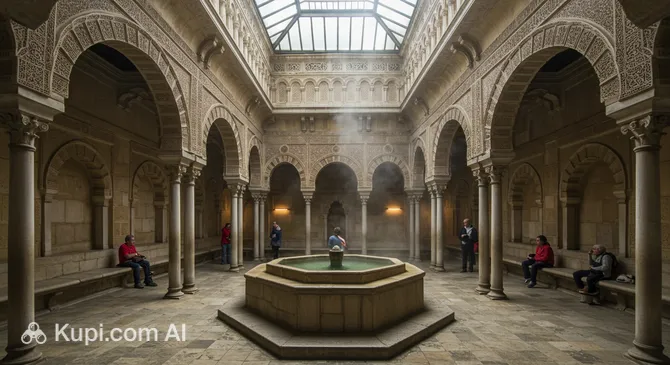
Arab Baths
Arab Baths. Иллюстрация. Источник: Kupi.com AI

The building, constructed from light-colored stone, consists of five main rooms following the traditions of ancient Roman baths. The main gem is considered to be the apoditerium — a changing room with an octagonal pool in the center, topped by a graceful dome on slender columns. This place attracts travelers with its mystical play of light and shadow.

Today, this site is recognized as a national heritage treasure. It impresses visitors not only with its preservation but also with how the ancient walls now host modern cultural events. The Arab Baths remain a must-see for those who want to feel the authentic spirit of medieval Catalonia.

Contacts

To plan your visit to this unique historical complex, it's helpful to have the official contact details on hand. You can check for information about special events or visiting rules directly with the administration.

How to contactContact
AddressCarrer del Rei Ferran el Catòlic, s/n, 17004 Girona, Spain
Phone+34 972 19 09 69
Websitewww.banysarabs.cat

What to Do

Inside the complex, guests are invited to follow the traditional route of medieval bathers. Start your tour at the apoditerium to admire the octagonal pool and elegant column capitals decorated with floral ornaments. This is the most photogenic spot in the baths, where the light penetrating through the dome creates a wonderful atmosphere.

Be sure to look into the rooms with different temperature settings: the frigidarium, tepidarium, and caldarium. Here you can see firsthand the hypocaust system — an ancient underground heating system that provided warmth for the floors and walls. Mosaic details and massive stone vaults allow you to appreciate the engineering skills of 12th-century builders.

In addition to the architecture, visitors can discover modern creativity, as contemporary art exhibitions are regularly held within the museum walls. After touring the halls, it's worth lingering to look at the information materials or purchase commemorative souvenirs and books about the city's history at the small kiosk near the entrance.

Getting There

Finding this architectural monument is easy, as it is located in the heart of the historical district, just a few steps from the majestic Cathedral. If you are arriving from Girona–Costa Brava Airport, it is most convenient to take a shuttle bus or order a taxi, which will take you to the edge of the Old Town in about 20–30 minutes.

Travelers from Barcelona usually choose the AVE high-speed trains. From Girona railway station, you can reach the attraction on foot in 20 minutes while enjoying views of the Onyar River, or take city buses No. 9, 11, or 14 to the Plaça de Catalunya stop and then walk through the picturesque quarters.

For those who prefer a car, it is important to remember that traffic in the city center is restricted. It is best to leave your vehicle at the Parking Girona Catedral (P2) paid parking lot. A short walk from the parking area to the entrance of the baths will allow you to immediately immerse yourself in the medieval atmosphere.

Ближайший город: Girona

History & Facts

The history of this site began in the late 12th century, with the first documented mention of the building dating back to 1194. It is believed that the complex was built by royal order (likely by Alfonso I) for the needs of the townspeople. Despite the fact that the baths were built at a time when Moorish influence in the region had already weakened, their architecture became a striking example of the Romanesque style with strong Eastern motifs.

In 1285, during the siege of Girona by French troops, the building was seriously damaged. However, as early as 1294, by decree of King James II, the baths were fully restored and transferred to private management on the condition that they remain operational. Public baths functioned here until the middle of the 14th century, remaining an important center of the city's social life.

Later, the building's fate changed: in the 17th century, it came under the control of a Capuchin convent. The nuns used the ancient halls as a laundry and warehouse, which, surprisingly, helped save the site from destruction and radical alterations. In 1929, the complex was purchased by the state and restored under the direction of the famous architect Rafael Masó i Valentí, after which the baths opened to visitors as a museum.

Time Needed

To fully explore the complex, 30–45 minutes is usually sufficient. This time is enough to leisurely view all the halls, study the information boards, and take atmospheric photos by the central pool.

If you decide to use an audio guide or happen upon one of the temporary contemporary art exhibitions, it is worth allowing about one hour for the visit. Thanks to its location in the center of the Old Town, a visit to the baths is very easy to combine with a tour of the Cathedral or a walk along the fortress walls.

Working Hours

The doors of the historical complex are open to visitors throughout the week. From Monday to Saturday, the baths operate on a standard schedule: 10:00 AM to 6:00 PM. This provides enough time to include the attraction in a daytime walking route through the city.

On Sundays and public holidays, the visiting hours are reduced — the museum is open from 10:00 AM to 2:00 PM. It is recommended to arrive in the first half of the day to avoid tourist groups and fully enjoy the silence of the ancient halls.

DayWorking hours
Понедельник10:00 – 18:00
Вторник10:00 – 18:00
Среда10:00 – 18:00
Четверг10:00 – 18:00
Пятница10:00 – 18:00
Суббота10:00 – 18:00
Воскресенье10:00 – 14:00

Nearby

Exploring the surroundings of the baths will allow you to fully enjoy the beauty of Girona, as the city's main symbols are concentrated nearby. A walk through these places will enrich your experience and help you better understand the cultural heritage of Catalonia.

NameDistance
Girona Cathedral0.1 km
Sunset Jazz Club0.1 km
Girona Art Museum0.1 km
Basilica of Sant Feliu0.1 km
Sant Pere de Galligants Monastery0.1 km
Museum of Jewish History0.2 km
Rafael Masó Foundation / Casa Masó0.2 km

Reached the end of the page?

That means the route is fully explored