Support

Pont de les Peixateries Velles

About

The bright red metal Eiffel Bridge is more than just a crossing over the Onyar River; it is a true symbol that defines the city of Girona. This pedestrian structure, officially known as Pont de les Peixateries Velles, catches the eye with its unusual industrial style, which fits surprisingly harmoniously with the ensemble of ancient buildings.
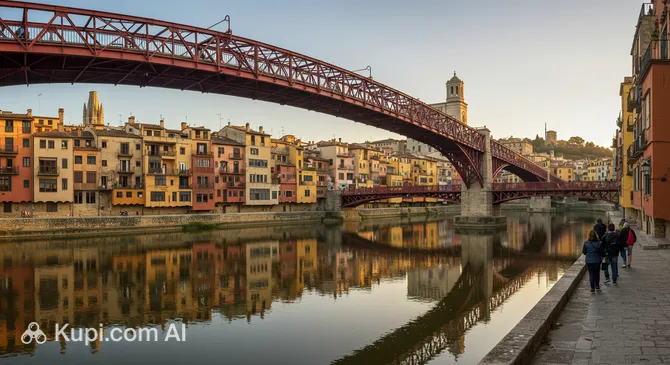
Eiffel Bridge
Eiffel Bridge. Иллюстрация. Источник: Kupi.com AI

Built in 1876, the bridge is the work of the legendary French engineer Gustave Eiffel. The fact that the structure appeared long before the famous Parisian tower gives it special historical value. For Spain, this object became an important example of the early use of lattice steel structures, which became the master's signature style.

The attraction's main feature is its incredible photogenic quality. The intricate lattice work of the vibrant red metal creates a magnificent contrast with the multi-colored facades of the "hanging houses" reflecting in the river's waters. This place is rightfully considered the best observation deck for those who want to capture the soul of ancient Girona.

Contacts

You can use the official contact information to inquire about the state of the site or to plan a walk as part of an organized group.

How to contactContact
AddressCarrer del Riu Onyar, 17004 Girona, Spain
Phone+34 972 01 00 01
Websitewww.pedresdegirona.com

What to Do

The main reason to visit the Eiffel Bridge is the stunning panoramic views. From the height of the bridge, you get the famous perspective of the "houses over the river" (Casas del Onyar). The colorful facades, tightly packed together, create a unique character that is best viewed from here. Don't forget your camera: the play of reflections in the water and the sharp geometry of the red beams make this spot the most popular photo location in the city.

Walking across the bridge allows for a smooth transition from the modern part of the city into the labyrinth of the old center. Nearby, just a few hundred meters away, other iconic sites await: the mysterious El Call Jewish Quarter with its narrow streets and the fascinating Museum of Cinema. Crossing the Eiffel Bridge turns a simple stroll into a journey through the ages, linking 19th-century industrial genius with the city's medieval past.

Getting There

Finding this architectural treasure is easy, as it is located in the very center of the historical part of the city. If you are arriving from other regions, the most convenient way is to take a train or bus from Barcelona. From the train station, the walk to the bridge takes about 10–15 minutes: just follow the signs toward the riverfront and the popular street Rambla de la Llibertat.

For those who prefer to travel by car, it is important to remember that the old center is a pedestrian zone. It is recommended to leave your car in one of the city parking lots on the approaches to the historic quarter and continue on foot to the address Carrer del Riu Onyar.

The city center is also easily accessible by taxi; simply ask the driver to drop you off at the Pont de les Peixateries Velles — this is the official name of the site, which is well known to all locals.

Ближайший город: Girona

History & Facts

The history of this structure began in 1876, when the project was developed by the prominent French engineer Gustave Eiffel. The bridge became one of the first examples in Spain of such a bold use of metal structures in civil engineering. The engineer applied steel ties, revolutionary for that time, which allowed for the elimination of intermediate supports, giving the entire structure incredible lightness and visual clarity.

Interestingly, this bridge was born 13 years before the famous Eiffel Tower graced Paris. There are only about twenty such bridges designed by the great engineer in the world, and the Girona specimen is considered one of the most elegant due to its delicate lattice structure.

Over time, the aggressive effects of moisture and constant use led to the wear of the metal. To preserve the city's appearance and ensure pedestrian safety, the original structures were replaced with an identical replica in 1973. Modern craftsmen reproduced every detail with precision, preserving the spirit of Eiffel's original design.

Time Needed

Since the bridge is a pedestrian zone and part of a city route, inspecting the structure itself usually takes from 15 to 30 minutes. This is quite enough time to leisurely walk from one bank to the other, examine the details of the riveted iron, and take some memorable photos.

However, if you plan to wait for the perfect lighting for photography or want to combine your visit with a tour of the neighboring Jewish Quarter, you should set aside about 1–1.5 hours for the walk. The atmosphere of this place encourages you to linger longer, watching the river flow and the city life.

Working Hours

As the site is an important part of the city's transport and pedestrian network, access to it is not restricted by time. You can visit the bridge at any time of day or night that is convenient for you.

According to official data, the bridge is open:

  • Monday — Sunday: 24/7
It is especially atmospheric here in the early morning when the city is just waking up, or at dusk when the city illumination turns on.

Круглосуточно

Nearby

The Eiffel Bridge serves as an ideal starting point for immersing yourself in the atmosphere of the medieval city. Exploring the surrounding streets will allow you to see the most iconic places that Catalonia is proud of in a single day.

NameDistance
CaixaForum Girona0.1 km
Houses of Onyar0.1 km
Museum of Jewish History0.2 km
Museum of Cinema – Tomàs Mallol Collection0.2 km
Rafael Masó Foundation / Casa Masó0.2 km
YEAH! Girona0.2 km
Girona Art Museum0.3 km

Reached the end of the page?

That means the route is fully explored