Support

Cases de l'Onyar

About

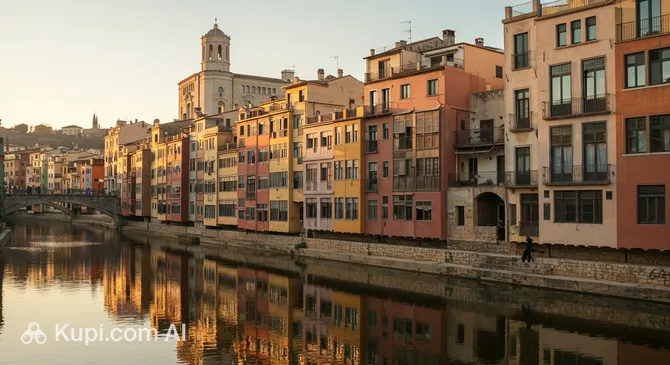
The Houses on the Onyar River (Cases de l'Onyar) are perhaps the most recognizable and photogenic architectural ensemble decorating the city of Girona. Brightly colored buildings, appearing to rise directly from the water, create a picturesque line of facades that has become a hallmark of which all of Spain is proud. This complex is included in the Inventory of the Architectural Heritage of Catalonia and is considered the soul of the old city.
Houses of Onyar
Houses of Onyar. Иллюстрация. Источник: Kupi.com AI

The facades of the houses are painted in warm shades of ochre, terracotta, and pastels. This palette was chosen by local artists for a reason: it is designed to emphasize the play of light at different times of day. A special place in this row is held by the snow-white Casa Masó—the only building in the group open to the public as a museum, showcasing the unique Noucentisme style.

The uniqueness of this place lies in its construction: the houses have narrow facades and literally hang over the river, resting on ancient city walls. Walking along the Rambla de la Llibertat, you will see how the architecture blends harmoniously with the natural landscape, creating a unique European coziness.

Contacts

For those planning to visit Casa Masó or wanting to learn more about the restoration of the complex, it is useful to check the official information from the city's tourist center.

Below are the main contact details for on-site orientation:

How to contactContact
AddressRambla de la Llibertat, 23, 17004 Girona, Spain
Websitewww.girona.cat

What to Do

The main reason thousands of travelers come here is for photo hunting. The most spectacular views of the multicolored houses open up from the bridges over the Onyar. Be sure to visit the Pont de les Peixateries Velles, better known as the Eiffel Bridge (built by the company of the famous creator of the tower in Paris)—its red metal structures serve as a perfect frame for the panorama.

If you're interested in taking a look "behind the scenes" of these bright facades, head to Casa Masó. This is the only opportunity to see the interior of one of the Onyar houses from the inside. You can examine preserved furniture from the beginning of the last century and enjoy the river view from windows that you otherwise only see from the outside.

A leisurely stroll along the Rambla de la Llibertat will allow you to feel the rhythm of the city. Visit at different times of day: in the morning, the sun floods the west bank, while in the pre-sunset hours, the houses are painted in deep golden tones, creating magical reflections in the water that are especially beautiful in calm weather.

Getting There

The famous facades are located in the very heart of the city, at Rambla de la Llibertat, 23. If you are traveling from Barcelona, the most convenient way is to take the AVE high-speed train (about 40 minutes) or a regional train. From the Girona railway station, the embankment is just a 10–15 minute walk along Carrer Nou towards the Old Town.

For those traveling by car, it is recommended to leave your vehicle in one of the public parking lots, such as Parking Rambla, as the historic center is best explored on foot. From the Cathedral or the Jewish Quarter, the walk to the river takes no more than 5 minutes of pleasant downhill strolling.

Within the city, buses also run with stops near the Rambla, and shuttles from Girona Airport regularly bring tourists to the central streets, from where the houses on the Onyar are just a stone's throw away.

Ближайший город: Girona

History & Facts

The history of this picturesque ensemble began as far back as the 15th century. Originally, these were modest fishing huts clinging to the 14th-century medieval defensive wall. Over time, as the city limits expanded, the houses began to grow upwards and "crawl" onto the wall itself, literally swallowing the ancient fortifications and turning them into part of their foundation.

Over the centuries, construction was spontaneous: owners added ledges, galleries, and extra floors, creating that unique, chaotic facade relief. For a long time, this area was considered poor and neglected until 1982, when the Catalan authorities initiated a large-scale restoration project led by architects Josep Fuses and Joan Maria Viader.

Interestingly, the color palette of the houses was not a random choice. Artists Enric Ansesa and Jaume Faixó developed a special "color map" of the Old Town, choosing shades of ochre, terracotta, and soft pastels to harmonize with the cathedral's stonework. Standing apart is Casa Masó, rebuilt in 1919 as a masterpiece of the Noucentisme style, combining four old buildings into one.

Time Needed

For simply admiring the panorama and taking vibrant shots from the bridges, 30–45 minutes will be enough. This is plenty of time to walk across several bridges and watch the multicolored walls reflect in the calm waters of the Onyar.

However, if you decide to go inside Casa Masó to appreciate the early 20th-century interiors, or if you want to combine your visit with a leisurely coffee on the Rambla de la Llibertat, it’s worth setting aside about 1.5–2 hours. A full walk, including the embankment and the adjacent streets of the Old Town, usually takes half a day and leaves the most complete impression.

Working Hours

Since the Houses on the Onyar River are part of the urban layout and an outdoor architectural ensemble, they can be admired 24/7 (Open 24 hours) on any day of the week. The night lighting of the buildings and their reflections in the dark water create a special romantic atmosphere, quite different from the daytime.

Keep in mind that Casa Masó, as a museum, operates on its own schedule. If you plan to go inside, it is recommended to check the visiting hours in advance on the official website or at the city's tourist office.

Круглосуточно

Nearby

The location of the houses on the Onyar makes them an ideal starting point for a walk through the historical center. Just a few steps from the embankment lie treasures of medieval architecture, the narrow streets of the Jewish Quarter, and majestic temples that complete the atmosphere of old Catalonia.

A stroll through the surrounding area will allow you to see the legendary lioness, climb ancient walls, and peek into quiet monastery courtyards:

NameDistance
Museum of Cinema – Tomàs Mallol Collection0.1 km
CaixaForum Girona0.1 km
Eiffel Bridge0.1 km
Museum of Jewish History0.2 km
Rafael Masó Foundation / Casa Masó0.2 km
YEAH! Girona0.3 km
Massana0.4 km

Reached the end of the page?

That means the route is fully explored