Support

Бронебашенная береговая батарея №35

About

Have you ever wondered what an underground fortress city looks like? The 35th Armored Coastal Battery is not just a historical monument, but a unique masterpiece of fortification art located in the legendary city of Sevastopol. Situated in Ukraine, this site is rightfully considered one of the most powerful coastal fortifications ever created to protect the Black Sea coast.

The complex is a sophisticated system of deep underground casemates, autonomous life-support systems, and massive artillery installations. It is a place where the engineering genius of the past meets the solemn memory of heroic events, making the battery a must-visit for anyone interested in military history and large-scale structures.
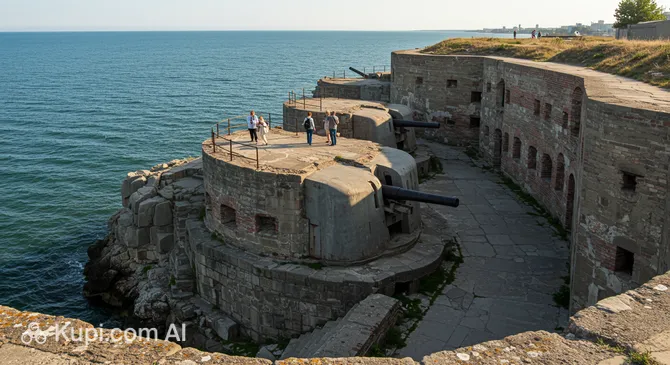
Coastal Battery No. 35
Coastal Battery No. 35. Иллюстрация. Источник: Kupi.com AI

Today, a modern museum complex is open here. Visitors can see preserved turret installations, command posts, and the garrison's living quarters, which provide a total immersion into the atmosphere of the last century. Battery No. 35 on the Chersonese Peninsula is a symbol of unshakeable spirit and the incredible strength of concrete and metal.

Contacts

To clarify information about visiting the museum complex or to book a tour, you can use the following contact details.

How to contactContact
AddressGagarinsky District, Sevastopol
Phone+7 978 860-87-59

What to Do

A visit to the battery offers a unique immersive experience into history. The main highlight is the guided tour routes passing through the deep underground casemates. You will see firsthand how the defenders lived: the site has preserved autonomous power stations, a hospital, telephone exchanges, and even living quarters that once functioned together as a single, well-coordinated organism.

Special attention should be paid to the gun yards and the command posts from which fire was directed. The museum halls feature rare exhibits: from original documents and photographs to personal belongings of soldiers and weapon samples of that era. Multimedia installations complement the tour, helping to visualize the scale of the battles that took place on these rocky shores.

For those who prefer a more thoughtful study, information stands are installed throughout the open territory of the complex. Memorial events and thematic educational programs are also regularly held here, which will be of interest to both adult researchers and young visitors wishing to learn more about the city's heroic past.

Getting There

The memorial complex is located at a significant distance from the city center, in the area of Kazachya Bay. To reach the site, it is most convenient to use public transport or a taxi. Minibuses and buses from the central districts run to the "Kazachya Bukhta" stop, from which you only need to walk about 150 meters following the signs toward the sea.

If you prefer comfort, a taxi ride from the city center will take about 20–30 minutes, depending on traffic. For those planning a visit by private car, convenient parking is available at the entrance to the complex. The road leads almost directly to the museum site; look for the turn toward the Chersonese Lighthouse as a landmark.

Ближайший город: Sevastopol

History & Facts

The history of this grand structure began back in 1910, when the General Staff of the Russian Empire decided to strengthen the city's southern defense lines. Construction started in 1913 but was suspended due to revolutionary events, only to be completed during the Soviet period. In 1929, the facility officially became part of the Black Sea Fleet's coastal defense, and that same year, it was personally visited by Joseph Stalin.

The technical equipment of the battery was staggering for its time: two turrets with 305mm guns made it one of the most powerful fortifications on the Black Sea. It was a true technological breakthrough, capable of withstanding the most serious threats from the sea.

During World War II, during the heroic defense of the city in 1941–1942, the battery became a legendary symbol of resilience. It not only provided powerful artillery support but, in the critical days of July 1942, became the last stronghold for Sevastopol's defenders, covering the evacuation and fighting to the last round.

Time Needed

To fully appreciate the scale of engineering and absorb the historical significance of this site, you should plan for a visit of 2 to 3 hours. This time will be sufficient to explore the surface part of the complex and participate in a detailed guided tour of the underground levels.

Given the emotional intensity of the exhibits and the complexity of the underground routes, there is no need to rush. We recommend setting aside an additional 30 minutes for a self-guided walk around the grounds and visiting the observation decks, which offer majestic views of the sea.

Working Hours

When planning your visit, please take note of the museum complex schedule. The museum is open to visitors from Tuesday to Sunday. Monday is the official day off.

Opening Hours:
• Tuesday – Sunday: 10:00 AM – 6:00 PM
• Monday: Closed

DayWorking hours
ПонедельникЗакрыто
Вторник10:00 – 18:00
Среда10:00 – 18:00
Четверг10:00 – 18:00
Пятница10:00 – 18:00
Суббота10:00 – 18:00
Воскресенье10:00 – 18:00

Nearby

Exploring the surroundings of Kazachya Bay and the Gagarinsky District will allow you to dive even deeper into the history and atmosphere of this maritime city. Numerous interesting locations are situated nearby, ranging from entertainment parks to unique archaeological reserves.

Enrich your experience by visiting nearby sites within easy reach of the memorial:

NameDistance
Prague Pub4.2 km
Bar Ne Bar5.7 km
Victory Park6.3 km
Bounty Beach6.4 km
Aquamarine Water Park6.8 km
Musson Shopping Mall7.3 km
Chersonesus Taurica National Preserve8.9 km

Reached the end of the page?

That means the route is fully explored