Support

Steinkjer

About

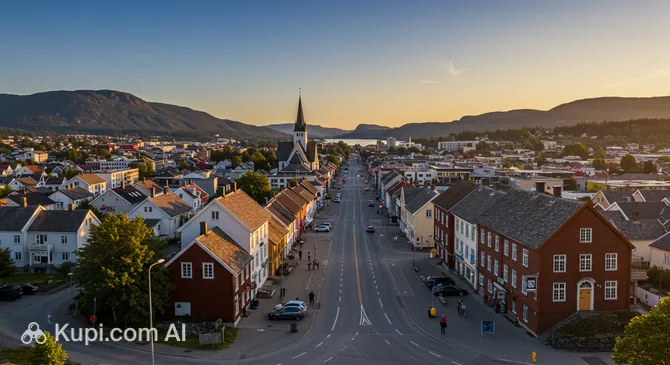
Steinkjer is a cozy town and the administrative center of the Trøndelag region, located in the central part of Norway. It is situated at the innermost part of the Trondheim Fjord, where salty sea water meets freshwater rivers, creating unique landscapes and excellent conditions for fishing and boat trips.

Steinkjer. Illustration.
Source: Kupi.com AI

The town's modern architectural appearance is characterized by functionalism, as the center was almost entirely rebuilt in the mid-20th century. However, these lands have been inhabited since ancient times. You can learn more about the stages of the settlement's development, from the Viking Age to the present day, in the history of Steinkjer section.

The town and its surroundings offer tourists a rich cultural program. A visit to the Egge Museum, an open-air ethnographic museum, is a must to immerse yourself in the atmosphere of the past. Nearby is one of the region's most famous landmarks — the "Bøla Reindeer" (Bølareinen) rock carving, which is approximately 6,000 years old.

Weather Overview

The climate in Steinkjer can be described as moderately cool with fairly high humidity throughout the year. Winters are genuine but without extreme frosts: in January and February, the average temperature stays around -3.5...-3.7°C, and at night the air cools down to -6°C. Snow falls frequently, creating picturesque winter landscapes.

Summer brings comfortable warmth, ideal for walking, though heat is rare here. The warmest month is July with an average of 14.2°C and daytime highs around 18°C. When planning your trip, be sure to check the latest information; the available weather in Steinkjer will help you pack correctly.

A characteristic feature of the local climate is regular precipitation. Even in the "driest" spring months, there are about 15 rainy days, and in October their number can reach 22. Expect cool summers with occasional rain and cold, snowy winters.

Average monthly temperature

Average monthly precipitation

Interesting Facts

Behind the outward tranquility of this northern town lies a rich history and unexpected geographical records. Steinkjer can surprise even seasoned Scandinavia experts with curious details that often remain hidden from standard guidebooks.

  • The Geographical Heart of the Country. It is within the municipality of Steinkjer that the official geographical center of Norway is located (considering the mainland). This symbolic point is situated in the picturesque Skjækra Nature Reserve in the Ogndalen valley. Tourists can hike to a special monument marking the "middle" of the nation.

  • A Phoenix City in Retro Style. Since the historical center was almost completely destroyed by bombings in 1940, Steinkjer had to be rebuilt from scratch. Today, it is considered one of the most cohesive and well-preserved examples of Norwegian post-war functionalism. Architects often call it an ideal "retro city," where the buildings from the 1940s and 50s look like a single ensemble.

  • A "Salmon" Name. The town's name has a very pragmatic origin. It is formed from Old Norse words meaning "stone" and "structure for catching fish" (a weir). This is a direct reference to the ancient tradition of blocking the river with stone dams to effectively catch the salmon for which these places are still famous today.

  • A Viking Capital. The Egge area, which is now part of the town, was one of the most important centers of power during the Saga Age. The residence of the powerful chieftain Kalv Arnesson, who played a key role in the famous Battle of Stiklestad, was located here. Historians believe that in those times, Egge was more influential than many royal estates.

  • The Largest Chair. Fans of unusual photo ops will find a fun attraction in Steinkjer. At the top of Oftenåsen hill, which offers the best panorama of the town and fjord, stands what locals claim is the world's largest garden chair. It is a giant wooden structure that you can climb to feel like a Lilliputian in the land of giants.

How to Get There

When planning a trip to this picturesque corner of the Trøndelag region, it's worth thinking through your route in advance. Steinkjer has good transport accessibility, though most tourists arrive via neighboring major transport hubs. You can find all the ways to get to the city on a separate page, and below we will look at the main options for arriving through airports and train stations.

The most convenient way to reach the region by air is a flight via Værnes Airport (IATA: TRD). This is a major international aviation hub receiving many flights. There is no airport in Steinkjer itself, but you can fly to Værnes Airport in Trondheim, which is about 68 km from Steinkjer. The journey from the airport to your destination by taxi or transfer will take about 2 hours. Due to high passenger traffic, the infrastructure and transport links here are well-developed.

Alternatively, you can consider Åre Östersund Airport (IATA: OSD), located in neighboring Sweden, in the city of Östersund. The distance to Steinkjer is about 175 km, which will require a longer trip — approximately 4 hours 40 minutes by car. There is also the small regional Røros Airport (IATA: RRS) in the town of Røros (160 km from Steinkjer), a journey from which will take about 4 hours 20 minutes.

For clarity, here is summary information on the main airports:

AirportPassenger trafficDistance
Trondheim Airport Værnes4 mln68 km
Ryumsjøen Airport37 76793 km
Roros Airport21 575160 km
Bronnoysund Airport117 471165 km
Åre Östersund Airport239 000175 km

If you prefer rail transport, an important transfer point is Trondheim S Station (IATA: XZT). In the provided list of nearby major hubs, the station in Steinkjer itself is not listed as a primary one, so many travelers focus on Trondheim. You can arrive at Trondheim S station in the city of Trondheim, which is approximately 69 km from Steinkjer. From there, you can reach the town by taxi or bus in about 2 hours, or use the local rail service connecting these cities.

Below is information about the nearest major railway station:

StationPassenger trafficDistance
Trondheim S Station1.5 mln69 km

Main Attractions

Steinkjer and its surroundings offer travelers an interesting combination of historical monuments and modern culture. Although many buildings in the center appeared only in the middle of the last century, the region is rich in heritage dating back centuries. Here are a few places worth including in your itinerary to get to know this Norwegian town better.

Mære Church (Mære kirke) is one of the most significant medieval buildings in the Trøndelag region. This stone church, built at the end of the 12th century, is situated on a hill offering a beautiful view. The site is notable for its history: archaeological excavations have shown that the temple was built directly over an ancient pagan shrine where sacrifices were performed. A visit to the church allows you to touch the era when Norway was transitioning from old beliefs to Christianity.

Steinkjer Church (Steinkjer kirke) is the complete opposite of ancient Mære and serves as a symbol of the town's rebirth after the Second World War. This modern white functionalist building, consecrated in 1965, is visible from afar thanks to its unusual bell tower. The main treasure of the interior is the unique stained glass and glass mosaics by the famous Norwegian artist Jakob Weidemann, which create a special atmosphere of light and color inside the temple.

For those who want to combine relaxation with entertainment, the Dampsaga Cultural Center is an excellent choice. It is located in the building of a former steam sawmill, which gives it a special industrial charm. Today, it is the heart of the town's social life: it houses a modern water park with pools for children and adults, a library, a cinema, and a concert stage. It is an ideal place for family fun after walks along the fjords.

Local Cuisine

Steinkjer's gastronomic scene is a mirror of the Trøndelag region, which is often called the "pantry" of Norway. Local cuisine relies on the freshest farm products, gifts from the forest, and fish from the cold waters of the fjord. The concept of "locally sourced food" (kortreist mat) is highly valued here, so restaurant menus often feature dishes whose ingredients were grown or caught literally next door.

The king of the local table is undoubtedly sodd. This is a traditional thick soup, considered the main festive dish in this region, but it is also available to tourists on regular days. Authentic sodd is made from a broth in which cubes of boiled mutton or beef and special meatballs are simmered. The dish is served with boiled potatoes and carrots, which are prepared separately so as not to cloud the transparency of the broth.

The perfect accompaniment to the soup is skjenning — thin, crispy, triangular-shaped flatbreads. They have a slightly sweet taste, as the dough is brushed with a mixture of milk and sugar. This is a unique pastry characteristic specifically of the Innherred region, the heart of which is Steinkjer.

Since the town sits at the confluence of rivers and the fjord, fishing is part of the way of life. In season, it's definitely worth trying dishes made from wild salmon or trout. Meat lovers will enjoy steaks or sausages made from elk and venison, which are often accompanied by juniper or lingonberry sauces.

As for drinks, it is customary here to accompany a meal with local craft beer or a glass of aquavit. Trøndelag produces special varieties of this Scandinavian potato distillate infused with herbs and spices, which perfectly helps digest hearty meat dishes. Among non-alcoholic beverages, black coffee is universally popular — Norwegians drink it in huge quantities at any time of day.

The food culture in Steinkjer is casual and lacks pretension. Locals love to dine in cozy cafes in shopping centers or family restaurants. For gourmets, farm shops (gårdsbutikk) in the surroundings of the town are of particular interest, where you can buy homemade cheeses, cloudberry jams, and fresh pastries directly from the producers.

Travel Tips

A trip to Steinkjer promises to be calm and relaxed, but even in such a cozy Norwegian town, there are nuances worth knowing in advance. To make your holiday in the heart of the Trøndelag region as comfortable as possible and free from extra worries, we have prepared a list of useful recommendations based on local realities.

  1. Clothing and Gear. The weather here is changeable, so the golden rule for a tourist in Steinkjer is the "onion principle" (layering). Even in summer, be sure to bring a windproof jacket and a raincoat, as precipitation occurs frequently. For winter trips, you will need thermal underwear and high-quality warm shoes with non-slip soles. If you plan on hiking the surrounding hills, trekking boots are essential.

  2. Transport Nuances. The town center itself is quite compact and easy to get around on foot. For trips to the surroundings, it is convenient to use regional buses; schedules and tickets are available in the AtB app. Taxis in Norway are expensive, so it's better to order one only when strictly necessary. If you want to explore the fjords and remote natural corners, renting a car is the most sensible solution.

  3. Finances and Payment. The official currency is the Norwegian Krone (NOK), but you will hardly need cash. Norway is a land of successful cashless payments: bank cards are accepted everywhere, from large hotels to tiny hot dog stands. Tipping is not mandatory, as service is included in the bill, but rounding up the amount in cafes and restaurants is welcomed as a polite gesture.

  4. Health and Water. Steinkjer is a very safe town where you can walk peacefully at any time of day. An important point: you can and should drink water straight from the tap; it is pure and very tasty here. Pharmacies (Apotek) operate on a standard schedule, and there are few 24-hour duty points, so it's better to bring any specific individual medications with you.

  5. Language and Connectivity. The primary language is Norwegian, but almost all locals, from schoolchildren to retirees, speak English fluently. For internet access, it's convenient to buy a prepaid SIM card from local operators (Telenor, Telia) at Narvesen or 7-Eleven kiosks. Free Wi-Fi is available in many cafes, hotels, and shopping centers.

  6. Local Etiquette. Norwegians value personal space and silence. A firm handshake is customary when meeting, while hugs are only appropriate with close friends. In public transport, try not to sit next to another passenger if there are free double seats — this is considered an intrusion into their comfort zone. Be punctual: being even 5 minutes late is considered poor form.

  7. What to Avoid. Never try to bargain in shops or at markets — it's not customary here and may be perceived as rudeness. Also, strictly avoid consuming alcohol in public places (streets, parks) — it is prohibited by law and carries a fine. Remember that strong alcohol is sold only in specialized state-run Vinmonopolet stores, which close early and do not operate on Sundays.

  8. Sunday Silence. Keep in mind that on Sundays in Steinkjer, as in the rest of the country, the vast majority of shops are closed, including grocery supermarkets. Only small kiosks and petrol station shops are open, where the selection is smaller and prices are higher. Plan your food and souvenir shopping in advance, ideally by Saturday lunchtime.

Steinkjer is a place where nature and civilization exist in harmony. By following these simple tips, you can feel not just like a tourist, but like a welcome guest, and take home only warm memories of Northern hospitality.

Entertainment & Nightlife

Nightlife in Steinkjer isn't characterized by the noise and scale of major metropolises, but it possesses its own unique Northern charm. Evening entertainment here is imbued with the concept of "koselig" — Norwegian coziness. It is an ideal place for those who prefer heartfelt conversations in a pub, live music, and a calm atmosphere over massive dance floors and neon lights.

The epicenter of evening activity is the town center, primarily the area around Kongens gate and the main square. This is where most establishments are concentrated, where locals and tourists gather after a work day or walks along the nearby fjords. On weekends, especially Friday and Saturday, the center comes alive: students from the local Nord University campus and town residents fill the bars, creating a friendly and relaxed environment.

Among the specific establishments worth noting, Vårt Hjem ("Our Home") stands out. This popular gastropub and performance venue is considered the heart of the town's musical life. It regularly hosts concerts by local bands, stand-up shows, and quizzes, which are very popular in Norway. The interior is decorated in warm tones, perfect for long conversations over a glass of beer.

Another landmark spot is Café Madam Brix. Located in one of the few historical buildings that survived the bombings or were restored in the old style, this cafe transforms into a cozy wine bar in the evening. It offers a more intimate atmosphere, suitable for a romantic date or a quiet evening with a book. The crowd here is typically slightly older, and the menu focuses on good wine and light snacks.

The atmosphere in Steinkjer's venues is very casual. There is practically no dress code: "casual" style is appropriate everywhere. You will feel comfortable in jeans and a sweater or in dressier attire, though evening gowns and tuxedos are rare here. Bars usually stay open until 1:00 AM or 2:00 AM on weekends and close earlier on weekdays.

Practical tips for tourists:

  • Timing: The liveliest time is Friday and Saturday evening after 10:00 PM. Norwegians often practice "vorspiel" (pre-partying at home), so they arrive at bars closer to midnight.
  • Prices: Be prepared for high alcohol prices, which is typical for all of Scandinavia. A glass of beer can cost from 90-100 NOK.
  • Safety: Steinkjer is an exceptionally safe town. Night walks through the well-lit center or along the waterfront carry no risks.
  • Transport: Public transport runs rarely at night. If your hotel is far from the center, it's better to save the number for the local taxi service (Trøndertaxi) in advance, as hailing a car on the street can be difficult.

If bars aren't your thing, the town offers other leisure options. The Dampsaga Cultural Center, mentioned earlier, invites you to a modern cinema in the evenings, showing world premieres (usually in the original language with subtitles). There is also a bowling club — a great place for an active evening with friends or family.

During the day, entertainment is more educational. Besides ethnographic museums, you can visit the town library, which often hosts daytime lectures and exhibitions, or go shopping at the Amfi Steinkjer shopping center, which also has several cozy coffee shops for relaxation.

Parks & Museums

Steinkjer is a town where the boundary between the urban environment and wild nature is practically erased. Thanks to its location deep in the fjord and its surrounding forested hills, it is easy to combine cultural leisure with active outdoor recreation. Green areas here are not just squares, but full-fledged nature reserves starting literally at the doorstep of residential buildings.

Byafjellet is the town's main recreational area, an extensive forest with a network of marked trails. It is a favorite spot for locals for walking, running, and skiing in winter. Here you can enjoy the silence of a real Norwegian forest without traveling far from civilization. Spectacular views of the town and fjord open up from the higher points, and the variety of routes allows you to choose a level of difficulty that suits you — from an easy family walk to serious trekking.

For a more relaxed time by the water, the Promenade along the Steinkjer River (Steinkjerelva) is ideal. A picturesque pedestrian zone stretches along the riverbank, which is famous for its salmon. This is a well-maintained space with benches and greenery, where it's pleasant to watch the fishermen or simply enjoy the sound of the water. The promenade connects the town center with coastal areas, creating a unified green corridor.

The cultural life of the town is closely interwoven with its rich historical past, which is vividly reflected in local museums.

Egge Museum is a key historical site in the region. It is located on the grounds of an ancient farm that was the residence of powerful chieftains during the Viking Age. It is an open-air museum where you can see preserved burial mounds from the Iron Age, traditional wooden buildings, and learn about the lifestyle of the ancestors of modern Norwegians. It is especially interesting here in summer: the museum comes alive with reenactors, craft workshops, and animals grazing in the meadows.

Connoisseurs of beauty should visit the Nord-Trøndelag Art Museum (Kunstmuseet NordTrøndelag). The gallery specializes in contemporary art, with an emphasis on works by artists associated with the Trøndelag region. The exhibitions change regularly, presenting paintings, graphics, and installations that often explore themes of Northern nature and identity. The museum is an important platform for cultural dialogue and is located in the very heart of the town.

Among the historical monuments, besides the churches already mentioned, the numerous rock carvings (petroglyphs) scattered in the surroundings are worth noting. Norway carefully protects these witnesses of the Stone Age. The most famous is the "Bøla Reindeer," but there are other, less crowded sites in the region with ancient images that allow you to touch a history dating back thousands of years.

Insider Tip: If you want to see something truly unique, go in search of the petroglyphs in the Bardal area, not far from Steinkjer. This is one of the rare places where drawings from completely different eras meet on one rock surface, layered on top of each other over millennia. This place is less publicized than Bøla but possesses an incredible energy.

Getting Around

The transport system in Steinkjer is compact and intuitive, allowing tourists to easily plan their movements. Unlike major metropolises, there are no subways, trams, or trolleybuses here. The main burden of passenger transport is carried by buses and regional trains, which work together as a coordinated mechanism, connecting the town center with residential areas and the surroundings.

The main bus operator is the company AtB. Modern, comfortable buses run through the town, strictly adhering to the schedule. The route network covers all key points, including shopping centers, residential areas, and tourist sites. For trips to neighboring towns in the Trøndelag region, it is convenient to use the Steinkjer railway station. It serves as the terminus for the Trønderbanen regional train line, which locals often use as a fast alternative to a subway for trips towards Trondheim.

The fare payment system is fully integrated into the digital space. The easiest and most cost-effective way to buy a ticket is to download the AtB mobile app (available for iOS and Android). In the app, you can plan a route, check current schedules, and purchase single tickets or passes for 24 hours or more. The cost is calculated by zones, but trips within the town usually fit into one zone. Buying a ticket with cash on board is not always possible and is generally significantly more expensive, so tourists are strongly advised to use the app.

Ticket validation happens automatically in the app upon purchase (the timer starts counting down immediately or from a selected time). When boarding the bus, you usually don't need to scan anything, but you must be ready to show the active ticket on your phone screen to the driver or inspector. It's important to keep your smartphone battery charged: a dead phone is equated to not having a ticket and carries a risk of a fine.

As an alternative to public transport, you can use taxi services. The main operator is Trøndertaxi. The cars are comfortable and safe, but the trips are quite expensive. It is better to book a taxi in advance through their own app or by phone, as hailing a car on the street can be difficult. During the summer period, bicycles are popular and are excellent for exploring the flat parts of the town and the waterfront.

Tourists should keep in mind that transport schedules depend heavily on the day of the week. On weekdays, buses run frequently, but on Saturday the number of trips is reduced, and on Sunday service can be very sparse. Night buses (Nattbuss) usually only run on Friday and Saturday nights to take patrons of bars and restaurants home. When planning an early departure or a late outing, be sure to check the app in advance.

Accommodation

Где остановиться:

Steinkjer, being the administrative center and an important transport hub of the region, offers travelers a balanced, though not overly extensive, choice of accommodation. It is difficult to find luxury five-star world-class resorts here, but the town has quality mid-range hotels, cozy guest houses, and excellent options for budget stays. The main focus of the local hospitality industry is on functionality, Scandinavian coziness, and a high level of service.

When choosing a place to stay, consider the purpose of your visit. The most popular and convenient area is the Town Center (Sentrum). Staying here puts you within walking distance of the train station, restaurants, and shops, which is ideal for tourists without a car. For road trippers traveling along the E6 highway, the Guldbergaunet district may be an attractive option. It is located slightly away from the town's hustle and bustle, surrounded by greenery, and often offers accommodation in campsites or cottages.

The town features both well-known hotel chains, guaranteeing familiar quality standards, and small family-run hotels with individual character. Many accommodation options include breakfast in the price, which in Norway is traditionally hearty and varied.

Booking tip: Summer is high season in Trøndelag, so the demand for housing in July and August increases significantly. Additionally, the town is often used as a transit point on the way to Northern Norway. It is highly recommended to book your room several weeks before your trip to guarantee availability and the best price.

The price range varies from moderate to high, which is typical for Norway. The most budget-friendly options remain spots at campsites (tents or cabins) and hostels. Booking is easily done through popular international online aggregators, but contacting the hotel directly can sometimes yield special offers or more flexible cancellation terms.

Nearby Cities

For those looking to explore the surroundings, Steinkjer serves as an excellent starting point for day trips to several interesting nearby locations. The town's convenient location on the main E6 transport artery and the railway line makes it easy to reach key attractions in the Trøndelag region.

The most popular destination is Trondheim — the historical capital of the country, located to the south. Here, travelers can visit the majestic Nidaros Cathedral, which is a national shrine, and stroll through the colorful Bakklandet district with its old wooden houses. For history buffs, a visit to neighboring Verdal is a must. This is the site of the famous Battle of Stiklestad, a turning point in the Christianization of Norway, where a large-scale cultural center is now open. Also worth noting is Stjørdal, known for its proximity to the airport and the historical Hegra Fortress, which played an important role in the country's defense in 1940.

CityPopulationDistance
Levanger10 33331 km
Verdal14 98636 km
Namsos8 47157 km
Grong2 50064 km
Stjørdalshalsen13 03267 km

These nearby destinations offer a glimpse into the diverse culture and landscapes of the region, from deep fjords to lively city streets.

Shopping & Souvenirs

General Overview: Shopping in Steinkjer is more practical than recreational, but it has everything you need for a comfortable stay and restocking. As the commercial center of the Innherred region, the town attracts residents of surrounding settlements with its wide selection of goods. Large chain stores and small niche shops coexist harmoniously here. Of particular interest to tourists are locally produced goods, especially in the gastronomic sphere, as the Trøndelag region is famous for its farming traditions.

Main Shopping Areas: If you prefer walking in the fresh air, head to the town center, around Kongens gate. Although many shops have moved into indoor complexes, there are still cozy boutiques, interior design shops, opticians, and bookstores here. A stroll through this part of town allows you to combine shopping with sightseeing and visiting cafes. The atmosphere here is calmer and more intimate, ideal for leisurely browsing.

Shopping Centers: The main point of attraction for shoppers is Amfi Steinkjer. It is one of the largest shopping centers in this part of Norway, conveniently located next to the main E6 highway. More than 100 stores are gathered under one roof: from popular international clothing and sports equipment brands to household goods and electronics. It also houses a pharmacy, a grocery hypermarket, and the state alcohol store Vinmonopolet, making the center a one-stop shop for any everyday needs.

Markets: Market trading in Steinkjer is primarily seasonal. The main event of the year is the famous Steinkjermartnan fair, which traditionally takes place in August. During these days, the town center transforms into a lively bazaar with stalls, concerts, and attractions, where you can buy handicrafts, clothing, and unique local products. At other times of the year, farm goods can be found at temporary stands or in specialized "Lokalmat" sections of supermarkets.

Souvenirs: The best gift from Steinkjer is the authentic taste of the region. Be sure to buy a tub of traditional local sodd soup — it is the main culinary symbol of the town. It is customary to serve it with skjenning — sweet, crispy triangular flatbreads produced only in this area. Also popular are wool products, warm sweaters with Norwegian patterns, and troll figurines, which will serve as a great reminder of the trip.

Opening Hours and Payment: Stores in major shopping centers are usually open from 10:00 AM to 8:00 PM on weekdays and until 6:00 PM on Saturdays. Street boutiques in the center may close earlier — around 4:30 PM or 5:00 PM. Sunday in Norway is a general day off when almost all shops are closed except for small kiosks. Bank cards are accepted everywhere, even for small purchases, so cash is practically unnecessary for tourists.

Tax Free: Tourists living outside Scandinavia can take advantage of the tax refund system. Look for the Global Blue or Tax Free logo in shop windows. When making a purchase over the established minimum (usually around 315 NOK), ask for a special receipt. You can get part of the VAT back when leaving the country at the airport or at a border crossing.
Reached the end of the page?

That means the route is fully explored