Support

Plaça de Catalunya

About

Plaça de Catalunya is not just the central square of Barcelona, but its true heart and one of the city's main symbols. Occupying an area of more than 50,000 square meters, it serves as a vital transport hub and a popular meeting place for both locals and tourists visiting Spain. It is here that the old city, with its Gothic streets, meets the elegant 19th-century Eixample district.

The square is famous for its unique "sun" shape, from which nine major streets radiate like rays, including the famous La Rambla boulevard and the Passeig de Gràcia shopping avenue. Its appearance is graced by impressive twin fountains, well-maintained green areas, and numerous sculptures created by famous Catalan masters such as Josep Llimona and Pablo Gargallo. This is one of the liveliest and most dynamic places in the city, where life is always buzzing.
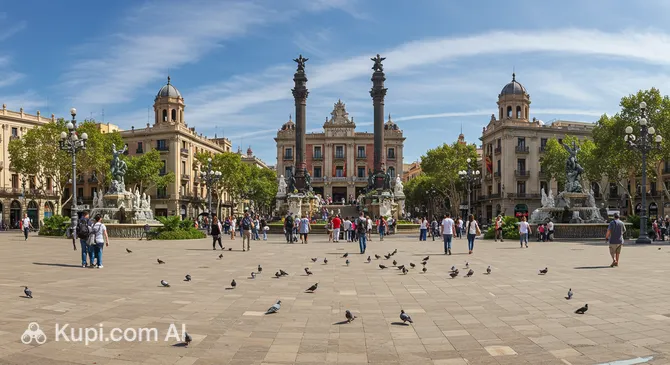
Plaça de Catalunya. Illustration.
Source: Kupi.com AI

Traveler photos:

For travelers, Plaça de Catalunya is the ideal starting point for exploring the Catalan capital. Many tourist routes and excursions begin here. Below the square lies a major transport hub connecting several metro and urban train lines, while on the surface, tourist buses and airport shuttles stop, making it not only a beautiful landmark but also a strategically important point for any guest of the city.

Contacts

Since Plaça de Catalunya is an open public space, it does not have a single information service. However, all necessary tourist information, including maps, brochures, and consultations, can be obtained at the main Barcelona tourist office, which is located directly under the square.

How to contactContact
AddressPlaça de Catalunya, L'Eixample, 08002 Barcelona, Spain
Websitewww.meet.barcelona

What to Do

Plaça de Catalunya offers many options for an interesting pastime. First and foremost, it is a true open-air museum where you can stroll leisurely while enjoying the architecture and numerous sculptures. Among them, works by famous Catalan masters such as Pablo Gargallo, Josep Clarà, and Josep Llimona stand out. Particular attention is drawn to the monumental monument to Francesc Macià, an important political figure in the history of Catalonia. The square also frequently serves as a venue for various exhibitions and performances, adding to its cultural richness.

One of the main highlights of the square is its impressive twin fountains. During the day, they provide coolness, and as evening falls, they transform into the central element of a mesmerizing spectacle. The water jets begin to "dance" to music, illuminated by colorful lights. This light show attracts many spectators, so it is recommended to check the schedule in advance so as not to miss this magical moment.

Additionally, thanks to its central location, Plaça de Catalunya is the perfect starting point for exploring the city. Famous streets originate here, including La Rambla and the Passeig de Gràcia shopping avenue. It is especially convenient to start a walk towards the adjacent Gothic Quarter, where the history of Barcelona began. A visit to the square is an opportunity to feel the rhythm of the city, relax by the fountains, and plan your further journey through its iconic landmarks.

Getting There

Getting to Plaça de Catalunya is incredibly easy, as it is the main transport heart of Barcelona. Thanks to its central location, the square serves as an intersection for many routes, making it easily accessible from almost any part of the city and its suburbs. No matter where you are staying, the journey here will be simple and fast.

The most convenient way is by public transport. Directly under the square is the major Catalunya interchange, where several metro lines (L1 and L3) meet, along with the FGC urban railway trains. Additionally, the Rodalies commuter train station is located here, which is convenient for those traveling from other towns in Catalonia. On the surface, there are numerous city bus stops connecting the square with all parts of Barcelona.

For tourists arriving at El Prat Airport, there is a special Aerobús shuttle, the final stop of which is right on Plaça de Catalunya. A taxi ride from central areas also won't take much time and will be quite affordable. If you are already in the center, for example, in the Gothic Quarter or on La Rambla, the best solution would be a leisurely stroll, allowing you to fully enjoy the city's atmosphere.

Nearest city: Barcelona

History & Facts

The history of Plaça de Catalunya is inextricably linked with the expansion of Barcelona in the mid-19th century. Until 1858, this area was a wasteland outside the city walls where trade flourished and residents of neighboring villages met. When the authorities finally allowed the demolition of the medieval fortifications, planning for the city's new look began. This site, already a customary gathering place for citizens, became a natural candidate for the future city center.

Interestingly, in the original city expansion plan designed by the famous engineer Ildefons Cerdà, there was no square at this location—it was intended for residential buildings. The main center of the new Barcelona was supposed to be the Plaça de les Glòries Catalanes. However, out of habit, residents continued to gather on the wasteland, which popularly became known as "Plaça de Catalunya." In the end, the will of the citizens proved stronger than urban planning designs, and the authorities were forced to recognize this site as the new central square.

The path to its modern appearance was long and difficult. In 1895, the mayor ordered the area to be cleared and landscaped, which required the demolition of several buildings and led to lengthy legal battles. For several years, the site turned into a semi-abandoned wasteland. Full-scale landscaping work only began in 1902 and continued for more than twenty years. Throughout its history, the square has constantly changed, acquiring its final look for the 1929 World Expo, thus becoming the heart of the city that is known and loved today throughout Spain.

Time Needed

For a quick introduction to the heart of Barcelona, Plaça de Catalunya, and to take a few memorable photos, you will need approximately from 30 minutes to one hour. This time is quite enough to leisurely walk around the entire area, admire its fountains and numerous sculptures, and watch the famous pigeons that have become an integral part of this place.

If you want to fully experience the atmosphere of the square, relax on a bench in the shade of the trees, or enjoy a cup of coffee at one of the cafes overlooking the square, it is worth setting aside 1-2 hours. This will allow you to enjoy the dynamics of this iconic spot without rushing, as it serves as a popular meeting point for both tourists and Barcelona locals alike. In the evening, you can catch the beautiful illumination of the fountains, which will add to your impressions.

It is important to remember that Plaça de Catalunya is not only a landmark but also a key transport and tourist hub for the city. From here, the famous La Rambla and Passeig de Gràcia boulevards begin, as well as the routes of many sightseeing buses. Most likely, you will return to the square several times during your trip to Spain, so while a single visit doesn't take much time, this place will become an important part of your journey through the city.

Working Hours

Since Plaça de Catalunya is an open public space, access to it is open to everyone at any time. You can visit it 24/7 and year-round, making it an ideal place for walks both during the day and late in the evening. No tickets, pre-registration, or booking is required to enter the square itself—admission is absolutely free. You can come here at any time convenient for you to enjoy its atmosphere.

It is important to note that while the square itself is accessible 24/7, the establishments located on and around it—such as the famous El Corte Inglés department store, cafes, restaurants, and the tourist information center—operate according to their own schedules. If you plan to visit any of these places, it is recommended to check their opening hours in advance on official websites or in local directories to ensure your trip to Barcelona is as comfortable as possible.

Nearby

The location of Plaça de Catalunya makes it an ideal starting point for exploring the main treasures of Barcelona. A walk through its surroundings will allow you to dive deeper into the city's atmosphere, as many iconic sites are literally just a few steps away. This is a unique opportunity to create a rich itinerary without needing public transport.

In the immediate vicinity of the square, architectural masterpieces, lively markets, and historical corners await you. Exploring these attractions will enrich your experience and show the many facets of the Spanish capital. Below is a list of interesting places located within a short walking distance.

NameDistance
Bobby's Free0.3 km
Palace of Catalan Music0.4 km
Casa Batlló0.7 km
Bishop's Bridge0.7 km
Cañete0.9 km
Picasso Museum0.9 km
Bali Spirit Luxury Art Spa0.9 km

Have you reached the end of the page?

So the route has been studied inside and out