Support

Roman Bridge of Salamanca

About

The Roman Bridge (Puente Romano) is not just an ancient structure, but a true symbol of the city of Salamanca and an outstanding monument to Ancient Roman engineering in Spain. Stretching across the Tormes River, the bridge is so significant to the city that its characteristic arches even grace Salamanca's coat of arms. It is a place where history is literally beneath your feet.
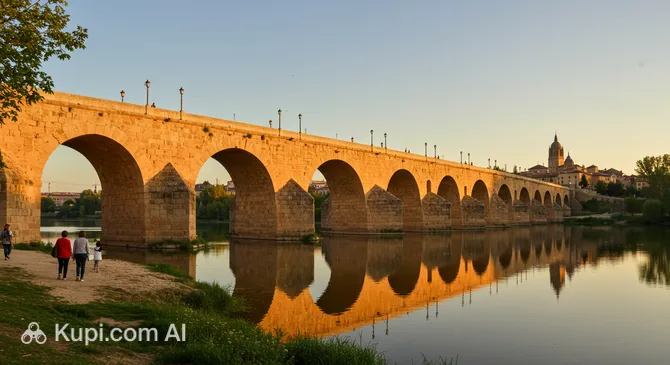
Roman Bridge of Salamanca. Illustration.
Source: Kupi.com AI

Traveler photos:

The bridge's design is impressive in its solidity and grace. It is approximately 176 meters long and consists of 26 semi-circular arches that have stood the test of time for centuries. Originally, the bridge was part of the famous Roman trade route—the "Silver Way" (Vía de la Plata), which connected the south and north of the Iberian Peninsula, playing a key role in the region's life.

Today, the Roman Bridge is fully pedestrianized. This makes it an ideal spot for leisurely strolls and one of the best viewpoints in the city. From here, you can enjoy magnificent panoramic views of the old town and Salamanca's majestic cathedrals. Walking across this bridge, especially at sunset, is an opportunity to touch a thousand years of history and capture unforgettable photographs.

Contacts

The Roman Bridge in Salamanca is a public historical monument open for strolls at any time. For further information, such as the bridge's history or city tours, you can visit the Salamanca tourist office.

How to contactContact
AddressPuente de Sánchez Fabrés, 37008 Salamanca, Spain
Websitewww.salamancaturistica.com

What to Do

Visiting the Roman Bridge is, first and foremost, an unforgettable walk across one of Salamanca's oldest structures. As you cross the Tormes River, you can enjoy magnificent panoramic views of the city's historic center. From here, you get the classic postcard view of the Old and New Cathedrals, as well as the picturesque river valley. It's the perfect place to feel the connection between eras and take some of the city's best photos, especially at sunrise or sunset.

The bridge often serves as a starting point for further exploration of the city. At its northern end is the ancient Church of Saint James (Santiago), built in the 12th century for pilgrims. While walking, you will also notice the neighboring Enrique Estevan Bridge, which creates an interesting architectural contrast. Thus, visiting the bridge is not just about seeing a landmark, but an opportunity to touch the Roman and medieval past of Salamanca and begin your journey through its historic streets.

Getting There

Getting to the Roman Bridge in Salamanca is very easy, as it is one of the city's key attractions and is within walking distance of the center. The bridge is located in the southern part of the historic center, making it a perfect destination for a walk. From the city's main square, the famous Plaza Mayor, the bridge is just a 10–15 minute walk away. The route takes you through the picturesque streets of the old town, allowing you to soak up the atmosphere of this unique place.

If you are arriving in Salamanca by train or bus from other cities in Spain, such as Madrid or Valladolid, you can easily reach the city center from the station by city bus or taxi. From there, it's just a short walk to the bridge. Travelers arriving by car should note that driving on the Roman Bridge itself is prohibited as it is pedestrian-only. It is recommended to leave your car in one of the city's parking lots and continue on foot to fully appreciate the beauty of this ancient structure and its surroundings.

Nearest city: Salamanca

History & Facts

The Roman Bridge (Puente Romano) in Salamanca is not just a scenic crossing, but a true monument to engineering and a living witness to history. Its construction dates back to the 1st century AD, presumably during the reign of Emperors Augustus or Trajan. For centuries, it was more than just a bridge; it was a key link in the famous "Silver Way" (Vía de la Plata), connecting the north and south of the Iberian Peninsula, and for a long time, it remained the only way to cross the Tormes River in this region.

The structure originally had 26 arches, but time and natural disasters have made their mark. Today, 15 original Roman arches remain—they are located closer to the city and are easily recognizable by their characteristic masonry. The remaining spans were destroyed during the catastrophic flood of 1626, known as the "Flood of Saint Polycarp," and were subsequently restored in the 17th century. Thus, today's bridge represents a unique blend of ancient Roman and later architecture.

Near the bridge entrance from the city side, you can see another intriguing detail—an ancient headless stone statue depicting, according to various versions, a bull or a wild boar. The origin of this figure is shrouded in legend and linked to the pre-Roman tribes that inhabited these lands. In 1998, due to its exceptional historical value, the Roman Bridge was declared a Spanish National Heritage site in Spain. Today, it is entirely pedestrian and serves as one of the best spots for a walk, offering magnificent views of the old town and its cathedrals.

Time Needed

Exploring the Roman Bridge in Salamanca (Puente Romano) usually takes 30 to 60 minutes. This is plenty of time to take a leisurely stroll across its entire length, enjoy the magnificent panoramic views of the old town and the Tormes River, and take some memorable photos.

The bridge is exclusively pedestrian, allowing tourists to wander at their own pace while admiring the ancient stonework preserved since the Roman Empire. An hour is enough to fully absorb the historical atmosphere and capture postcard views of Salamanca's cathedrals. It is particularly beautiful at sunset when the sun paints the city in golden hues.

If you plan on more than just a walk and want to visit nearby attractions or relax in one of the parks along the riverbank, you should factor a bit more time into your itinerary. However, to get acquainted with the bridge itself as a historical monument, one hour will be more than enough.

Working Hours

The Roman Bridge in Salamanca is not just a historical monument, but an active open-air pedestrian zone. Because of this, it is accessible for visiting 24 hours a day, year-round. You can walk across its ancient stones at any time that suits you, whether it’s early morning to catch the city in silence, or late evening to enjoy the views of illuminated Salamanca and the Tormes River.

Since the bridge is a public space, no tickets or advance bookings are required to visit. Admission is completely free. This makes it one of the city's most accessible attractions, easily included in any walking itinerary.

Open 24 hours

Nearby

Visiting the Roman Bridge in Salamanca is just the starting point for exploring the rich history and culture of this amazing city. To truly experience the atmosphere of Salamanca, it’s worth exploring other treasures located within walking distance. The city's compact historic center makes it easy to get around on foot, discovering new points of interest around every corner.

A stroll around the bridge will allow you to dive deeper into Spain's past and present. Just a few minutes' walk away, you'll find famous cathedrals, unique museums, and charming squares, each telling its own story. Below is a list of attractions located right nearby.

NameDistance
Casa Lis Art Nouveau and Art Deco Museum0.3 km
Museum of Automotive History0.3 km
Courtyard of the Minor Schools0.4 km
Unamuno House Museum0.4 km
Calixto and Melibea Garden0.4 km
The Frog of Salamanca0.5 km
Cave of Salamanca0.5 km

Have you reached the end of the page?

So the route has been studied inside and out