Support

Giralda Tower

About

The Giralda Tower is a prominent landmark and one of the main symbols not only of Seville but of all Spain. This majestic quadrangular tower, standing approximately 98–104 meters high, rises above the Seville Cathedral, representing a unique combination of Moorish and Christian architecture that reflects the rich and complex history of the region.
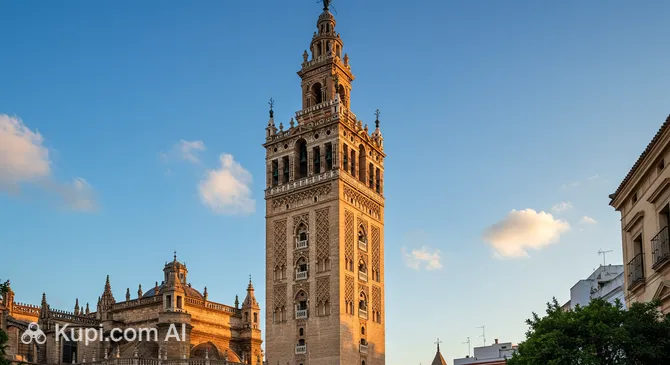
Giralda Tower. Illustration.
Source: Kupi.com AI

Traveler photos:

Originally, the Giralda was built in the 12th century as a minaret for the city's main mosque during the reign of the Almohad dynasty. After the completion of the Reconquista and Seville's transition to the rule of Christian monarchs, the former minaret was converted into a bell tower for the new grand cathedral. Later, the tower was crowned with a Renaissance belfry, which created its unique, eclectic appearance that continues to delight visitors today.

Today, the Giralda Tower, along with the cathedral and the Alcázar palace, is listed as a UNESCO World Heritage site and is a must-visit for all guests of the city. One of the unique features of the tower is the absence of steps—gentle ramps lead to the top. Upon reaching the observation deck, you will be rewarded with breathtaking panoramic views over all of Seville.

Contacts

To plan your visit to the Giralda Tower, it is recommended to check the official website of the Seville Cathedral, of which it is a part. There you can find up-to-date information on opening hours, ticket prices, and any potential changes to the schedule. Below are the main contact details.

How to contactContact
AddressAv. de la Constitución, s/n, Casco Antiguo, 41004 Sevilla, Spain
Phone number+34 902 09 96 92
Websitewww.catedraldesevilla.es

What to Do

The main highlight for visitors to the Giralda Tower is the opportunity to climb to its summit. A unique feature of the ascent is that instead of the usual stairs, a wide and gentle ramp with 35 sections is laid inside the tower. This design makes the climb surprisingly comfortable, and on the way up, you can examine the internal structure of the tower through small windows. The reward for the climb will be a breathtaking panoramic view from the observation deck over the entire historic part of Seville, including the labyrinth of narrow streets, the cathedral courtyard, and the roofs of ancient buildings.

In addition to the magnificent views, a visit to the tower allows you to see its unique details up close. At the top, you will be at the level of the famous bells, which still ring today during religious holidays. Look closely at the intricate brickwork and Oriental patterns decorating the facades—this is a legacy of the Moorish era. And at the very base of the tower, you can find massive stones with faint Roman inscriptions, testifying to the even more ancient history of this place.

Since the Giralda is the bell tower of the Seville Cathedral, its visit is inextricably linked with the exploration of the temple itself. Your ticket usually grants access to both, allowing you to get a complete picture of this grand architectural complex. Thus, a visit to the Giralda is not just a climb to an observation deck, but a true immersion into the centuries-old history and culture of Spain.

Getting There

The Giralda Tower is conveniently located in the heart of the historic center of Seville, making it easily accessible for tourists. Its exact address is Calle Mateo Gago, 1, close to such iconic landmarks as the Plaza del Triunfo and the majestic Seville Cathedral, of which it is an integral part. Thanks to its impressive height, the tower is visible from many points in the city, making it an excellent landmark for navigation while walking.

The attraction can be reached by public transport. Seville has a well-developed network of city buses and trams, with the nearest stops just a few minutes' walk from the cathedral. For example, you can take bus C5 (Garcia de Vinuesa stop) or tram T1 (Archivo de Indias stop). If you prefer a more comfortable way to travel, you can always take a taxi, which will drop you off right at the foot of the tower.

Since the historic city center is perfectly adapted for walking and cycling, many tourists prefer to reach the Giralda on foot or by rented bike. This option allows you to leisurely soak up the atmosphere of the ancient streets and fully experience the charm of the Andalusian capital. Even if you are in a different neighborhood, it is easy to find your way—simply follow the signs for the Cathedral or head towards the towering silhouette of the tower.

Nearest city: Seville

History & Facts

The history of the Giralda Tower dates back to the 12th century, during the reign of the Almohad dynasty in Spain. Its construction began in 1184 based on the design of the architect Ahmad ben Baso as a minaret for the Great Mosque of Seville. The work was completed in 1198 under the direction of another architect, Ali al-Ghomari. At that time, the tower served not only its primary religious function but also as an important observation point and even one of the largest observatories in Europe.

The tower's fate changed dramatically after the completion of the Reconquista. When construction began on a grand cathedral on the site of the mosque in the 15th century, it was decided to preserve the former minaret, converting it into a bell tower. The Giralda acquired its modern and recognizable appearance in the 16th century when the Cordoban architect Hernán Ruiz added the upper part—an elegant bell tower in the Spanish Renaissance style. This harmonious blend of the austere Moorish base and the ornate Renaissance top makes the tower a true architectural masterpiece.

One of the most intriguing details testifying to the multilayered history of this site is hidden in the very foundation of the tower. Massive stone blocks with surviving ancient Roman inscriptions were used for its foundation. This fact indicates that significant Roman-era buildings were located here even before the mosque was built. Thus, the Giralda is not just a monument of two cultures, Moorish and Christian, but also a kind of stone chronicle preserving the traces of different civilizations.

Time Needed

When planning a visit to the Giralda Tower, you should expect that it will take between 1 and 1.5 hours to explore, including the climb to the observation deck and the descent. This is plenty of time to leisurely ascend the famous ramps, which replace stairs, and fully enjoy the breathtaking panoramic views of Seville from above. Since the incline is quite gentle and comfortable, the climb won't take much effort, allowing you to focus on the beauty of the city unfolding before you.

However, it is important to remember that the Giralda Tower is an integral part of the grand Seville Cathedral, and access to it is usually included in the general ticket for the entire complex. The cathedral itself is one of the largest in the world, and exploring it requires additional time. To study its impressive interiors and chapels and to see the tomb of Christopher Columbus, you should allow at least another 1–1.5 hours. Thus, for a complete and leisurely discovery of the entire attraction—both the cathedral and the tower—it is better to set aside about 2.5–3 hours.

If your time in Seville is limited, you can focus only on climbing the tower, which takes about an hour. But to get a full picture of this unique monument of Spain's history and architecture, it is highly recommended to make time to visit the entire complex. The average recommended time for visiting the cathedral and the tower is about 1 hour and 15 minutes, but for a more thoughtful visit, it is better to have more time to spare.

Working Hours

The Giralda Tower is open to visitors year-round, although its opening hours may vary depending on the season, as well as religious services and cultural events held in the cathedral. Generally, from Monday to Saturday, the tower is open for visits from 10:45 AM to 5:00 PM or 7:00 PM, and on Sundays from 2:30 PM to 6:00 PM or 7:00 PM. To avoid any misunderstandings, it is highly recommended to check the most up-to-date schedule on the official website of the Seville Cathedral immediately before your visit.

Given the immense popularity of this attraction, we strongly advise buying tickets in advance online. This will not only guarantee entry at your desired time but also help you avoid long queues, especially during the peak tourist season. Please note that access to the Giralda Tower is usually included in the general admission ticket to the Seville Cathedral, so when purchasing, make sure your ticket entitles you to visit both the tower and the temple itself.

Nearby

After exploring the Giralda Tower, don't be in a hurry to leave the area. Its surroundings are a true open-air museum, where every corner holds a piece of Seville's rich history. A stroll through the nearby streets will allow you to dive deeper into the atmosphere of the Andalusian capital and discover other iconic sites located just steps away.

Some of the city's most important attractions are in the immediate vicinity of the tower. This makes the Giralda an ideal starting point for further exploration of the historic center. Below is a list of interesting places you can visit without spending much time on travel.

NameDistance
Filo0.1 km
General Archive of the Indies0.2 km
Bar Postiguillo Tapas0.3 km
Flamenco Dance Museum0.3 km
Royal Alcázar of Seville0.4 km
Puerta de Jerez0.4 km
Tower of Gold0.5 km

Have you reached the end of the page?

So the route has been studied inside and out