Support

Armenian Cathedral of Lviv

About

Hidden behind the facades of ancient houses, the Armenian Cathedral in Lviv is one of the city's oldest and most atmospheric monuments. Located in the heart of historical Ukraine, in the city of Lviv, this temple serves not only as the spiritual center of the Armenian community but also as a unique architectural treasure included in the UNESCO World Heritage list.
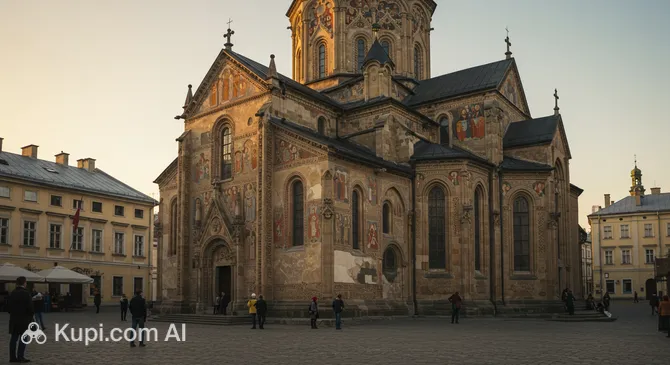
Armenian Cathedral of Lviv
Armenian Cathedral of Lviv. Иллюстрация. Источник: Kupi.com AI

The cathedral is a stunning ensemble where traditions of Eastern architecture, Gothic, Renaissance, and Art Nouveau intertwine. Its walls, reaching 1.5 meters in thickness, are built of large stone, and the dome rests on special hollow ribs made of clay acoustic jars (holosnyky) to create exceptional acoustics. Passing through the arched passages, you enter quiet courtyards with ancient tombstones and carved portals where time seems to stand still.

The interior's main highlights are the fantastic early 20th-century murals and a wooden ceiling with Oriental motifs. The complex is compactly integrated into the dense development of Virmenska Street, creating a sense of a mysterious and sacred space separated from the bustle of the modern metropolis.

Contacts

To confirm the current schedule for events and visits, you can use the following contact details:

How to contactContact
AddressVirmens'ka St, 7/13, L'viv, L'vivs'ka oblast, Ukraine, 79000
Phone+380 322 742 956

What to Do

A visit to the cathedral is, first and foremost, a visual and spiritual journey. Start your tour with the inner courtyards. Here you can see the unique wooden "Golgotha" chapel with a carved altar depicting the suffering of Christ, as well as examine the old 16th–17th century cemetery with epitaphs in Armenian and Latin. Pay attention to the St. Christopher Column — an elegant 18th-century monument rising in the middle of the courtyard.

Inside the temple, be sure to look up: you will be impressed by the carved wooden ceiling and the golden mosaic in the dome. The main magnet for the eyes is the expressive wall paintings by Jan Henryk Rosen. His works, such as "The Funeral of St. Odilo," are executed in the Art Nouveau style and create a mystical, almost hypnotic atmosphere thanks to deep shadows and elongated figures.

History buffs will find it interesting to study the architectural details of different eras: the powerful Piotr Krasowski bell tower, the Baroque gates, and the metal grilles. If your visit coincides with a service, you can hear traditional Armenian chanting, which sounds particularly majestic within these walls. This place is perfect for thoughtful contemplation and capturing authentic photographs.

Getting There

Finding the cathedral is easy, as it is located in the very heart of the historical center at 7/13 Virmenska Street. It is just a 5–10 minute walk from the famous Rynok Square. While strolling through the narrow pedestrian streets of the old town, you will definitely notice its distinctive silhouette and cozy arched courtyards.

If you are coming from further away, you can use public transport. The nearest stops are "Rynok Square" or "Teatralna," served by trams No. 1, 2, 8, and 9. From the main railway station, the most convenient way is to take tram No. 8 (the trip takes about 15–20 minutes) or a taxi, which will take you to the edge of the pedestrian zone in 10 minutes.

Since the cathedral is located in a densely built historical area, car parking is extremely limited. Visitors traveling by private vehicle are advised to leave their car in one of the paid parking lots outside the central ring and continue on foot, enjoying the atmosphere of the ancient city.

Ближайший город: Lviv

History & Facts

The history of the Armenian community in Lviv began as early as the second half of the 13th century. The stone Armenian Cathedral of the Assumption of Mary was founded in 1356–1363 on the site of an ancient wooden church. Construction was led by the architect Doring and funded by wealthy Armenian merchants — Jacob of Caffa and Panos of Kayseri. Elements of ancient Armenian architecture, reminiscent of the famous temple in Ani, can still be recognized in its design.

Over the centuries, the temple complex was constantly expanded and modified. In the 15th century, an open arcade was added; in 1571, the architect Piotr Krasowski built the bell tower; and in the 17th century, the western nave, a Benedictine monastery, and an archbishop's palace were added. After a devastating fire in 1676, the cathedral was under restoration for nearly fifty years, which introduced Baroque elements to its appearance.

The large-scale restoration of 1908–1927 under the direction of F. Minczyński deserves special attention. It was during this period that the interior was decorated with unique murals by the artist Jan Henryk Rosen and mosaics that masterfully combine Eastern art traditions with Art Nouveau elements.

During the Soviet years, the cathedral building was used as a storage facility for art gallery exhibits. Justice was restored only in 2000, when the church was returned to the faithful. The first service in the renovated cathedral took place in 2001, and in 2003, it was solemnly consecrated by Patriarch Karekin II, once again making the cathedral the vibrant spiritual heart of the Armenian community.

Time Needed

To leisurely explore the cathedral and its surroundings, a typical visitor will need from 1 to 1.5 hours. This is plenty of time to soak up the atmosphere and discover the details hidden in the quiet courtyards.

We recommend setting aside about 30 minutes for a walk through the exterior ensemble, including an inspection of the "Golgotha" chapel and the old cemetery. The remaining 40–50 minutes should be spent inside the temple itself to examine in detail the dome mosaics, the carved wooden ceiling, and Rosen's famous frescoes, which reward careful study.

Working Hours

Since the exact opening hours of the cathedral may change depending on religious holidays and services, visitors are advised to check the information on-site or consult the official resources of the city's Armenian community.

Generally, the temple doors are open to tourists during the daytime; however, keep in mind that during liturgies, viewing the interiors may be restricted so as not to disturb the faithful. We recommend planning your visit for the first half of the day.

Nearby

The cathedral's location in the city's historical core makes it easy to combine a visit with other interesting sites. Exploring the nearby streets will help you dive deeper into the region's multifaceted culture and discover both classic monuments and modern entertainment centers.

NameDistance
Pharmacy Museum0.1 km
Lviv Ancient Museum0.1 km
Italian Courtyard0.2 km
Dzyga Art Center0.2 km
Taras Shevchenko Monument0.3 km
Dobryi Druh 5 Pub0.3 km
Hash Rest & Bar0.3 km

Reached the end of the page?

That means the route is fully explored