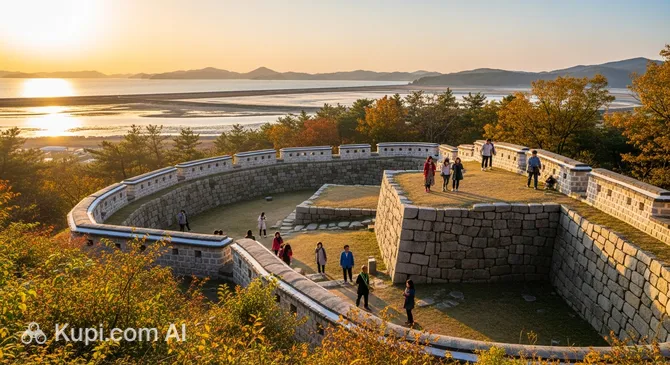
Haeryong is a unique corner of South Korea, officially recognized as the most populous myeon (township) in the country. Located in the picturesque Jeollanam-do province, this area serves as an important suburban hub for the city of Suncheon. Despite its primarily residential status, Haeryong attracts those who want to see the real, non-touristic life of modern Korea, where traditional tranquility meets the energy of dense urban development.
Haeryong. Illustration.
Source: Kupi.com AI
Geographically, Haeryong covers an area of about 50 km² in the southeast of Suncheon. The district's population exceeds 46,000 people, creating a special atmosphere of a dynamic "city within a city." Urbanized blocks closely neighbor rural landscapes and the hilly terrain characteristic of the peninsula's southern coast. If you are interested in the history of development of modern Korean suburbs, Haeryong is an excellent example of an agrarian zone's transformation into a powerful residential enclave.
Among the district's highlights are its proximity to the famous Suncheon Bay and its convenient infrastructure. There are no noisy tourist thoroughfares here; instead, there is an abundance of cozy local markets and authentic Korean eateries. Visiting Haeryong is an invitation to look behind the scenes of Korean daily life, enjoy leisurely strolls through residential neighborhoods, and feel the rhythm of life in Jeollanam-do province.
Weather Overview
The climate in Haeryong is of the subtropical monsoon type, typical for the southern part of the Korean Peninsula. The weather here is largely determined by its proximity to the sea, which makes climatic conditions milder but also quite humid. Travelers should be prepared for distinct seasonal changes, each of which gives the area its own charm.
Summers in the district are hot and humid: the average temperature in August reaches 26–30°C. Most precipitation falls during this period, especially in July when the rainy season arrives. Winters, by contrast, are fairly mild and dry; the average January temperature fluctuates around 1–2°C, and snow falls rarely. If you want to know more about what weather in Haeryong to expect in a specific month, we recommend checking current forecasts.
The most favorable times to visit are spring (April–May) and autumn (October–November). During these months, comfortable temperatures ranging from 15–22°C are established, and air humidity decreases. Jeollanam-do's autumn landscapes are especially beautiful when the hills around Haeryong are painted in gold and crimson hues, creating ideal conditions for long walks.
Average monthly temperature
Average monthly precipitation
Interesting Facts
National Record Holder: Haeryong is officially the most populous myeon (a township-level administrative unit) in the Republic of Korea, with over 46,900 residents.
Population Density: With an area of 49.93 km², the population density here reaches an impressive 940 people per square kilometer, comparable to the figures of many large cities.
Unique Name: The district's name is written in Hangul as 해룡면 (Haeryong-myeon), which translates using Hanja characters (海龍面) as "Sea Dragon Township."
Geographic Coordinates: The center of the district is located at 34°54′47″ North latitude and 127°32′22″ East longitude.
Administrative Heart: The myeon office is located in the Woljeon-ri neighborhood at 1228-10, Haeryong-ro, serving as a primary landmark for all navigation routes in the area.
How to Get There
Haeryong's transport accessibility is largely ensured by its close connection to a major transport hub—the city of Suncheon. Most travelers choose this route as the most reliable and fastest. The region's infrastructure allows for easy combination of various modes of transport, making a trip to Haeryong as comfortable as possible, even for first-time visitors to the southern part of Korea.
For those who prefer air travel, the closest option is Yeosu Airport (RSU), located about 50 kilometers away. After landing, you can use a shuttle or taxi, which will take about an hour. The airport serves domestic flights, connecting the region with Seoul and Jeju.
Railway transport is one of the most convenient ways to reach the district. The nearest major station is in Suncheon, where high-speed KTX trains from Seoul arrive (travel time is about 3 hours). From Suncheon Station, you can reach Haeryong by local bus or taxi in just 20–30 minutes. Intercity bus service is also well-developed: direct buses from the capital take about 4–5 hours.
Haeryong largely remains a "hidden gem" for those seeking the everyday aesthetics of Korea. One of the district's key points is its administrative center in Woljeon-ri. Social life is concentrated here around the myeon office: small squares where locals gather to relax and modern residential complexes that represent examples of efficient Korean urban planning.
For those who enjoy walking, Haeryong-ro street is of particular interest. This is the district's main artery, lined with numerous local shops, bakeries, and cafes. Walking here, you can observe how life unfolds in the country's most populous myeon and feel the contrast between modern high-rises and cozy green islands in the courtyards.
While there are no major historical monuments within Haeryong itself, its main "attraction" is the local markets. These are the places where life pulses: here you can see seasonal produce from nearby farms, try street food prepared using the same recipes for decades, and experience the hospitality of the people of southern Jeollanam-do.
Local Cuisine
The culinary traditions of Haeryong are inextricably linked to the rich gastronomic heritage of Jeollanam-do province, which is considered the "breadbasket" and "kitchen" of South Korea. The main emphasis here is on the freshness of ingredients: seafood is delivered straight from the southern coast, and vegetables come from surrounding farms. In local establishments, you should definitely try kimchi-jjigae—a spicy and rich kimchi soup prepared here with exceptional skill.
One of the highlights of local cuisine is seasonal seafood dishes, such as hoe (thinly sliced raw fish). Another popular choice is tteokguk—a traditional soup with rice cakes, served here with plenty of greens and aromatic seasonings. The overall character of Haeryong's gastro-scene is honest home cooking in small family restaurants, where portions are always generous and flavors are authentic.
As for drinks, Haeryong offers a taste of the famous makgeolli—traditional Korean rice wine, which has its own unique flavor profiles in this region. Also, don't forget the local tea: proximity to tea plantations allows you to enjoy drinks made from high-quality green leaves. For a quick snack, the markets near Haeryong-ro are ideal, where you can buy hot hotteok (sweet pancakes) or odeng (fish cakes in broth).
Travel Tips
A visit to Haeryong will give you a unique experience of encountering the authentic Korean province, and these tips will help make your stay here as comfortable as possible.
Clothing and Essentials: Jeollanam-do has high humidity, especially in summer, so choose clothes made of natural fabrics. Be sure to bring comfortable shoes for walking. It can be windy in winter, so a light but windproof jacket will be useful. For power outlets, you will need a Type F adapter (European standard).
Transport: The main transport is buses. We recommend purchasing a T-money card immediately upon arrival. For navigation, it is best to use the Naver Map or KakaoMap app, as Google Maps does not always work correctly in Korea.
Finances: The official currency is the South Korean won. Cards are accepted almost everywhere, including small cafes in Haeryong, but always keep some cash for markets and topping up your transport card. Tipping is not customary in Korea.
Health and Safety: The area is extremely safe. Pharmacies (Yak-guk) can be found near the myeon office. If medical assistance is needed, most large clinics are located in neighboring Suncheon.
Communication: English is less common here than in Seoul. Learn basic phrases: "Annyeong-haseyo" (Hello) and "Kamsa-ham-nida" (Thank you). Free Wi-Fi is available in many public places.
Local Etiquette: Greet people with a slight bow. Hand over money or items with two hands—this is a sign of respect.
What to Avoid: Do not enter private homes or traditional restaurants wearing shoes (always look for a special shelf at the entrance). Try not to speak loudly on public transport.
Extra Tip: If you plan to stay for a long time, Haeryong is an ideal place to find quiet housing with quick access to all the infrastructure of Suncheon.
Come to Haeryong for genuine smiles and a peaceful rhythm of life—this district will reveal Korea to you from a new, very warm side.
Entertainment & Nightlife
Entertainment in Haeryong is predominantly quiet and family-oriented, which is typical for a residential suburban area. Most evening activity is concentrated in cozy cafes and TV cafes, where locals gather to watch broadcasts or discuss news over a cup of coffee. These are ideal spots for those wanting to immerse themselves in the atmosphere of Korean "hygge"—comfort and leisure.
Nightlife in the traditional sense—with loud clubs and bars—is virtually non-existent here. For bright lights and dance floors, residents and guests usually head to the center of neighboring Suncheon, a trip that takes about 20–30 minutes. There, you can find popular noraebangs (karaoke boxes) and pubs that stay open late into the night.
During the day, entertainment revolves around outdoor recreation. Residential blocks feature modern playgrounds and small sports zones popular with young people. In the summer, the district may host local food festivals where you can sample Jeollanam-do specialties accompanied by performances from local groups.
Parks & Museums
Haeryong is primarily a residential oasis where greenery is integrated directly into the urban environment. While there are no large-scale museum complexes here, the district boasts well-maintained green zones along residential blocks. These small parks and squares are perfect for daily walks, offering peace and respite from the city's hustle and bustle. About 20% of the district's territory is covered by vegetation, creating a comfortable microclimate.
Special attention should be paid to the walking routes along Haeryong-ro. Ornamental trees are planted here, and cozy relaxation areas with benches and playgrounds for children have been established. In the spring, these alleys are transformed by blossoms, becoming a favorite spot for photo shoots among locals.
For large-scale cultural impressions and classical museums, guests of Haeryong usually head to neighboring Suncheon. However, Haeryong itself is interesting as an "open-air museum" showcasing the evolution of Korean urban development. The proximity to Suncheon Bay allows you to reach one of the country's most significant natural parks in minutes, making Haeryong a convenient base for eco-tourism enthusiasts.
Getting Around
The public transport system in Haeryong is tightly integrated into the network of Suncheon city. The primary way to get around is by city buses, which run between the myeon's residential blocks and the central areas of the city every 10–20 minutes. A trip to the center of Suncheon takes no more than 20 minutes, making travel very fast and convenient.
To pay for bus and taxi fares, it is best to use a unified transport card like T-money or Cashbee. You can buy and top them up at any 24-hour convenience store. The bus fare is fixed and costs about 1,200–1,500 won. A discounted rate applies when transferring between buses within a certain timeframe.
Within the Haeryong district itself, many prefer to move on foot or by bicycle thanks to the presence of dedicated paths and sidewalks. Taxis are also easily available and relatively inexpensive: a short-distance trip will cost about 5,000–8,000 won. During peak hours, minor traffic congestion may occur at the main exits from the district, but overall, the transport situation remains stable.
Accommodation
Since Haeryong is primarily a residential and suburban area, the choice of traditional hotels here is limited. The main accommodation stock consists of modern apartments and guesthouses, which are often geared toward long-term stays. This is a great option for those who want to feel like a local and appreciate the comfort of Korean daily life in a quiet neighborhood.
Small mini-hotels and motels can be found along the main thoroughfare, Haeryong-ro. The cost of a stay here typically starts from 50,000 won per night, making the district attractive for budget travelers. If you are looking for high-end chain hotels or luxury resorts, you should consider accommodation options in central Suncheon, which is easily accessible from Haeryong by public transport.
When planning a trip, especially during national holidays (such as Chuseok or Seollal), it is recommended to book accommodation in advance. Most properties in this area are available on popular international platforms, though for more authentic guesthouses, it is sometimes useful to check local Korean booking services.
Nearby Cities
Thanks to its location at the intersection of important transport routes in southern Korea, Haeryong serves as an excellent starting point for exploring the surroundings of Jeollanam-do province. Just a few minutes' drive away are unique nature reserves and historical cities, each worthy of separate attention.
The closest and most important neighbor is Suncheon, located just 8 kilometers away. It is a city of gardens and eco-tourism, where you must visit Suncheon Bay with its endless reed fields. Also nearby is the industrial yet charming Gwangyang, famous for its spring plum blossom festivals.
For those willing to travel a bit further, the port city of Yeosu is a wonderful option. It is famous for its seascapes, modern aquarium, and cable car over the sea. Also within an hour's drive are the cities of Sacheon and Jinju, the latter of which is renowned for its fortress and lantern festival.
Exploring these cities will allow you to see the diversity of South Korea: from high technology and industrial giants to quiet Buddhist temples and protected natural areas.
Shopping & Souvenirs
Shopping in Haeryong is focused on the daily needs of residents, making it very convenient and budget-friendly for tourists. You won't find high-fashion boutiques here, but you can visit large branches of Korean retailers such as E-Mart or Lotte Mart. These supermarkets are true treasure troves where you can buy everything from the latest Korean cosmetics to high-quality electronics and household essentials.
Main shopping activity is concentrated around the myeon office and along Haeryong-ro street. Numerous specialized shops are located here: pharmacies with traditional remedies, stationery stores, and small farm shops. These are exactly the places to look for authentic Korean products, such as local green tea or kits for preparing traditional dishes, which make excellent souvenirs.
If you want to bring home something truly unique, visit the local food markets. They often sell handmade items and seasonal delicacies from the Jeollanam-do region. Prices in Haeryong are pleasantly surprising in their affordability, and most shops are open from 10 am until late in the evening and accept international bank cards.